
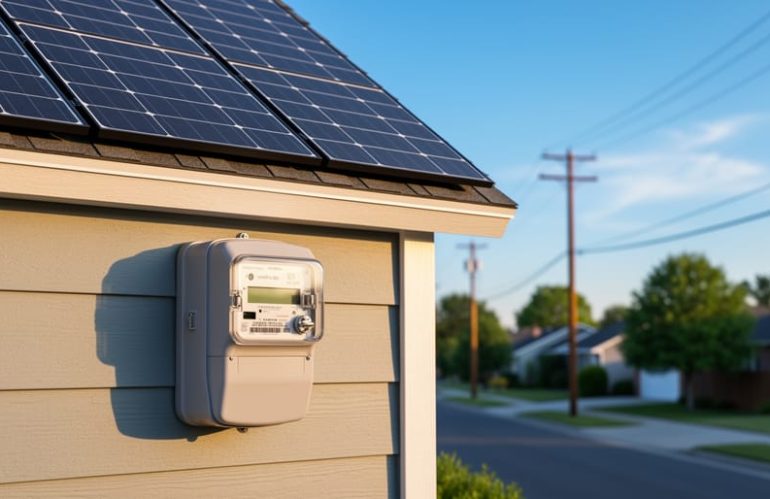
Imagine your electric meter spinning backward on sunny days, crediting your account for the excess solar energy your panels produce. That’s net metering in action—a billing mechanism that transforms your home into a mini power plant while slashing your energy costs. When your solar panels generate more electricity than you use, the surplus flows back to the grid, and your utility company credits your account at the retail rate you normally pay. During evenings or cloudy days when your panels produce less, you draw from these banked credits instead of paying full price for grid electricity. This straightforward exchange means your monthly bill reflects only the net difference between energy produced and consumed, often reducing costs by 70-90%. Unlike complicated energy programs, net metering operates automatically through your existing meter—no extra equipment or monitoring required. The financial impact is substantial: most homeowners reach solar payback within 5-8 years, after which their panels generate decades of essentially free electricity. Available in over 40 states with varying policies, net metering remains the single most important incentive making residential solar economically viable, turning your roof into a long-term investment that pays dividends while reducing your carbon footprint.
What Is Net Metering? The Basics Every Homeowner Should Know
Think of net metering like a two-way energy bank account. When your solar panels produce more electricity than your home needs, that excess power flows back to the utility grid, and you receive credits on your electricity bill. Later, when your panels aren’t producing enough power (like at night or on cloudy days), you can use those credits instead of paying full price for electricity from the grid.
Here’s how it works in practice: On a sunny afternoon, your solar panels might generate 30 kilowatt-hours of electricity, but your home only uses 20. Those extra 10 kilowatt-hours get sent to the grid, and your utility meter literally spins backward, crediting your account. Then, when evening arrives and your panels stop producing, you draw electricity from the grid, using up some of those credits you earned earlier.
This billing mechanism makes solar panels far more valuable for homeowners. Without net metering, any excess electricity you generate would simply be lost or given away for free. With it, every ray of sunshine your panels capture translates into real savings on your energy bills.
The beauty of net metering is its simplicity. You don’t need battery storage to benefit from your solar panels’ full production. The grid essentially acts as your battery, storing your excess energy as credits. At the end of each billing cycle, you only pay for your net electricity usage – the difference between what you consumed and what you contributed.
Most states offer some form of net metering, though the specific rules and credit rates vary by location. Understanding these local policies is essential when calculating your potential solar savings.
How Net Metering Actually Works in Your Home
The Role of Your Bidirectional Meter
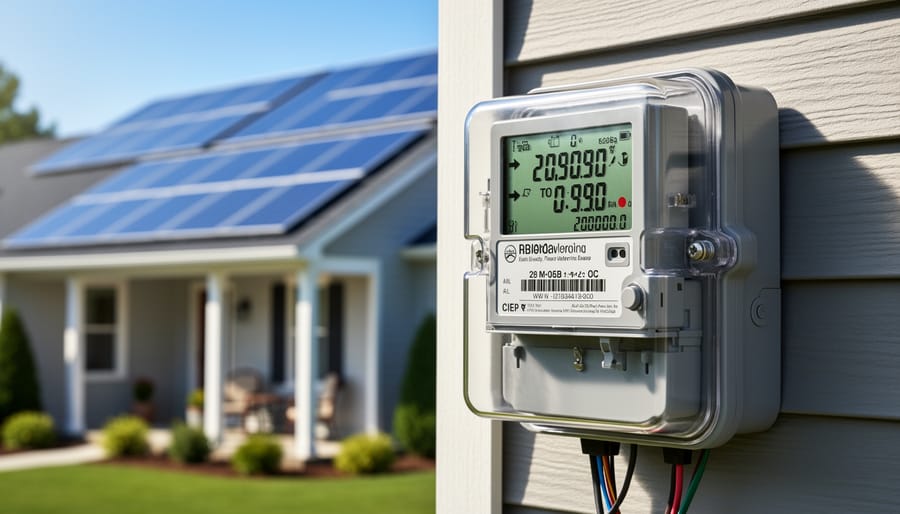
At the heart of net metering is a special device called a bidirectional meter, which replaces your standard electric meter. Think of it as a smart scorekeeper that tracks electricity moving in both directions.
Unlike traditional meters that only count electricity flowing into your home, a bidirectional meter measures two things: the power you draw from the grid when your solar panels aren’t producing enough, and the excess energy your panels send back to the grid on sunny days. It literally spins forward when you’re using grid power and backward when you’re feeding power back.
The beauty of this system is its simplicity. You don’t need to monitor it or flip any switches. The meter automatically tracks everything in the background, calculating the net difference between what you’ve used and what you’ve contributed. At the end of your billing period, you’re only charged for your net consumption. If you’ve sent more electricity to the grid than you’ve used, you’ll see a credit on your bill. This straightforward tracking mechanism is what makes net metering such an attractive benefit for solar homeowners.
Monthly and Annual Credit Cycles
One of the best features of net metering is that your excess energy credits don’t disappear if you don’t use them right away. When your solar panels produce more electricity than you need during sunny months, those credits accumulate on your account and automatically roll over to the next month. This means summer production can help cover your energy needs during cloudier winter months.
Think of it like a bank account for your electricity. During peak production months, you’re making deposits. When your panels produce less energy, you withdraw from your credit balance to offset your utility bill.
However, what happens to leftover credits at the end of your 12-month billing cycle varies by utility company and state regulations. Some utilities will pay you for remaining credits at a wholesale rate, which is typically lower than retail prices. Others may allow credits to roll over indefinitely, while some utilities reset your balance to zero without compensation. This is why properly sizing your solar system matters. You want to generate enough electricity to meet your annual needs without creating excessive surplus that you won’t be compensated fairly for. Check with your local utility to understand their specific year-end policy before installing your system.
Net Metering vs. Net Billing: What’s the Difference?
While these terms sound similar, they work quite differently for your wallet. Understanding the distinction can significantly impact your solar savings.
With net metering, you receive full retail credit for the electricity you send back to the grid. If you pay 15 cents per kilowatt-hour for electricity, you get 15 cents credited for every kilowatt-hour you export. It’s a straightforward one-to-one exchange that maximizes your financial benefit.
Net billing, on the other hand, compensates you at a lower rate for exported energy. Instead of receiving full retail credit, you might only get the wholesale rate, which is often 30-50% less than what you pay for electricity. Using the same example, you’d pay 15 cents per kilowatt-hour but only receive 7-8 cents for what you export.
Think of it this way: net metering is like getting store credit at full price for a return, while net billing is like getting only half your money back.
Why are some states making this switch? Utility companies argue that net billing better reflects the actual market value of solar energy and helps cover grid maintenance costs. However, this transition means solar homeowners see reduced savings over time.
Several states have already moved from net metering to net billing programs, including California, Hawaii, and Nevada. Each state’s program differs in compensation rates and specific rules, so it’s essential to check your local policies before installing solar panels.
The good news? Even under net billing, solar panels still provide substantial savings on your energy bills. The payback period may be slightly longer, but you’re still generating your own clean energy and reducing dependence on traditional utilities. Many homeowners find that even with lower export rates, the combination of direct solar usage and reduced grid purchases makes solar a smart financial choice.
The Real Financial Benefits for Your Household
Net metering transforms your solar panels from an environmental choice into a powerful money-saving tool. Here’s what that means for your wallet.
The typical American household with solar panels and net metering saves between $800 and $1,400 annually on electricity bills. That’s real money back in your pocket every year. In states with high electricity rates like California or Massachusetts, annual savings can climb even higher, reaching $1,500 to $2,000.
Let’s look at a real-world example. Sarah, a homeowner in New Jersey, installed a 6-kilowatt solar system that cost $18,000 before incentives. With net metering, her monthly electric bill dropped from $180 to just $15. That’s $1,980 in annual savings. Combined with the federal solar tax credit and state incentives, her payback period shortened to just 7 years instead of 12 years without net metering.
Net metering accelerates your return on investment by ensuring you get full value for every kilowatt-hour your panels produce. Without it, excess electricity generated during sunny afternoons would simply go to waste. With net metering, those credits offset your evening and nighttime usage when your panels aren’t producing.
The financial impact extends beyond monthly savings. Homes with solar panels and net metering agreements typically see property values increase by 3 to 4 percent. If your home is worth $300,000, that’s an additional $9,000 to $12,000 in equity.
Bottom line: net metering isn’t just about being green. It’s about keeping more green in your bank account while protecting yourself against rising utility rates for decades to come.

Net Metering Regulations: What Changes From State to State
Net metering policies aren’t one-size-fits-all across the United States, and understanding your local rules is key to maximizing your solar savings. The good news? Most states have embraced net metering in some form, making it widely accessible to homeowners like you.
Currently, over 40 states have net metering programs, though the specifics vary considerably. Some states mandate that utilities must offer net metering to all eligible customers, while others make it optional or cap the number of participants. The compensation rates also differ—some states credit you at the full retail electricity rate for the power you send back to the grid, while others offer a reduced rate based on wholesale electricity costs.
California, New Jersey, and Massachusetts have particularly robust programs with generous credit structures. Other states might limit system sizes or impose additional fees. A few states have moved toward alternative programs that function similarly but use different compensation models.
Before investing in solar panels, it’s essential to research your local solar regulations to understand exactly what benefits you’ll receive. Check with your utility company and explore available state solar incentives to get the complete picture of your potential savings. Even in states with less generous programs, net metering typically still provides significant financial benefits that make solar a smart investment for your home and wallet.

Common Myths About Net Metering Debunked
Let’s clear up some confusion about net metering with facts instead of fiction.
One common misconception is that your utility company will send you checks for extra electricity. While it sounds great, here’s what actually happens: when your solar panels produce more power than you use, those credits stay on your account. You’re essentially banking energy for later use, not creating a second income stream. Some states do offer cash payments at the end of the year for unused credits, but it’s typically at a wholesale rate much lower than retail electricity prices.
Another myth suggests net metering is disappearing everywhere. The reality? While some states have modified their programs, most still offer net metering in some form. Over 40 states currently maintain net metering policies, though the specific rules and credit values vary by location. Changes tend to affect new solar customers rather than eliminating programs entirely.
Some people worry that net metering unfairly shifts costs to non-solar customers. Studies show that solar actually provides grid benefits like reduced infrastructure costs and lower peak demand, often balancing out any cost shifts.
Finally, there’s a belief that net metering complicates your electric bill beyond understanding. Truth is, your bill simply shows energy consumed, energy produced, and your net usage. Most utilities have made their billing statements clearer and more straightforward than ever, making it easy to track your savings month to month.
Net metering transforms solar panels from a simple environmental choice into a powerful financial tool for your home. By crediting you for the excess energy your system produces, it dramatically shortens your payback period and maximizes your long-term savings. You’re not just reducing your carbon footprint—you’re taking control of your energy costs and protecting yourself against rising utility rates.
The combination of environmental responsibility and economic benefit makes solar energy an increasingly smart investment for homeowners across the country. With net metering policies available in most states, there’s never been a better time to explore how solar can work for your specific situation. Every month you wait is another month of potential savings left on the table.
Ready to see how much you could save? The first step is simple: check your local incentives and get a personalized quote from qualified solar installers in your area. With net metering on your side, you’ll be generating clean energy and earning credits before you know it. Your future self will thank you for making the switch today.