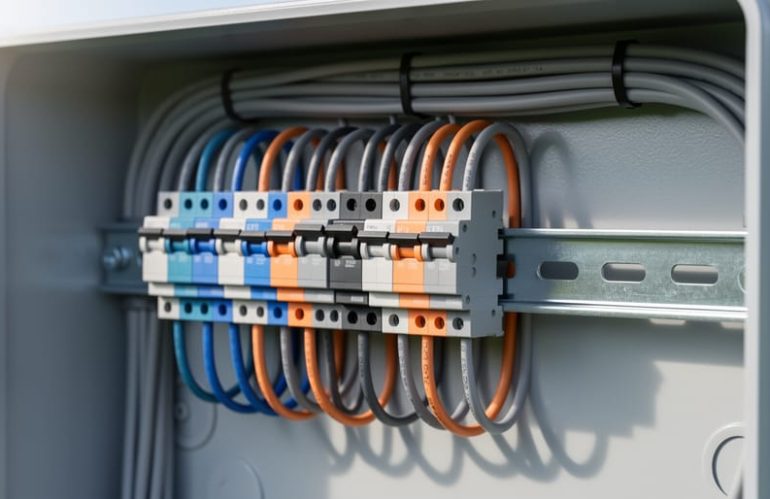
If you have ever seen an installer open the grey box beside your inverter, you have probably noticed rows of small, colour-coded blocks clipped onto a metal strip. Those are DIN rail terminal blocks, and they do a quiet but important job. They hold every conductor in a combiner box or backup panel in a fixed, labelled and serviceable position, so your solar and battery system stays safe and easy to inspect.
You do not need to wire anything yourself to benefit from understanding them. Knowing which types sit inside your system and what a good inspection looks for makes it easier to ask sensible questions and spot a messy job.
Key Takeaway: DIN rail terminal blocks give each conductor a defined connection point on a standard rail. Neat, correctly rated and clearly labelled blocks are one of the quickest visual signs of a well-built solar combiner box or battery backup panel.
What DIN Rail Terminal Blocks Actually Do
A DIN rail is a standardised metal strip, usually mounted inside an enclosure. A terminal block clips onto it and gives you a safe place to land a wire, clamp it and, if needed, join it to a neighbouring wire. Think of it as a tidy junction that replaces loose twisted connections and wire nuts.
In a home solar system, they typically sit in a few places:
- the combiner box, where strings of panels are brought together before the run to the inverter
- the AC isolation or distribution enclosure near the inverter
- the battery backup panel, where critical circuits are separated from the rest of the house
The rail-mounted approach matters for three reasons. Connections are held under controlled clamping pressure rather than relying on someone’s hand-twisted joint. Each circuit sits in its own position, so a technician can trace it without guessing. And a single block can be replaced without disturbing the ones beside it.
The Terminal Types You Are Likely to See
Not every block is the same. When an installer walks you through the panel, these are the types worth recognising.
Feed-through blocks
The everyday workhorse. A feed-through block connects one incoming conductor to one outgoing conductor, passing the circuit straight through. You will see many of these in a row, each carrying a separate string or circuit.
Earth (grounding) blocks
These are usually green and yellow. They connect protective earth conductors to the rail and enclosure so that a fault has a safe path. A missing or loose earth connection is one of the first things a careful inspector looks for.
Fuse blocks
A fuse terminal block holds a small fuse in line with the circuit, often with a hinged lever or a pull-out carrier. In a combiner box, this protects each string. If a fault occurs, the fuse opens the circuit and the block makes it clear which one tripped.
Disconnect blocks
Disconnect, or knife-disconnect, blocks include a lever or slide that lets a qualified person open a circuit for testing without removing the wire. They are useful in battery backup panels, where isolating a circuit safely is part of routine servicing.
Connection technology
Blocks also differ in how they clamp the wire. Screw-clamp, spring-clamp and push-in designs are all common. None is automatically better; what matters is that the block is rated for the conductor size and the circuit it carries.
Warning: The inside of a combiner box or backup panel can hold live DC and AC circuits, and a solar array keeps producing voltage whenever there is light. Opening these enclosures and working on terminal blocks is a job for a licensed electrician or accredited solar installer, never a DIY project.
What an Installer Checks at Inspection
You are not expected to test anything, but it helps to know what a competent inspection of the terminals involves. A good installer will typically look for:
- Correct ratings. Each block should suit the voltage, current and conductor size of its circuit, and DC circuits need components rated for DC.
- Secure, undamaged connections. Wires should be fully seated, with no exposed bare conductor beyond the clamp and no signs of overheating such as discoloured plastic.
- Clear identification. Markers should label every circuit so that nobody has to trace wires to work out what is what.
- Proper earthing. Earth blocks should be present, tight and connected to the rail or bonding as the design requires.
- Complete accessories. End plates, end stops and jumpers should be in place so the blocks cannot slide along the rail and adjacent blocks are properly separated.
If a panel looks improvised, with mixed block types, missing labels or conductors crowded under a single clamp, ask for it to be reviewed.
Planning for Servicing and Expansion
Solar systems rarely stay static. Many households add a battery a year or two after the panels go up, or add a string when the roof is extended. Terminal blocks make that growth manageable, provided there is spare rail space and the original installer chose a block range that is easy to extend.
When you request a quote, it is reasonable to ask whether the combiner box leaves room on the rail for future circuits and whether replacement blocks will be easy to source later. For buyers in Australia, a trusted Australian distributor with a massive stocked industrial terminal range makes later repairs and upgrades far simpler, and RS offers a din rail terminal blocks distributor option with a massive stocked range of DIN rail terminal blocks from Phoenix Contact, WAGO, Weidmüller, Siemens, ABB Entrelec and RS PRO, covering feed-through, grounding, fuse and disconnect variants. Installers can match a replacement block to what is already on the rail instead of redesigning the panel.
Questions Homeowners Often Ask
Can I replace a terminal block myself?
No. Even one replacement means isolating the circuit and working in an enclosure that may be energised from the array or battery. Leave it to a licensed professional.
What if I notice a burning smell or discoloured plastic near the panel?
Treat it as urgent. Do not open the enclosure or touch the terminals. Keep clear of the panel, use only the isolation switches your installer has shown you if they are safe to reach, and contact a licensed electrician or accredited solar installer straight away.
The Bottom Line
Recognising feed-through, earth, fuse and disconnect blocks, and knowing what a tidy, well-labelled panel looks like, puts you in a stronger position when you speak with your installer. Always leave the live work to the professionals.