Imagine cutting your electric vehicle charging costs to nearly zero while powering your car with completely clean energy from your own roof. This isn’t a futuristic fantasy—thousands of homeowners are already doing it today by combining solar panels with their EVs, and the process is far simpler than most people think.
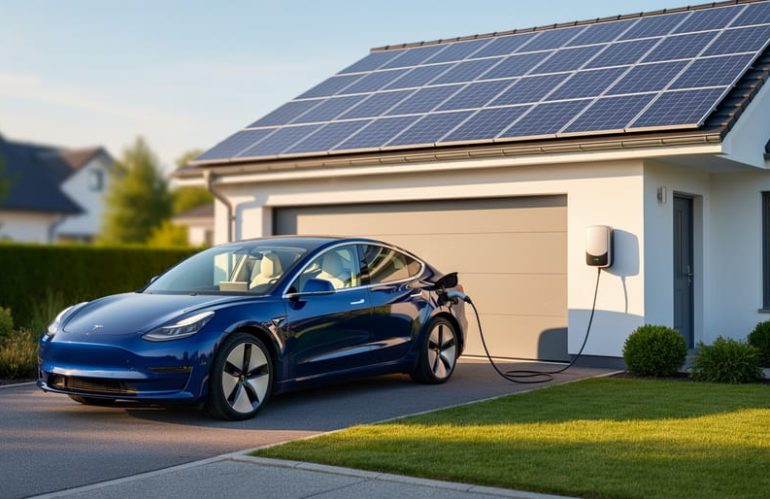
The concept works beautifully: solar panels generate electricity during the day, which either charges your EV directly or feeds into your home battery system for nighttime charging. With solar panel integration, you’re essentially creating your own personal filling station that never runs dry and costs nothing to operate after installation.
Here’s what makes this combination so compelling right now. A typical home solar system can generate enough electricity to power both your house and your EV, potentially saving you $1,500 to $2,000 annually on gasoline and electricity combined. Federal tax credits currently cover 30% of your solar installation costs, while many states offer additional EV charging incentives that stack on top.
The math is straightforward: most EVs need about 30-40 kilowatt-hours to fully charge, which a standard 6-8 kilowatt residential solar array can easily produce on a sunny day. You don’t need specialized equipment beyond your regular EV charger, and your panels work with any electric vehicle brand.
This article breaks down exactly how to make solar-powered EV charging work for your specific situation, what it actually costs, and how quickly you’ll see returns on your investment.
How Solar Panels Actually Charge Your Electric Car
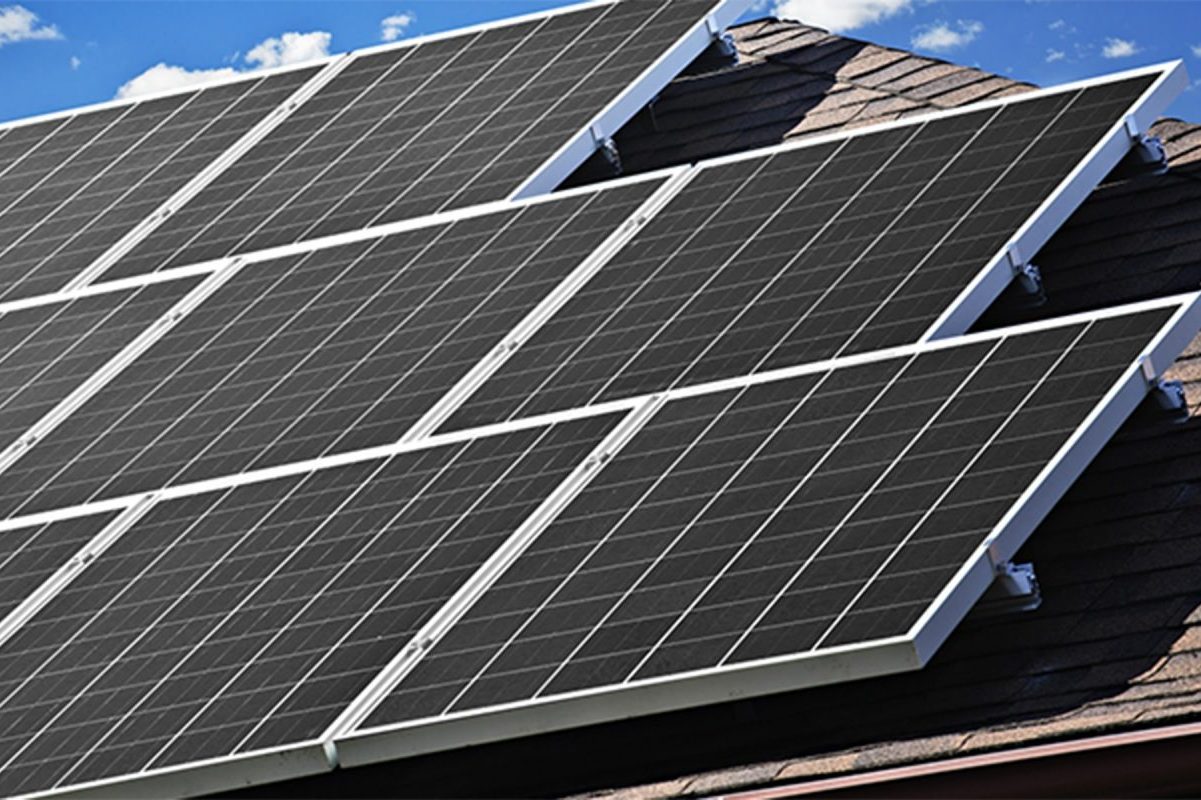
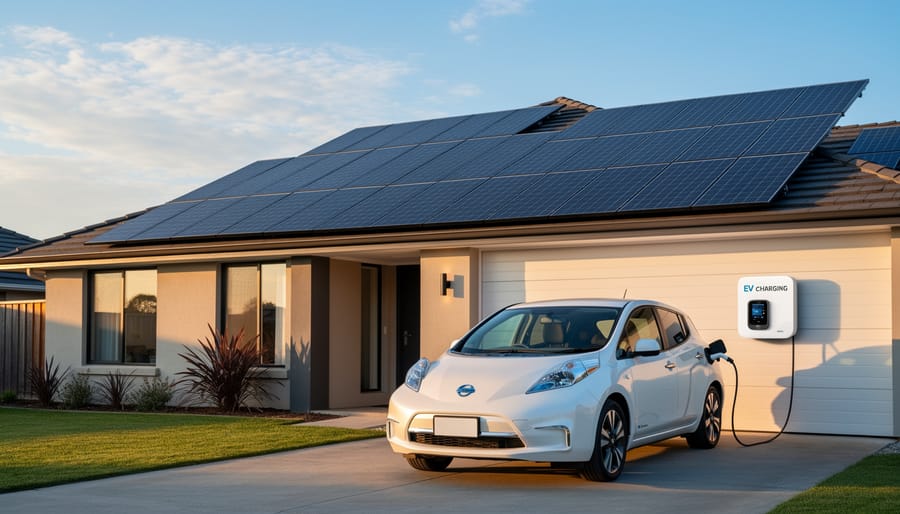
The process of charging your electric car with solar panels is refreshingly straightforward. During daylight hours, your rooftop solar panels convert sunlight into electricity through photovoltaic cells. This electricity flows into your home’s electrical system, where it powers your household appliances, lights, and anything else plugged in—including your EV charger.
Here’s where it gets interesting: you don’t need any special equipment to connect your solar panels and electric car. When you plug your EV into your home charger, it simply draws power from your home’s electrical system, just like any other appliance. If your solar panels are generating electricity at that moment, your car uses that clean, free solar power. If the sun isn’t shining, your car draws from the grid like it normally would.
Many homeowners worry that solar panels need to directly connect to their EV charger, but that’s actually a myth. Your solar system and EV charger work together automatically through your home’s existing electrical panel. When your panels produce more electricity than your home needs, that excess power either charges your car’s battery or flows back to the grid for credit through net metering programs.
The beauty of this setup is its simplicity. Unlike solar panels on EVs themselves, which face engineering challenges, rooftop solar works seamlessly with your home charging setup. You’re essentially creating a miniature clean energy ecosystem right at home, where sunshine becomes transportation fuel without complicated conversions or additional infrastructure. Charge during sunny afternoon hours, and you’re essentially driving on pure sunlight—no fossil fuels required.
The Real-World Benefits You’ll Actually Notice
Slashing Your Transportation Costs
The math is straightforward and compelling: charging your electric vehicle with solar energy delivers substantial savings compared to both gas-powered cars and grid-charged EVs.
Let’s look at real numbers. The average American drives about 12,000 miles annually. A typical gas vehicle getting 25 miles per gallon at $3.50 per gallon costs roughly $1,680 per year in fuel. Charging an EV from the grid at the national average of $0.14 per kWh drops that cost to about $600 annually. But charging with your own solar panels? You’re looking at nearly zero fuel costs after your system is paid off.
| Vehicle Type | 1-Year Cost | 5-Year Cost |
|---|---|---|
| Gas Vehicle (25 MPG) | $1,680 | $8,400 |
| Grid-Charged EV | $600 | $3,000 |
| Solar-Charged EV | $50 | $250 |
Industry research shows that pairing an EV with solar can cut costs by 60% compared to grid charging alone. Over five years, that’s a savings of $8,150 compared to gas or $2,750 compared to grid electricity. These savings accelerate as gas prices rise and as you pay down your solar system, eventually reaching pure savings with no fuel costs whatsoever.
Energy Independence That Actually Works
Imagine unplugging from the volatility of energy markets entirely. When you charge your electric car with solar panels, you’re no longer affected by gas price spikes or utility rate increases. The energy powering your vehicle comes from your roof, at a cost that’s locked in from day one.
This independence extends beyond just saving money on fuel. Many solar-plus-EV setups include battery storage, giving you backup power during grid outages. While your neighbors wait for electricity to return, you can keep essential appliances running and your car charged, ready for emergencies or evacuation if needed.
The financial predictability alone is transformative. Instead of budgeting for unpredictable fuel costs, you know exactly what your transportation energy will cost for the next 25-plus years. As utility rates climb and gas prices fluctuate with global events, your energy costs remain stable. You’ve essentially prepaid for decades of fuel at today’s prices, protecting yourself from future increases while reducing your environmental footprint. That’s genuine energy security on your terms.
Your Environmental Impact, Simplified
Let’s put your environmental impact into perspective with numbers that actually mean something. The average gas-powered car will emit more than 350 grams of carbon dioxide per mile driven. When you charge your electric vehicle with solar panels instead, you’re essentially dropping that number to nearly zero for your daily commute.
Here’s what that looks like in real terms: If you drive 12,000 miles annually, you’re preventing roughly 4.6 metric tons of carbon dioxide from entering the atmosphere each year. That’s equivalent to planting about 76 trees or taking a second car off the road completely.
Even better, you’re not just reducing emissions during your commute. You’re also eliminating the pollution created during gasoline production and transportation, which adds another 20-30% to a gas car’s total environmental footprint. Your rooftop solar system generates clean energy right where you need it, cutting out all those extra environmental costs.
The beauty of this setup is that your positive impact compounds over time, growing larger with every sunny day and every mile you drive.
What You Need to Make It Work
Sizing Your Solar System for EV Charging
Here’s the good news: figuring out whether your solar system can handle EV charging is actually quite straightforward, and you might be surprised by how achievable it is.
Start with your vehicle’s needs. The average electric car driven 12,000 miles annually uses about 3,000-4,000 kWh of electricity per year. That translates to roughly 250-350 kWh per month. To generate this energy, most homeowners will find that charging an EV typically requires 5-10 solar panels, depending on your location and panel efficiency.
Here’s a simple calculation to try: Check your most recent electric bill to see your monthly solar generation. If you already have solar panels and consistently produce 300+ kWh more than you use each month, congratulations – you’re already set to charge an EV without adding panels. If you’re producing excess energy but not quite that much, you might only need a few additional panels.
For those designing your solar system from scratch, simply add your current monthly electricity usage to your expected EV charging needs. A typical household uses 900 kWh monthly, so you’d be looking at roughly 1,200 kWh total with an EV – usually achievable with 20-30 panels depending on your roof’s sun exposure.
The calculation becomes even simpler if you drive less than average. Commute only 20 miles daily? You’ll need proportionally fewer panels. Many homeowners discover they can cover both home and vehicle energy needs with a moderately-sized system, making the economics surprisingly attractive. The key is matching your actual driving habits to your solar capacity, not overbuilding for hypothetical maximum usage.
Charging Equipment Options
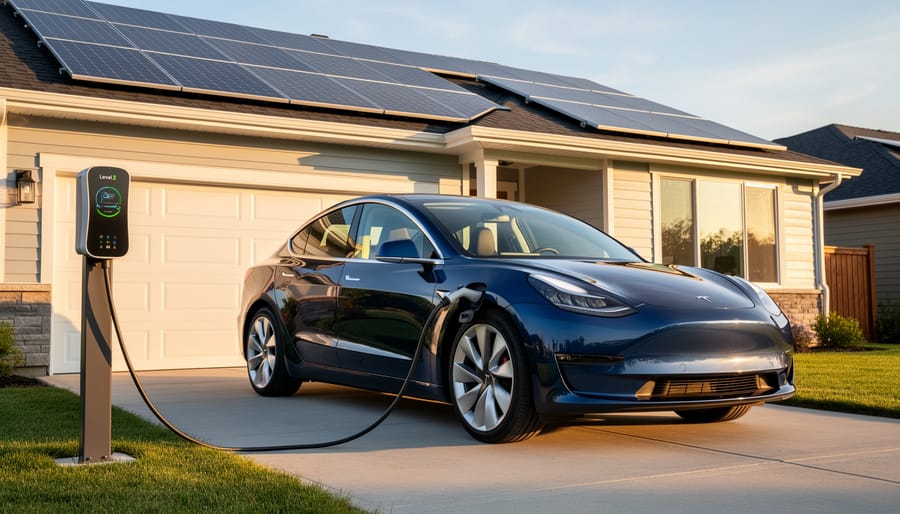
When it comes to charging your electric car with solar power, you’ll need to choose between two main types of home charging equipment. Think of Level 1 as the slow-and-steady option and Level 2 as the faster alternative.
Level 1 chargers plug into your standard 120-volt household outlet, the same one you’d use for a lamp or phone charger. These add about 3-5 miles of range per hour of charging. If you have a short daily commute and can charge overnight, this option works perfectly fine and costs nothing extra beyond the cable that often comes with your EV. It’s ideal for people who drive less than 40 miles per day and aren’t in a rush.
Level 2 chargers require a 240-volt outlet, similar to what your dryer uses. They’re considerably faster, adding 12-60 miles of range per hour depending on your car and charger model. You’ll need an electrician to install the appropriate outlet or hardwired unit, which typically costs between $500-2,000 including equipment and installation.
Here’s the practical reality: if your solar panels generate enough electricity during the day and your utility offers good net metering, either charger will effectively use your solar power. The choice comes down to your daily driving needs and schedule flexibility. Most homeowners with longer commutes or multiple EVs find Level 2 charging worth the upfront investment for the convenience factor alone. If you’re already installing solar panels, adding Level 2 charging capability during the same electrical work often makes financial sense.
Common Myths That Stop Homeowners (And Why They’re Wrong)
Let’s clear up some common misconceptions that might be holding you back from enjoying the financial and environmental benefits of solar-powered EV charging.
Many homeowners assume this setup is prohibitively expensive or impossibly complicated. The reality is much more encouraging. While there is an upfront investment, federal tax credits can cover up to 30% of your solar installation costs, and most homeowners recoup their investment within 6-8 years through eliminated fuel costs and reduced electricity bills. The technology isn’t experimental or cutting-edge anymore—it’s proven, reliable, and becoming more affordable every year.
Another widespread myth is that solar panels only work when the sun is shining, making nighttime charging impossible. This misunderstands how the system actually works. Your solar panels feed excess electricity into the grid during the day, earning you credits through net metering. You then use those credits to charge your EV at night, essentially banking sunshine for later use. With battery storage, you can capture solar energy during the day and use it directly whenever you need it, completely independent of the grid.
Can I charge my EV at night with solar panels?
Yes, through net metering or battery storage. Net metering credits you for daytime solar production, which offsets nighttime charging costs. Battery systems store solar energy for direct use after sunset.
What happens on cloudy days?
Solar panels still generate electricity on overcast days, just at reduced capacity (typically 10-25% of full output). Your grid connection or battery backup ensures uninterrupted charging regardless of weather.
Is solar EV charging too expensive for average homeowners?
With federal tax credits, state incentives, and financing options, most homeowners find the system affordable. Monthly savings on gas and electricity often exceed loan payments from day one.
Do I need a special electric vehicle?
No, all EVs charge the same way through standard charging equipment. Your solar system simply provides the electricity—any EV will work perfectly.
Some people worry that their roof isn’t suitable or their car isn’t compatible. The truth is that most homes with even partial southern exposure can support effective solar installations. As for vehicles, every electric car uses the same basic charging principles—your solar system doesn’t care what brand you drive.
Perhaps the most damaging myth is that solar EV charging is only for wealthy early adopters or environmental extremists. This combination actually makes practical financial sense for middle-class families who want to stop spending money on gasoline and take control of their energy costs. It’s not about being perfect—it’s about being smart with your money while doing something positive for the environment.
Making the Numbers Work for Your Household
Let’s break down the real costs and savings in simple terms, so you can make an informed decision that fits your budget.
The upfront investment typically includes solar panel installation (averaging $15,000-$25,000 for a home system) and your electric vehicle purchase. However, this is where the good news starts: federal tax credits currently cover 30% of your solar installation costs. That’s an immediate reduction of $4,500-$7,500 off your solar investment. Many states offer additional rebates, and EV incentives can put up to $7,500 back in your pocket for qualifying vehicles.
Your payback period depends on three main factors: your current electricity rates, how much you drive, and how much sunshine your roof receives. Most homeowners see their solar investment pay for itself within 7-12 years. If you’re charging an EV, you can accelerate this timeline significantly because you’re replacing expensive gasoline with free sunshine.
Here’s a straightforward way to estimate your savings: Calculate your annual gasoline costs (miles driven divided by your old car’s MPG, multiplied by gas prices). Then add your current home electricity bill. For many families, this totals $3,000-$5,000 yearly. With solar panels powering both your home and car, you could reduce this expense by 70-90%, saving $2,100-$4,500 annually. Even accounting for the initial investment, you’re building equity while gasoline buyers continue paying without any return.
Don’t forget the hidden financial benefits. Your home value typically increases by the full value of your solar installation, and you’re protected against rising electricity rates for the next 25-30 years. Meanwhile, EV maintenance costs run about half of what you’d spend on oil changes, transmission repairs, and other conventional vehicle upkeep.
The bottom line: while the upfront numbers might seem substantial, you’re not spending money, you’re redirecting it from ongoing expenses into an asset that pays dividends for decades. Most homeowners who make this switch wish they’d done it sooner once they see their first $0 electricity bill and skip their first gas station.
Adding Solar to Your Existing EV Setup (Or Vice Versa)
Good news: whichever system you have first, adding the second is typically straightforward. The key is planning ahead to ensure they work together efficiently.
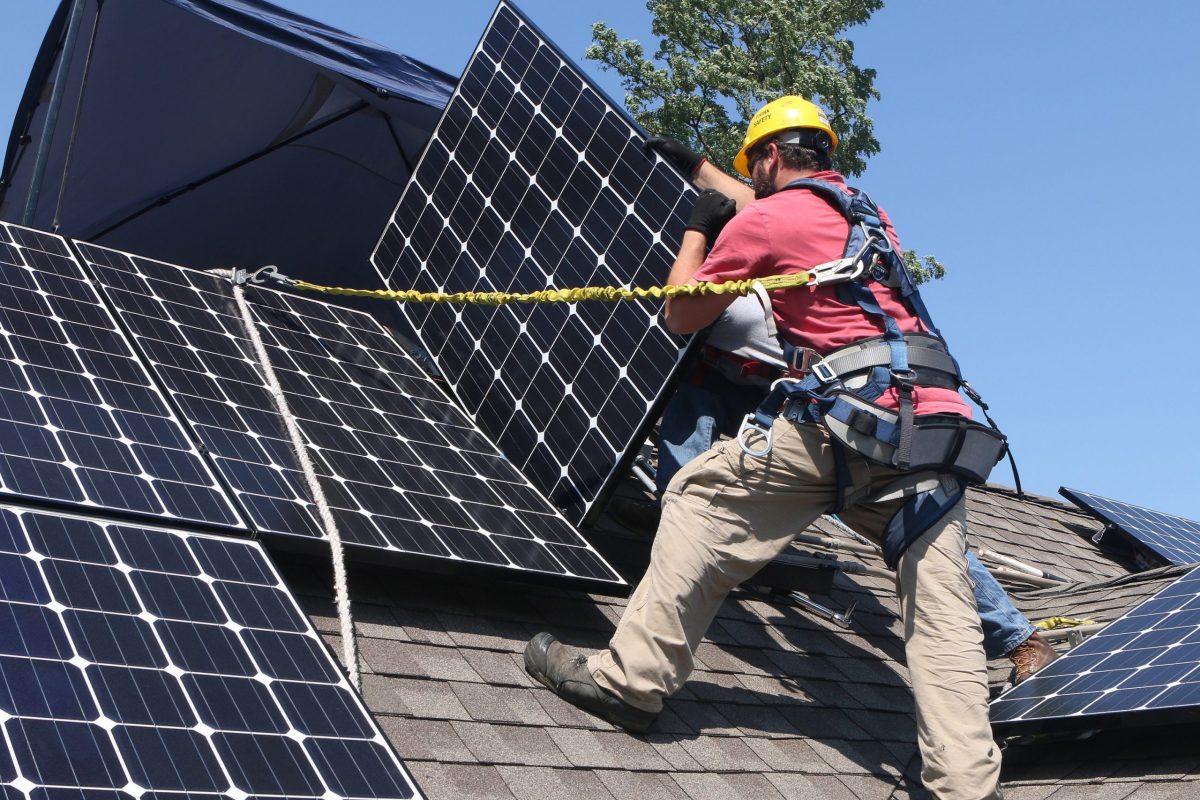
If you already own an EV and want to add solar, start by reviewing your current electricity bills to understand your total household consumption plus EV charging needs. This gives you an accurate picture of what size solar system you’ll need. Many homeowners underestimate by only considering their pre-EV usage, then find their panels don’t cover their charging demands. A solar installer can assess your roof’s capacity and recommend a system that accommodates both your home and vehicle needs.
One common pitfall: assuming your current electrical panel can handle everything. Adding solar often requires panel upgrades, especially in older homes. Budget for this possibility upfront rather than being surprised mid-installation.
For homeowners with existing solar who are buying an EV, you’re in an excellent position. Check whether your current system produces excess electricity during the day. Many solar owners already send surplus power back to the grid, and that energy could charge your car instead. Review your net metering statements to see if you’re consistently overproducing. If so, you may not need additional panels at all.
If your solar system is near capacity, consider adding panels before purchasing your EV. Expanding an existing array is usually more cost-effective than installing a completely new system later. Plus, with solar-ready infrastructure already in place, the additional installation costs are minimal.
The biggest mistake in either scenario? Not coordinating your charging schedule with solar production. Install a smart charger that automatically charges your EV during peak solar hours, typically 10 a.m. to 3 p.m. This simple step ensures you’re actually using your solar energy rather than drawing from the grid at night when your panels aren’t producing.
Battery Storage: Is It Worth Adding to the Mix?
A home battery system can transform your solar EV charging setup from good to great, but it’s not essential for everyone. Think of a battery as a piggy bank for your solar electricity—it stores excess power your panels generate during the day so you can use it to charge your car at night or during cloudy weather.
The biggest advantage of adding battery storage is charging flexibility. Without a battery, you’re limited to charging when the sun is shining. If you work from home or can charge during midday hours, this might not be a problem. But for most people who need to charge overnight after their evening commute, a battery means you’re still using your own solar power instead of drawing from the grid.
Battery systems also provide backup power during outages, keeping your home running and your car charging even when the grid goes down. This peace of mind appeals to many homeowners, especially in areas prone to blackouts.
- Charge your EV anytime using stored solar power, not just during daylight hours
- Provides backup power during grid outages for both home and vehicle
- Maximizes use of your solar energy instead of sending excess back to the grid
- Increases energy independence and reduces reliance on utility companies
- Adds significant upfront cost, typically between $10,000-15,000 installed
- May take 10-15 years to pay for itself through energy savings alone
- Requires additional space and occasional maintenance
- Not necessary if you can charge during peak solar production hours
The financial case for batteries depends heavily on your situation. If your utility offers poor net metering rates or expensive time-of-use pricing, a battery becomes more attractive. However, if you have favorable net metering that credits you fairly for excess solar power, you might skip the battery initially and add one later if needed. Many homeowners successfully charge their EVs with solar panels alone, treating the grid as their virtual battery.
Charging your electric car with solar panels isn’t just a futuristic dream—it’s a practical reality for everyday homeowners right now. You’ve seen how the technology works, the financial savings you can expect, and the positive environmental impact you’ll make. While the upfront investment requires planning, the combination of lower electricity bills, reduced fuel costs, and available incentives makes this an increasingly smart financial decision. You’ll be protecting yourself from rising energy prices while significantly cutting your carbon footprint. The best part? You don’t need to be an engineer or have a massive budget to get started. Begin by getting quotes from reputable solar installers, calculate your specific energy needs based on your driving habits, and explore financing options that fit your budget. Thousands of homeowners have already made the switch successfully, and with today’s technology and incentives, there’s never been a better time to join them. Take that first step with confidence—a cleaner, more affordable driving future is within your reach.