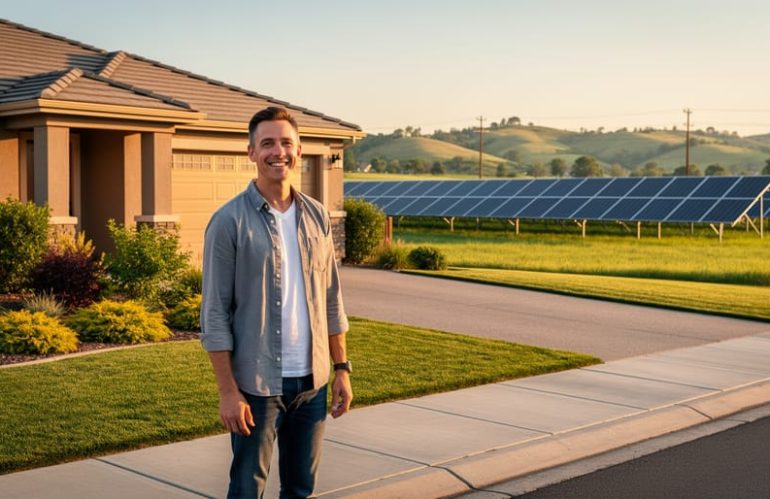
Community solar lets you tap into clean energy without installing a single panel on your roof. Instead of navigating the complexities of rooftop installation, you simply subscribe to a portion of a larger solar array built in your area—often in a nearby field or on a commercial building. Your share of the electricity generated flows directly to your utility bill as credits, typically saving you 5-15% on energy costs each month.
This arrangement solves a frustrating problem: nearly half of American homeowners can’t install traditional rooftop solar due to shading, roof age, rental situations, or homeowner association restrictions. Community solar removes these barriers entirely. You’re not responsible for maintenance, repairs, or upfront equipment costs. The solar farm operator handles everything while you enjoy the financial and environmental benefits.
The process works seamlessly with your existing utility service. Each month, you receive credits based on your share of the community array’s production. These credits offset your regular electricity consumption, lowering your bill automatically. You maintain your current utility provider and service—nothing changes except the amount you pay.
For environmentally-conscious homeowners who’ve felt locked out of the solar revolution, community solar offers a legitimate path forward. You’ll reduce your carbon footprint, support renewable energy development in your region, and save money simultaneously. No roof assessment needed, no installation crews, no equipment decisions—just straightforward access to clean energy that starts benefiting you immediately.
What Community Solar Actually Means for Your Energy Bill
Community solar flips the traditional solar model on its head in the best possible way. Instead of installing panels on your own roof, you’re essentially buying a share in a larger solar farm located elsewhere in your area. Think of it like a community garden, but for electricity—you get the benefits without needing the physical space on your property.
Here’s how the money part works, which is what really matters for your wallet. Once you subscribe to a community solar program, the solar farm generates clean energy that feeds into the local power grid. You receive credits on your monthly utility bill based on your share of that energy production. These credits offset what you would normally pay for electricity, typically saving subscribers between 5% and 15% on their energy costs each year.
The beauty of this arrangement is its simplicity. You don’t pay for installation, maintenance, or repairs—those responsibilities belong to the solar farm operator. Your only commitment is your subscription, which usually requires no upfront costs or involves a small enrollment fee. You continue receiving your regular utility bill, but now it includes solar credits that reduce the bottom line.
This differs dramatically from rooftop solar installations. Traditional panels require significant upfront investment, often $15,000 to $25,000, plus ongoing maintenance responsibilities. You also need suitable roof space, the right orientation for sun exposure, and permission if you’re renting. Community solar eliminates every single one of these barriers.
The financial benefit is immediate too. Unlike rooftop installations that take years to recoup initial costs, community solar starts saving you money from day one. There’s no waiting period for return on investment because there’s minimal investment to begin with.
Perhaps the most overlooked advantage is flexibility. If you move within the same utility service area, your subscription typically moves with you. Try doing that with rooftop panels. This makes community solar particularly attractive for renters, condo owners, or anyone who might relocate in the coming years but still wants to embrace clean energy and reduce their monthly expenses.
Why Urban Homeowners Are Turning to Community Solar
The Apartment and Condo Solution
For years, renting an apartment or owning a condo meant missing out on solar savings. You didn’t own the roof, couldn’t make structural changes, and watched homeowners enjoy benefits that seemed out of reach. Community solar changes that completely.
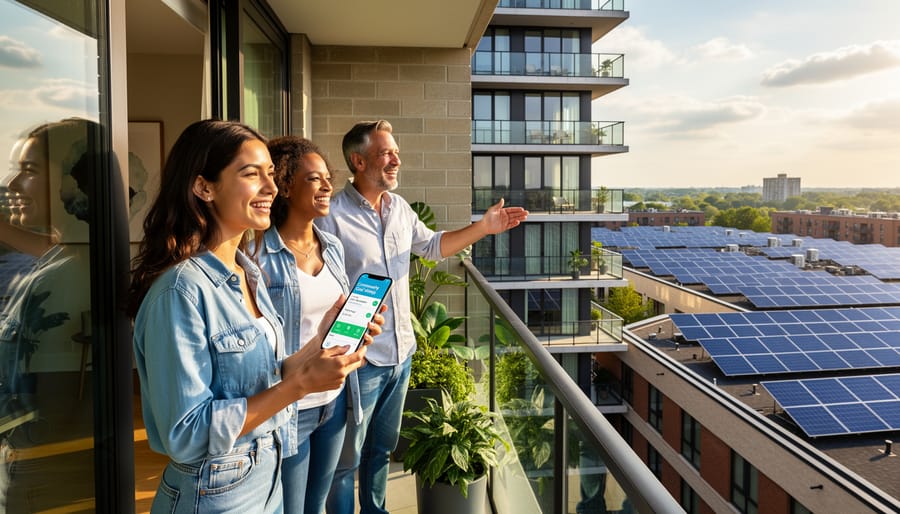
These programs let you subscribe to a portion of a shared solar farm without installing anything on your property. You simply sign up, choose your subscription level, and start receiving credits on your electricity bill. No roof required, no permission from landlords needed, and no upfront installation costs.
This is a game-changer for the millions of Americans who want to go solar but don’t have the right living situation. Whether you’re in a high-rise downtown or a rental townhouse, you can finally tap into clean energy savings. You’re not locked into long-term contracts either. If you move to a new apartment across town or even to another participating area, your subscription can often move with you.
The financial benefits are real and immediate. Most subscribers save between 5-15% on their monthly electricity bills, with credits appearing automatically. You’re supporting renewable energy and reducing your carbon footprint while keeping more money in your pocket each month.
When Your Roof Just Won’t Work
Not every home is designed for solar panels, and that’s especially true in cities. Your roof might face the wrong direction, catching minimal sunlight throughout the day. Maybe towering buildings or mature trees cast persistent shadows across your rooftop, blocking the sun when you need it most. Older roofs might not have the structural integrity to support heavy panels, and some simply aren’t large enough to accommodate a traditional installation.
These aren’t minor inconveniences—they’re genuine dealbreakers that can make rooftop solar inspections reveal disappointing news. Even innovative solutions like vertical solar panels can’t overcome every obstacle. Renters face an additional hurdle: they simply don’t own the roof and can’t make installation decisions.
Here’s the good news: community solar completely bypasses these limitations. Since the solar farm is built on a separate site specifically chosen for optimal sun exposure, your individual roof situation becomes irrelevant. The panels are installed on land selected for maximum efficiency—no shading issues, no structural concerns, no orientation problems. You receive the financial benefits and environmental impact of solar energy without needing a single panel on your property. It’s solar power freed from the constraints of your particular building, making clean energy accessible regardless of where or how you live.
How Community Solar Installation Works in Cities
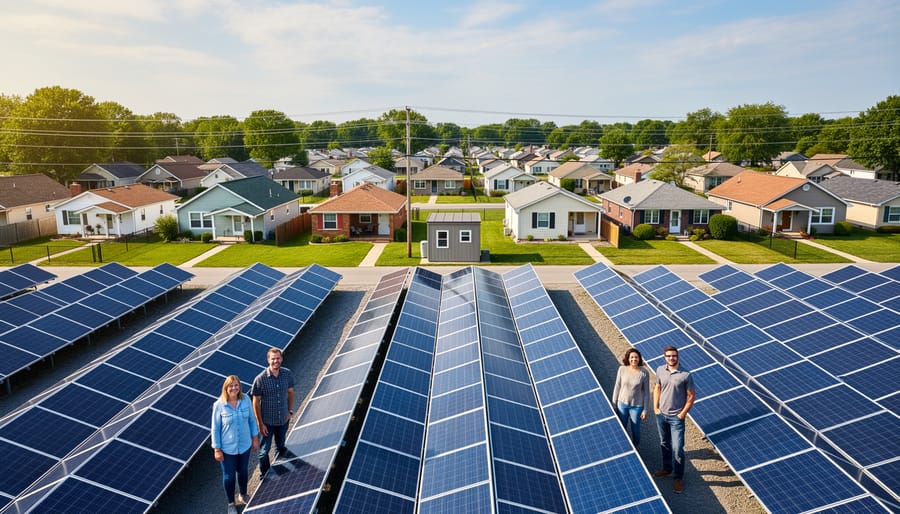
Community solar projects bring renewable energy to city dwellers through creative location strategies that work around urban space constraints. Unlike rooftop panels that require your own property, these shared solar arrays are built in nearby locations and connected to the local power grid, allowing you to benefit from clean energy generated elsewhere.
The most common approach places community solar farms on open land just outside city limits, typically within 10 to 40 miles of participating homes. These nearby facilities generate electricity that feeds directly into your utility’s grid, and you receive credits on your monthly bill for your share of the production. Think of it like a community garden, but instead of growing vegetables, you’re harvesting sunlight.
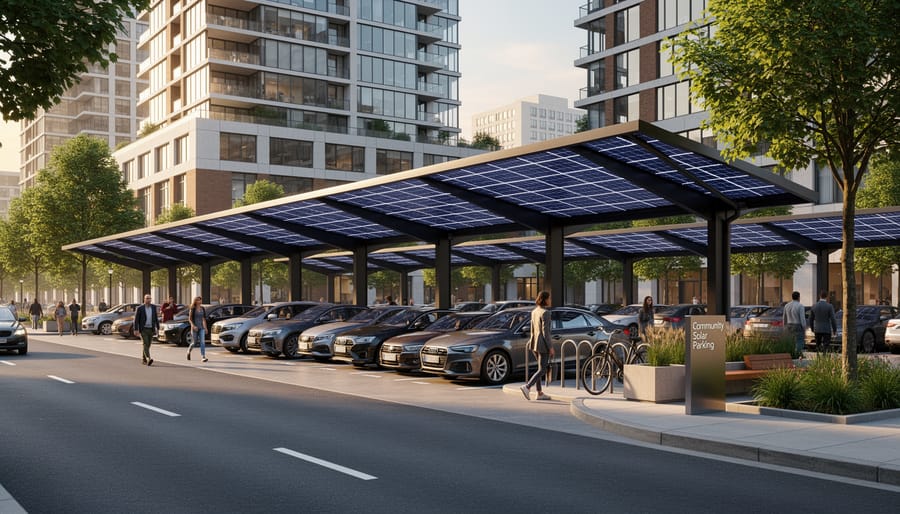
Cities are also getting inventive with underutilized spaces right within their boundaries. Solar parking canopies are transforming mundane parking lots into dual-purpose energy generators, providing shade for vehicles while producing clean power. These structures are popping up at shopping centers, municipal lots, and residential complexes, turning wasted vertical space into community energy assets.
Brownfield sites, former industrial areas unsuitable for residential development, offer another excellent opportunity for urban solar installations. These previously neglected spaces can host large solar arrays without competing for valuable urban real estate, effectively turning environmental liabilities into community benefits.
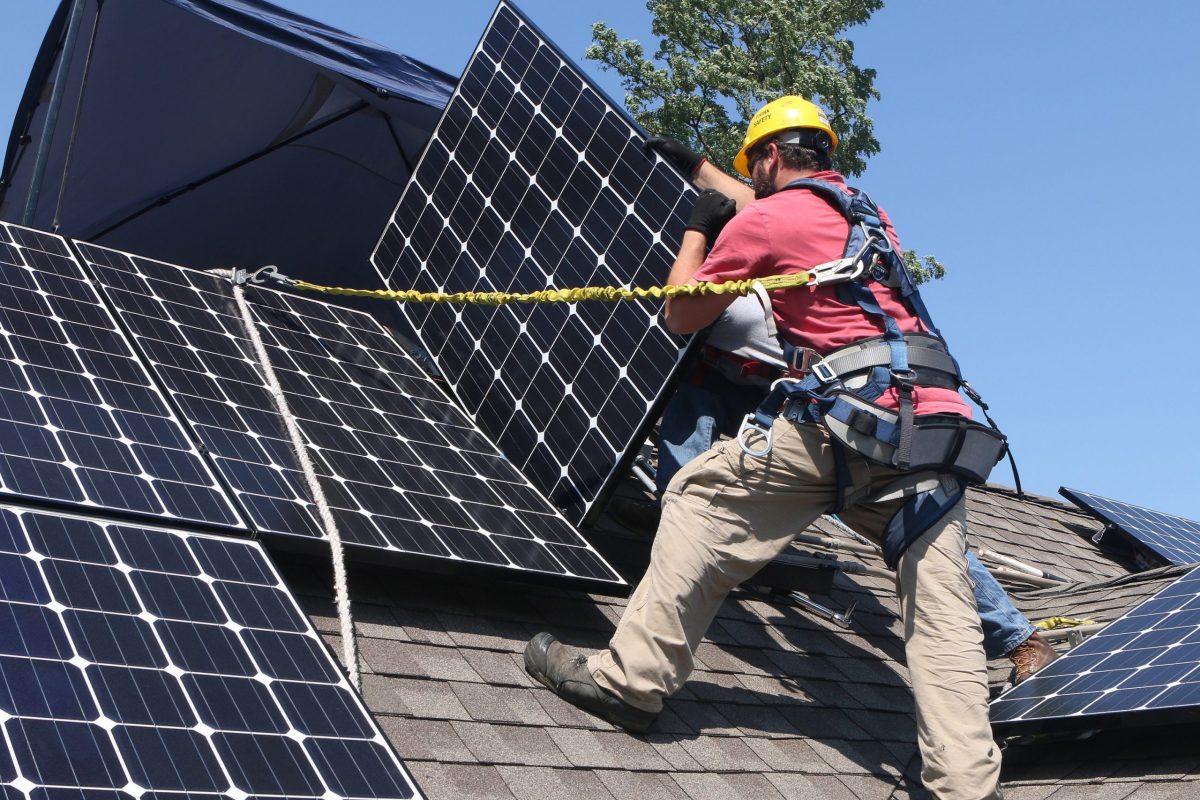
The installation process itself mirrors traditional solar farms but requires additional coordination with local utilities and city planners. Developers handle all the heavy lifting, including securing permits, installing equipment, and managing grid connections. Once operational, the system requires minimal maintenance, with most projects backed by 20 to 25-year agreements that guarantee your energy credits and savings. You simply sign up, and the solar energy starts reducing your electricity bills, no rooftop work required.
The Real Costs and Savings Breakdown
Let’s clear up a common misconception right away: you don’t need to own solar panels to enjoy serious savings on your electricity bill. Community solar operates on a subscription model that eliminates the biggest barrier to solar energy—those hefty upfront costs.
With traditional rooftop solar, you’re looking at an investment of $15,000 to $25,000 before incentives. Even with tax credits and financing options, that’s a significant commitment. Community solar flips this model entirely. There are zero upfront costs, no installation fees, and no maintenance expenses to worry about.
Here’s how the numbers actually work. You subscribe to a portion of a shared solar farm, typically through a simple online signup process. Your subscription is sized to match your household’s energy consumption. Each month, the solar farm generates credits based on the electricity your share produces. These credits appear directly on your utility bill, reducing what you owe.
Most community solar programs guarantee savings between 5% and 15% compared to standard electricity rates. Some programs offer even higher discounts, particularly in states with strong renewable energy incentives. The beauty of this arrangement is predictability. While traditional utility rates fluctuate and generally trend upward, your community solar subscription rate is often locked in, protecting you from future price increases.
The subscription fee itself is straightforward. You only pay for the solar credits you receive, and this amount is always less than what those credits save you on your utility bill. Think of it as buying electricity at a discount. If your solar credits save you $50 on your utility bill, you might pay $45 for those credits—pocketing the difference with zero effort on your part.
There’s no risk of equipment failure draining your wallet, no roof compatibility concerns, and no decrease in home value if panels don’t suit your aesthetic. You’re simply redirecting money you already spend on electricity toward a cleaner, cheaper source. When you move, most programs allow you to transfer your subscription to your new address or cancel without penalty, offering flexibility that rooftop systems simply can’t match.
Finding and Joining a Community Solar Program
Ready to explore community solar for your home? Finding the right program is easier than you might think. Start by searching online databases like EnergySage Community Solar Marketplace or your state’s clean energy website. Simply enter your zip code to see available programs in your area. Many utility companies also maintain lists of approved community solar providers, so check your utility’s website or give them a call.
Once you’ve identified a few options, it’s time to compare programs. Request subscription agreements from each provider and review them carefully. Look for clearly stated savings percentages—reputable programs typically offer 5-15% off your current electricity costs. The agreement should specify the subscription term length, cancellation policies, and whether there are any upfront fees. Most legitimate programs require little to no money down, which is one of their biggest advantages.
Ask providers these essential questions: What percentage of my electric bill will come from community solar credits? Are there enrollment or cancellation fees? How long is the contract term, and what happens if I move? Can I see examples of actual subscriber savings? A trustworthy provider will answer these questions transparently and provide references from current subscribers.
Watch for these red flags: providers who pressure you to sign immediately, agreements with vague savings language, or programs requiring large upfront payments. Be cautious of contracts longer than 25 years or those with complicated cancellation policies that lock you in regardless of circumstances.
The enrollment process itself is straightforward. You’ll typically provide your utility account information, choose your subscription size (usually a percentage of your energy usage), and sign the agreement. Within one to three months, you’ll start seeing community solar credits appear on your utility bill, reducing your overall costs while supporting clean energy in your community. It’s that simple to start saving money and helping the environment.
Community Solar vs. Rooftop Panels: Which Is Right for You?
Choosing between community solar and rooftop panels isn’t about picking a winner—it’s about finding what fits your life. Both paths lead to clean energy and savings, just through different routes.
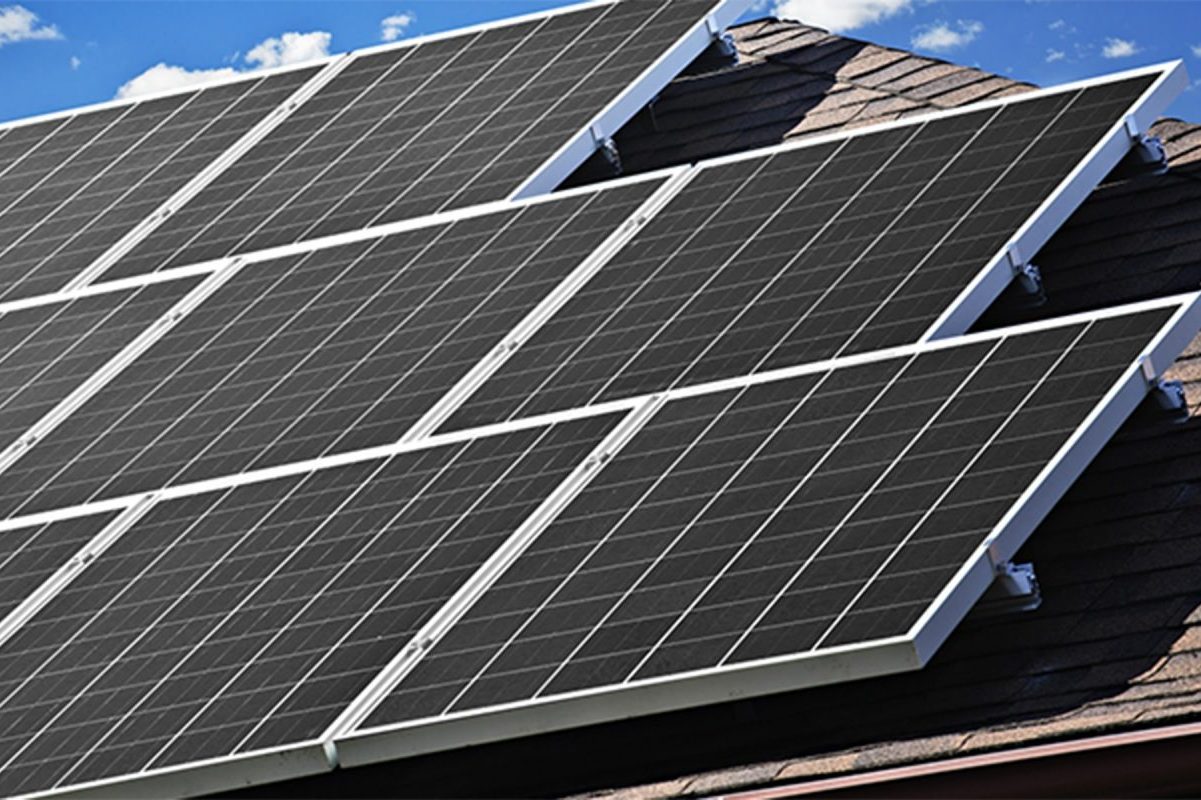
Rooftop panels make sense if you own your home, have a suitable roof with minimal shading, and plan to stay put for several years. You’ll enjoy maximum long-term savings, increase your property value, and maintain complete control over your system. Options like solar-integrated design can even enhance your home’s appearance. The upfront investment pays off handsomely over time, typically within 7-10 years.
Community solar shines when rooftop installation isn’t practical. If you rent, live in a condo or apartment, have a shaded or aging roof, or simply want to avoid the installation process, community solar removes those barriers. You’ll start saving immediately without any upfront costs, maintenance responsibilities, or roof modifications. The flexibility to move without losing your solar benefits appeals to many modern homeowners.
Consider your timeline too. Planning to relocate within five years? Community solar offers clean energy without commitment concerns. Settling in for the long haul with a sun-drenched roof? Traditional panels might maximize your investment.
Your budget matters as well. Community solar requires zero down payment, while rooftop systems need either cash reserves or financing approval. However, rooftop panels typically deliver higher lifetime savings.
The good news? You don’t have to choose forever. Start with community solar today and transition to rooftop panels when circumstances change. What matters most is taking that first step toward sustainable living and lower energy bills—whichever path you choose.
Community solar is transforming how city dwellers and those without ideal roof conditions can participate in the clean energy movement. By removing traditional barriers like shading, roof age, or rental restrictions, these shared solar programs make renewable energy accessible to millions more households. When you join a community solar project, you’re not just reducing your own energy costs—you’re contributing to a larger shift toward sustainable power generation that benefits everyone.
The environmental impact of widespread solar adoption cannot be overstated. Each household that switches to solar energy, whether through rooftop panels or community programs, reduces carbon emissions and decreases reliance on fossil fuels. As more people embrace these options, we collectively build a cleaner, healthier future for our communities and planet.
Now is the perfect time to explore your community solar options. Check with your local utility company, research available programs in your area, and calculate your potential savings. Whether you choose traditional rooftop installation or a community solar subscription, taking this step toward renewable energy means joining a growing movement of homeowners committed to sustainability and financial savings. Your participation matters, and the path to cleaner energy is more accessible than ever before.