

Going solar transforms your relationship with your electric bill, but understanding how you’ll actually be charged can feel like decoding a foreign language. The truth is simpler than most people think: when your panels generate electricity, you’re either using it immediately to power your home, sending excess back to the grid for credits, or drawing from the grid when production is low. This exchange creates a new billing structure that, when properly understood, puts money back in your pocket month after month.
Most homeowners worry they’ll lose savings to confusing fees or complicated metering systems. Reality check: solar billing is designed to work in your favor. Your utility company tracks what you produce versus what you consume, typically through net metering programs that credit you for surplus energy at retail rates. These credits roll over, essentially turning your meter backward and slashing your bills during low-production months.
The key to maximizing these financial benefits lies in understanding three elements: how your utility calculates credits, when time-of-use rates apply, and what minimum charges remain regardless of your production. Armed with this knowledge, you’ll confidently navigate statements, spot opportunities for additional savings, and ensure every ray of sunshine translates directly into dollars saved.
What Solar Billing Actually Means (Without the Confusion)
Reading Your New Solar Bill
Your solar bill might look different from your old electric bill, but it’s actually easier to understand once you know what you’re looking at. Think of it like a simple report card showing how your solar panels performed during the month.
The first number you’ll see is energy produced—this is how much electricity your solar panels generated, measured in kilowatt-hours (kWh). It’s like checking how much fruit your garden harvested. Next, you’ll find energy consumed, which shows how much electricity your household actually used during that same period.
Here’s where it gets interesting: the net energy calculation. This is simply the difference between what you produced and what you consumed. If your panels generated 800 kWh but you only used 600 kWh, you have a surplus of 200 kWh. Think of it like baking cookies—if you made 20 but only ate 15, you have 5 extras to share.
Those extra kilowatt-hours don’t go to waste. Through net metering, your utility company tracks this surplus and issues credits to your account. These credits roll over month to month, essentially banking your sunshine for cloudy days or winter months when your panels produce less. During peak production months, you might even see your electric charges drop to zero, with credits building up for future use. The result? Significant savings that compound over time.
How Smart Billing Systems Put More Money Back in Your Pocket
Real-Time Tracking That Works for You
Gone are the days of waiting for your monthly utility bill to understand your solar performance. Today’s monitoring systems bring complete transparency to your fingertips, showing exactly how much energy your panels produce and how much money you’re saving in real time.
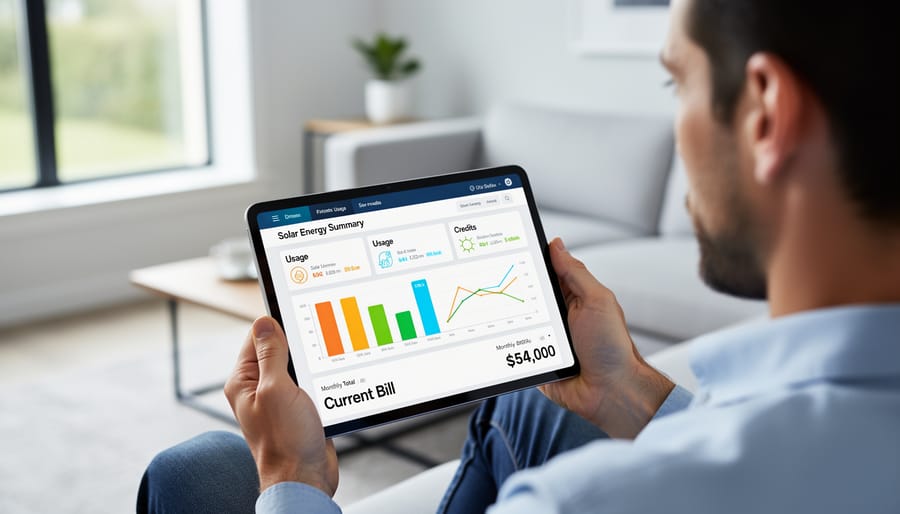
Modern solar monitoring works through simple smartphone apps or web dashboards that display your energy data in plain English. You’ll see colorful graphs showing your daily production, current electricity consumption, and how much you’re sending back to the grid. These user-friendly interfaces translate complex electrical measurements into easy-to-understand metrics, like dollars saved today or this month.
The beauty of real-time data tracking is how it empowers your daily decisions. Notice your panels producing extra energy on a sunny afternoon? That’s the perfect time to run your dishwasher or charge your electric vehicle. See a dip in production? You might discover a simple issue like leaves covering a panel before it significantly impacts your savings.
Most systems even send alerts about unusual patterns, helping you stay proactive about maintenance. This instant visibility eliminates billing surprises and helps you truly understand the value your solar investment delivers every single day. You’re not just hoping your panels work effectively; you know they are.

Automatic Incentive Applications
One of the most overlooked aspects of going solar is making sure you actually receive all the money you’re entitled to. Modern solar billing systems take the guesswork out of this process by automatically tracking and applying available incentives on your behalf.
Here’s the reality: there are dozens of federal, state, and local programs designed to reward solar adoption, but they’re notoriously complex to navigate. The federal Investment Tax Credit alone can save you thousands of dollars, and many states offer additional rebates that stack on top. Without an optimized system tracking these opportunities, money simply falls through the cracks.
Smart billing platforms continuously monitor which incentives you qualify for based on your location, system size, and energy production. When you generate excess electricity that feeds back to the grid, the system automatically calculates your credits. When seasonal rebate programs open up, you’re notified immediately. Think of it as having a financial assistant dedicated solely to maximizing your solar returns.
The best part? This happens behind the scenes. You don’t need to research changing regulations, file complicated paperwork multiple times, or worry about missing application deadlines. The system handles the heavy lifting while you simply enjoy lower energy bills and the satisfaction of knowing you’re capturing every dollar you’ve earned from your solar investment. This automation transforms what could be a frustrating administrative burden into effortless savings.
The Incentives You’re Entitled To (And How to Actually Get Them)

Federal Tax Credits Made Simple
The federal Investment Tax Credit (ITC) is one of the biggest financial perks of going solar, letting you deduct 30% of your total solar system costs from your federal taxes. That could mean thousands of dollars back in your pocket. Here’s the good news: you don’t need to be a tax expert to claim it.
Modern solar billing systems automatically track and document everything the IRS requires. Your system records installation costs, equipment purchases, and related expenses in clear, organized reports. When tax season arrives, you’ll have all the documentation ready to go, whether you’re working with a tax professional or filing yourself.
Think of your solar billing platform as your personal tax assistant. It maintains a detailed digital paper trail that satisfies federal requirements without you lifting a finger. No more hunting through filing cabinets or worrying about missing receipts. The system captures dates, amounts, and itemized expenses from day one, making the tax credit process remarkably straightforward. Many homeowners are pleasantly surprised to discover that claiming their solar tax credit is actually easier than they imagined, thanks to properly organized billing records that do the heavy lifting for them.
State and Local Rebates
Beyond federal incentives, many states and local utilities offer additional rebates that can significantly boost your solar savings. These programs vary widely depending on where you live—some states offer thousands in upfront rebates, while others provide performance-based incentives that pay you for the energy your system produces. The challenge? Keeping track of what you qualify for and actually claiming these benefits can feel overwhelming.
This is where modern solar billing systems shine. The best platforms automatically monitor your eligibility for local programs and alert you when it’s time to claim rebates. Instead of sorting through paperwork or missing deadlines, you’ll receive clear notifications with simple instructions for submitting applications. Some systems even generate the necessary documentation for you, transforming what used to be a tedious process into a few clicks.
Think of it as having a personal assistant dedicated to maximizing your solar investment. These billing systems track your system’s performance against program requirements, ensuring you don’t leave money on the table. For homeowners, this means accessing benefits you might not have even known existed—all without the paperwork headaches that often discourage people from claiming what they’ve earned.
Net Metering Credits Explained
When your solar panels produce more electricity than your home uses, that extra energy doesn’t go to waste. Instead, it flows back into the electrical grid, and your utility company credits your account through a process called net metering. Think of it as your electric meter running backward, banking energy for later use.
Here’s the good news: these credits directly reduce your electricity bill, often at the same retail rate you’d pay for grid power. During sunny afternoons when your panels are working overtime, you’re essentially storing value for evening hours or cloudy days when you’ll draw from the grid again. Over a month, your bill reflects the net difference between what you consumed and what you contributed.
The key to maximizing these credits lies in proper system optimization. An accurately sized solar installation matched to your actual energy patterns ensures you’re capturing every possible kilowatt-hour of production. Modern monitoring systems track this exchange in real-time, giving you complete visibility into how much credit you’re earning. Many homeowners find that optimized systems generate enough credits during peak production months to offset usage during lower-production periods, sometimes resulting in minimal or zero electric bills year-round.
What Makes a Solar Billing Experience Actually User-Friendly
Mobile Access and Notifications
Modern solar monitoring apps put your billing information right in your pocket, making it easier than ever to stay on top of your solar investment. Instead of waiting for monthly statements, you can check your energy production and savings in real-time from anywhere—whether you’re at work, on vacation, or simply relaxing at home.
These apps send helpful alerts when something seems off, like unusually low production on a sunny day or unexpected spikes in grid consumption. This means you can address potential issues quickly, protecting your savings before they’re impacted. Think of it as having a friendly assistant watching over your system 24/7.
The best part? Watching your savings grow becomes genuinely exciting. Many homeowners report feeling more engaged with their solar investment when they can see daily updates showing exactly how much money they’re saving and how much cleaner energy they’re producing. This visibility helps you make smarter energy decisions, like running major appliances during peak solar production hours, maximizing your financial benefits without any guesswork.
Common Solar Billing Myths That Cost Homeowners Money
Many homeowners hesitate to go solar or miss out on savings because they believe common misconceptions about how solar billing actually works. Let’s clear up these myths so you can make informed decisions and keep more money in your pocket.
One persistent myth is that you’ll still pay full electricity bills even with solar panels. In reality, most homeowners see their electricity costs drop dramatically, often by 70-90%. Your bill doesn’t disappear entirely because you’ll still have minimal connection fees and charges for power you draw from the grid at night, but your monthly costs will be significantly lower than before.
Another costly misconception is that net metering is too complicated to be worth the effort. The truth is, net metering is remarkably simple. When your panels produce more energy than you use, the excess goes back to the grid, and you receive credits on your bill. These credits offset the electricity you use when your panels aren’t producing, like during evening hours. It’s essentially a fair trade that happens automatically, with no action required on your part.
Many people also believe that solar billing requires constant monitoring and management. Modern solar systems handle everything behind the scenes. Your utility company tracks your energy production and consumption automatically, applying credits where appropriate. You’ll still receive a regular bill, just like before, making the transition seamless.
Perhaps the most financially damaging myth is that solar incentives and tax credits are too good to be true or impossible to claim. Federal tax credits currently cover up to 30% of your installation costs, and many states offer additional rebates. These aren’t gimmicks—they’re legitimate government programs designed to encourage renewable energy adoption. Working with experienced solar providers ensures you claim every benefit you’re entitled to, maximizing your return on investment from day one.
At its heart, optimized solar billing isn’t about navigating complicated systems or deciphering confusing statements. It’s about transparency, clarity, and ensuring you get every dollar of savings you deserve. Your solar installation journey shouldn’t end with uncertainty about your bills. The right solar provider will make billing as straightforward as checking your bank account, with clear breakdowns of your credits, charges, and net savings.
You deserve to understand exactly how much you’re saving each month and how incentives are working in your favor. When solar billing is done right, it becomes a tool that empowers you rather than confuses you. This transparency directly translates to better financial outcomes and peace of mind.
The future of home energy is bright, and well-managed solar billing plays a crucial role in making that future accessible to everyone. By expecting and demanding user-friendly billing practices, you’re not just benefiting your wallet—you’re contributing to a more sustainable world while enjoying the financial rewards that solar energy promises.