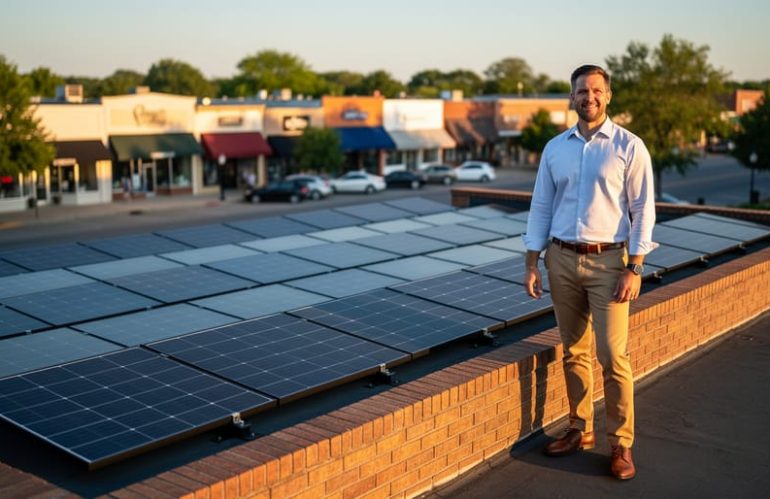
Solar energy doesn’t require draining your savings or waiting years to afford it. Choose from zero-down solar loans that let you own your system immediately while monthly payments often cost less than your current electric bill. Explore solar leases and power purchase agreements where you pay nothing upfront and simply purchase the electricity your panels generate at a reduced rate. Consider home equity financing to leverage your property’s value for lower interest rates and potential tax deductions. Investigate state and local programs offering grants, rebates, or specialized green energy loans that reduce your total investment by thousands of dollars.
The financing options available today make solar accessible regardless of your current cash position. Most homeowners discover their monthly financing payment is immediately offset by eliminated electricity bills, meaning solar pays for itself from day one. With the federal solar tax credit covering 30% of installation costs and financing terms extending up to 25 years, you control both your energy future and your budget. The key is matching the right financing structure to your financial goals, whether that’s maximizing ownership benefits, minimizing monthly costs, or eliminating maintenance responsibilities entirely.
Why Small Businesses Are Turning to Solar Now
Small businesses across the country are making the switch to solar energy, and it’s not just about going green anymore. The financial case for solar has become increasingly compelling as electricity costs continue climbing year after year. Many business owners are seeing their monthly energy bills eat into profits, making solar panels a strategic investment rather than simply an environmental statement.
The numbers tell a clear story. Recent federal tax incentives allow businesses to claim up to 30% of their solar installation costs through the Investment Tax Credit. Additionally, many states offer their own rebates and incentives that can further reduce the initial investment. When you combine these benefits with accelerated depreciation options, the return on investment often exceeds what traditional business investments deliver.
But perhaps the biggest shift is in how accessible solar has become. You no longer need tens of thousands of dollars sitting in your business account to go solar. Modern financing options mean you can start saving on energy costs from day one, often with little to no money down. These arrangements allow businesses to redirect cash flow toward growth instead of utility companies.
The technology itself has also improved dramatically while costs have dropped by more than 70% over the past decade. Today’s solar panels are more efficient, more durable, and come with warranties that protect your investment for 25 years or more. For small business owners looking to control operating expenses and gain energy independence, solar has evolved from a nice-to-have into a smart financial move that pays dividends for decades.
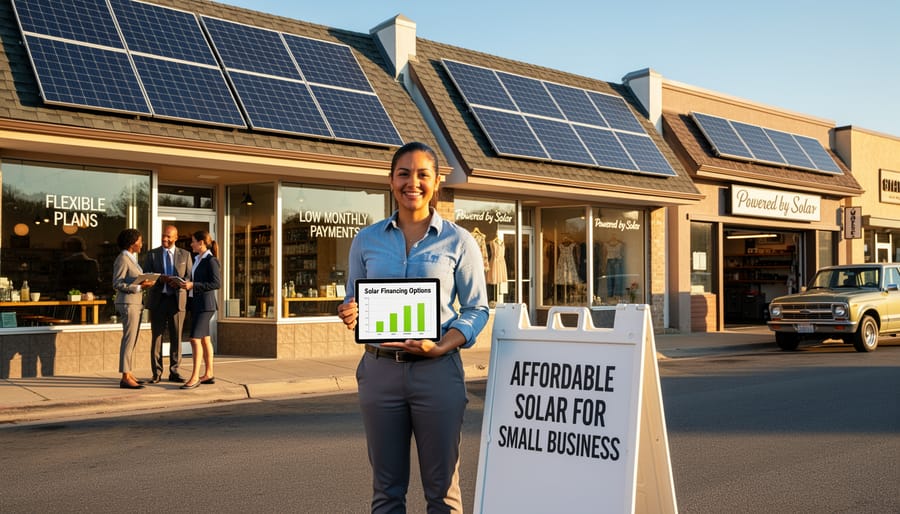
The Real Cost of Going Solar for Your Business
Here’s the reality: going solar for your business doesn’t mean emptying your savings account or taking on crushing debt. In fact, many small businesses start saving money from day one without spending a dime upfront.
Let’s talk real numbers. A typical small business solar installation might cost between $50,000 and $150,000 before incentives. That sounds intimidating, right? But here’s what changes the game: the federal solar tax credit immediately knocks off 30% of that cost. So that $100,000 system? You’re really looking at $70,000 after the credit.
Now here’s where it gets even better. With financing options like solar loans and leases, you’re not writing a check for $70,000. Instead, you might pay $400 to $800 monthly, which often costs less than your current electricity bill. Think about it: you’re replacing one monthly payment (your power bill) with another (your solar payment), except the solar payment eventually ends while electricity rates keep climbing forever.
Many businesses choose power purchase agreements where they pay nothing upfront and simply buy the electricity their panels generate at a lower rate than the utility charges. You save money immediately without any capital investment.
The myth that solar requires massive upfront capital comes from outdated information. Today’s financing landscape is designed specifically for businesses that want to save money without tying up cash. Whether you’re running a coffee shop, retail store, or professional office, there’s a financing structure that fits your cash flow and budget. The key is understanding which option aligns with your business goals and financial situation.
Five Financing Options That Work for Small Businesses
Cash Purchase: Fast Returns for Businesses with Capital
If your business has capital available, paying cash for your solar installation delivers the fastest return on investment and maximum long-term savings. With outright purchase, you own the system from day one, which means every kilowatt-hour of solar energy directly reduces your electricity costs without any loan interest eating into your savings.
The financial benefits add up quickly. Most businesses see their solar investment pay for itself within 5-7 years through eliminated energy bills, and then enjoy 20-25 years of essentially free electricity. You’ll also claim the federal Investment Tax Credit, which covers 30% of your system cost, directly reducing what you owe the IRS that year. Many states offer additional rebates and incentives that further improve your bottom line.
Cash purchase makes particular sense for established businesses with strong cash flow or those looking to invest reserves productively. You avoid loan origination fees, interest payments, and complex paperwork. Plus, owning your system outright increases your property value and gives you complete control over maintenance and upgrades.
Solar Loans: Own Your System, Keep the Savings
Solar loans work much like a car loan or home improvement loan—you borrow money to purchase your system outright and repay it over time with interest. The big difference? Your monthly loan payment often costs less than what you’re currently spending on electricity, meaning you start saving from day one.
Most solar loans offer terms between 10 and 25 years, with interest rates typically ranging from 3% to 8% depending on your credit score and lender. Many require no money down, making solar accessible without draining your business savings. Your monthly payments stay predictable throughout the loan term, while energy costs for non-solar users continue climbing.
Here’s the real advantage: you own the system immediately. That means you qualify for the 30% federal tax credit, any state incentives, and you keep 100% of the energy savings forever. Once you’ve paid off the loan, your solar panels continue generating free electricity for decades. You also add value to your property—studies show solar installations increase property values significantly.
Solar loans offer maximum flexibility. You can choose your equipment, installer, and loan terms that match your budget. No third-party complications, no lease restrictions—just straightforward ownership that pays you back year after year.
Solar Leases: Go Solar with Zero Down
Solar leases offer a simple path to going solar without any upfront investment. Here’s how it works: a solar company installs panels on your property at no cost to you, and you pay a fixed monthly lease payment to use the system. Think of it like renting the equipment rather than owning it.
This option appeals to budget-conscious businesses because the monthly costs are predictable and typically lower than your previous electricity bills. Even better, maintenance and repairs are included in your lease agreement, so you won’t face unexpected expenses if something needs fixing.
The main trade-off when considering leasing versus buying is that you won’t receive tax credits or incentives, as the leasing company retains ownership. However, for businesses wanting immediate savings without capital expenditure or maintenance responsibilities, leases provide a straightforward, low-risk entry into solar energy that starts reducing your energy costs from day one.
Power Purchase Agreements (PPAs): Pay Only for Power You Use
Power Purchase Agreements offer a truly zero-down approach to going solar. Unlike leases where you pay a fixed monthly fee regardless of production, PPAs charge you only for the electricity your system actually generates, typically at a rate lower than your utility company’s price per kilowatt-hour.
Here’s what makes PPAs different: a third-party company owns and maintains the solar panels on your property, and you simply purchase the power they produce. There’s no equipment cost, no maintenance responsibility, and often no long-term financial commitment beyond the agreement term.
This model has become increasingly attractive for small businesses with limited capital because it eliminates upfront investment while delivering immediate savings. You’re essentially replacing one electricity bill with another, smaller one. The solar company handles installation, monitoring, repairs, and even insurance. You just enjoy cleaner energy at predictable rates that don’t fluctuate with utility price increases, making budgeting simpler and your bottom line greener.
Government Incentives and Tax Credits You Can Stack
The good news about solar financing is that you’re not paying full price. Multiple government programs work together to dramatically reduce your actual costs—and you can combine them.
The biggest benefit comes from federal tax incentives, specifically the Investment Tax Credit (ITC). This lets you claim 30% of your total system cost as a credit on your federal taxes. For a $20,000 system, that’s $6,000 back in your pocket. Unlike a deduction, a tax credit reduces what you owe dollar-for-dollar.
Many states offer additional incentives on top of the federal credit. These vary widely but can include performance-based payments, additional tax credits, or property tax exemptions that prevent your home’s increased value from raising your property taxes.
Local utility companies often provide rebates for installing solar, sometimes offering hundreds or thousands of dollars depending on your system size.
For businesses, there’s accelerated depreciation through MACRS, which allows you to deduct a significant portion of your system’s cost from taxable income over five years.
When you stack these programs together, your effective cost can drop by 40-50% or more, making solar far more affordable than the sticker price suggests.
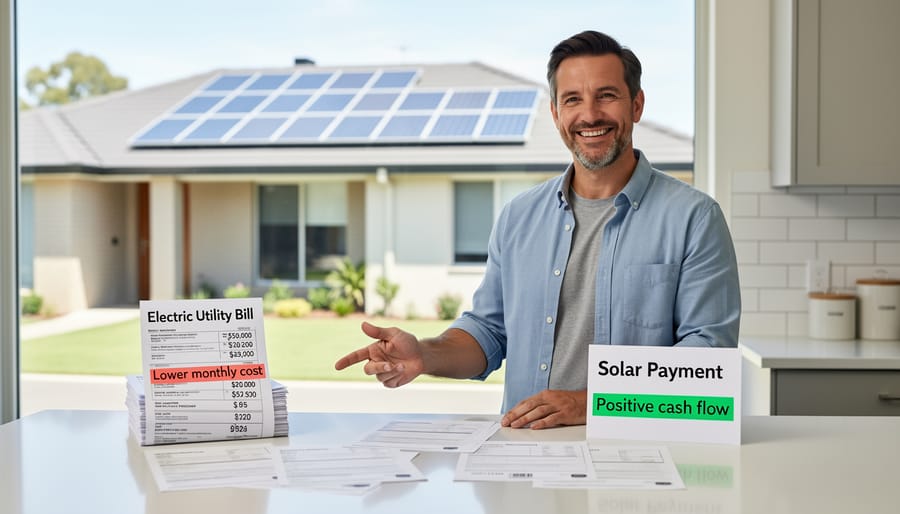
What Your Monthly Payment Could Actually Look Like
Let’s break down what a typical small business might actually pay each month when financing a solar system, because the numbers are often more manageable than you’d think.
Imagine a small retail shop that currently pays around $450 per month for electricity. They decide to install a $30,000 solar system that will cover about 80% of their energy needs. Here’s how the math works out:
With a 10-year solar loan at 5% interest, the monthly payment comes to roughly $318. Meanwhile, their electricity bill drops to about $90 since they’re still buying a bit of power from the grid. That’s a total monthly cost of $408, which is already $42 less than what they were paying before going solar. From day one, they’re saving money.
Now consider a small office building spending $650 monthly on electricity. They finance a $45,000 system with a 15-year loan at 4.5% interest, paying approximately $344 per month. Their new utility bill? Around $130. Combined, that’s $474 monthly compared to their previous $650, putting an extra $176 back in their pocket every single month.
The beauty of these examples is that you’re not waiting years to see benefits. Your reduced electricity costs help offset your loan payment immediately. And once that loan is paid off, you’re looking at decades of dramatically lower energy bills with minimal maintenance costs.
Many business owners are surprised to discover that financing solar is like trading one monthly payment for a smaller one, except this payment eventually disappears entirely while your savings continue growing.
Common Myths About Solar Financing (And the Truth)
Let’s clear up some common misconceptions that might be holding you back from going solar.
You need perfect credit to qualify. Not true. While good credit certainly helps you secure better interest rates, many financing options exist for people with average or even fair credit scores. Some programs specifically cater to various credit ranges, and leasing arrangements often have more flexible requirements than traditional loans. The key is shopping around and being honest about your financial situation.
It takes forever to break even. This outdated belief doesn’t account for today’s competitive financing rates and increased energy costs. With zero-down payment options and monthly loan payments that often match or fall below your current electricity bill, many homeowners start saving from day one. Most solar systems now pay for themselves within 7-10 years, and they typically last 25-30 years, giving you decades of virtually free electricity.
Financing is too complicated. Solar financing has become remarkably straightforward. Lenders have streamlined their applications, often providing decisions within hours. You’re essentially choosing between owning your system through a loan or having someone else own it through a lease or power purchase agreement. Think of it like deciding between buying or leasing a car. Once you understand the basic differences, the choice becomes much clearer. Plus, reputable solar installers guide you through every step, explaining options in plain English and helping you find the best fit for your budget and goals.
How to Choose the Right Financing Option for Your Business
Choosing the right solar financing starts with understanding your business’s unique situation. Think of it as finding the best fit rather than the “perfect” option—what works depends on your priorities and circumstances.
Start by looking at your current cash flow. If you have reserves available and want maximum long-term savings, paying cash makes sense. You’ll own the system outright and capture all financial benefits immediately. However, if cash flow is tight or you’d rather keep funds available for core business needs, financing or leasing options preserve your working capital while still delivering energy savings from day one.
Next, consider your tax situation. If your business pays significant federal taxes, a solar loan lets you claim valuable tax credits and depreciation benefits that can cover a substantial portion of your system cost. On the other hand, if you’re a nonprofit or don’t have much tax liability, a Power Purchase Agreement might be better since the financing company claims those incentives and passes savings to you through lower electricity rates.
Think about ownership preferences too. Do you want to own the equipment and build equity, or would you prefer a maintenance-free solution where someone else handles repairs? Loans and cash purchases give you ownership, while leases and PPAs transfer that responsibility to providers.
Finally, align your choice with your business goals. Planning to stay in your location long-term? Ownership options maximize value. Prioritizing predictable expenses? Fixed-rate financing or PPAs offer budget certainty. There’s no wrong answer—just the right match for your situation.
Next Steps: Making Solar Financing Simple
Ready to make the switch to solar? Start by gathering a few key pieces of information: your average monthly electric bill, your home’s energy usage over the past year, and your credit score if you’re considering a loan. This groundwork helps installers provide accurate quotes tailored to your situation.
When talking with solar companies, ask specific questions: What financing options do they recommend for your circumstances? What are the total costs, including interest? How long until you break even? What warranties and maintenance are included? A reputable installer will answer clearly without pressure tactics.
Compare at least three offers side-by-side. Look beyond the monthly payment to understand the full picture—total system cost, interest rates, contract length, and projected savings. Check online reviews and verify certifications.
Remember, solar financing isn’t complicated when you know what to look for. Thousands of homeowners are already enjoying lower energy bills and contributing to a cleaner environment. The financial tools exist to make solar accessible right now, without waiting years to save up. Take that first step today by requesting quotes, and you’ll quickly see how achievable clean, affordable energy really is for your home.
Going solar is no longer reserved for businesses with deep pockets. Whether you choose a loan, lease, PPA, or cash purchase, there’s a financing path that fits your budget and business goals. The financial benefits are real—lower energy bills, tax incentives, and protection from rising utility rates—all while reducing your environmental footprint. Many small businesses are already discovering that solar pays for itself over time, turning what seems like a major investment into a smart financial decision. The best part? Getting started is easier than you think. With qualified installers and flexible financing options available, the transition to clean energy is both practical and profitable. Now is the perfect time to explore which solar financing option works for your business and take that first step toward energy independence and long-term savings.