CEC efficiency ratings reveal the true performance of solar inverters in real-world conditions, directly impacting your home’s energy production and financial returns. While manufacturers often advertise peak efficiency numbers, CEC (California Energy Commission) ratings provide a weighted average that better reflects how your inverter will perform throughout varying sunlight and temperature conditions. For homeowners investing in solar systems, understanding CEC efficiency helps make informed decisions that can translate to thousands of dollars in energy savings over time. Modern solar inverters typically achieve CEC efficiency ratings between 95% and 98%, with each percentage point potentially affecting your system’s annual power output by hundreds of kilowatt-hours. Whether you’re evaluating microinverters, string inverters, or hybrid solutions, this standardized efficiency metric serves as your most reliable guide for comparing options and maximizing your solar investment’s long-term value.
What Makes CEC Efficiency Different from Standard Ratings
Standard inverter efficiency ratings typically reflect performance under ideal laboratory conditions, often measured at a single operating point. While these peak efficiency numbers look impressive on spec sheets, they don’t tell you much about how the inverter will perform throughout an actual day in your home.
The CEC weighted-average efficiency takes a different approach. Instead of reporting a single peak value, this metric evaluates inverter performance across multiple power levels that reflect real-world operating conditions. The California Energy Commission developed this testing protocol to weight efficiency measurements according to how often an inverter actually operates at each power level during typical use.
Here’s what makes the CEC rating more practical: it measures efficiency at 10%, 20%, 30%, 50%, 75%, and 100% of rated capacity, then applies weights to each measurement based on statistical solar irradiance data. Because your system spends more time operating at partial load than at full capacity, especially during morning and evening hours or cloudy conditions, these weighted measurements matter more than a single peak number.
The CEC-AC rating goes a step further by specifying the maximum continuous AC output power the inverter can deliver under CEC test conditions. This rating helps you match inverter capacity to your system size and ensures you’re not oversizing or undersizing equipment. When you compare inverters, looking at both the CEC efficiency percentage and the CEC-AC rating gives you a complete picture of how the unit will perform in your specific installation.
Most quality residential inverters show CEC efficiency ratings between 96% and 98%. That might seem like a small range, but even a 1% difference compounds over the 25-year lifespan of your system. The standardized testing methodology also makes it easier to compare products across manufacturers, something that’s difficult when everyone reports peak efficiency under their own preferred conditions.
Why California Energy Commission (CEC) Standards Matter
The California Energy Commission (CEC) plays a vital role in shaping the future of solar energy by establishing and maintaining rigorous efficiency standards for inverters. Just as solar panel efficiency ratings help homeowners make informed decisions, CEC standards ensure that inverters meet specific performance benchmarks before entering the market.
These standards protect consumers by guaranteeing that inverters operate at optimal efficiency levels, helping homeowners maximize their solar investment. When an inverter meets CEC requirements, it means the device has been thoroughly tested and proven to convert DC power from solar panels to usable AC power with minimal energy loss.
The CEC’s testing procedures are particularly relevant for California residents, but their influence extends nationwide. Many manufacturers across the U.S. design their products to meet these standards, making them the de facto benchmark for quality and performance. This widespread adoption helps drive innovation in the industry while ensuring homeowners can rely on their solar investment to deliver consistent, efficient power conversion for years to come.
By choosing CEC-compliant inverters, homeowners can feel confident they’re getting equipment that meets strict efficiency requirements and will help maximize their energy savings.
Real-World vs. Laboratory Performance
While laboratory tests show inverters performing at peak efficiency under controlled conditions, real-world performance often tells a different story. In actual installations, inverters face varying temperatures, changing sunlight conditions, and different power loads throughout the day.
Laboratory testing typically occurs at a constant room temperature with steady power input, resulting in those impressive efficiency ratings you see on spec sheets. However, your rooftop inverter might experience temperature swings from freezing to scorching, cloud coverage changes, and varying household energy demands.
This is precisely why CEC efficiency ratings are so valuable. The California Energy Commission developed this weighted-average efficiency protocol to better represent real-world inverter performance. The testing measures efficiency at multiple power levels (10%, 20%, 30%, 50%, 75%, and 100% of rated capacity) and weights them according to how often each load occurs in typical residential installations. This weighted calculation provides a far more accurate prediction of actual energy conversion than a single peak efficiency number.
| Power Load | Peak Efficiency Rating | CEC Weighted Efficiency Rating |
|---|---|---|
| 10% | 92% | 90% |
| 25% | 96% | 95% |
| 50% | 98% | 97% |
| 75% | 97% | 96% |
| 100% | 96% | 95% |
For example, an inverter with 98% peak efficiency might average 96% CEC efficiency, which more accurately reflects what you’ll experience at home. The CEC-AC rating, which calculates the actual AC power output you can expect based on this weighted efficiency metric, is listed on most inverter spec sheets alongside the nominal AC power rating. When comparing models, pay attention to both the CEC-AC rating and the CEC weighted efficiency, not just the peak numbers.
Understanding this difference helps set realistic expectations for your solar system’s performance and ensures you make a more informed investment decision.
Diagram comparing CEC efficiency curve vs standard efficiency ratings across different power loads
How CEC Efficiency Impacts Your Energy Bills
Energy Production vs. Energy Usage
Understanding the relationship between energy production and usage is crucial to maximize your solar investment. While CEC efficiency ratings give you a good baseline for inverter performance, real-world energy production often varies from theoretical maximums. A 97% efficient inverter doesn’t necessarily mean you’ll get 97% of your solar panels’ power to your home.
Various factors affect actual energy output, including temperature, shade, and time of day. For example, if your solar panels produce 6,000 watts of power, a 97% efficient inverter might deliver around 5,820 watts under ideal conditions. However, real-world conditions typically result in slightly lower outputs.
Think of it like fuel economy in cars – while rated efficiency provides a benchmark, actual performance depends on how and when you use it. The good news is that modern CEC-rated inverters are highly efficient across different power levels, helping you capture more solar energy throughout the day, even during periods of lower sunlight.
Calculate Your Potential Savings
To calculate your potential savings from a higher efficiency inverter, use this simple formula: multiply your system’s annual energy production (in kWh) by your electricity rate (per kWh) and the efficiency difference between inverters (as a decimal).
For example, if your 10kW solar system produces 14,000 kWh annually, your electricity rate is $0.15 per kWh, and you’re comparing a 95% efficient inverter to a 98% efficient inverter (3% difference or 0.03):
14,000 kWh × $0.15 × 0.03 = $63 annual savings
This means choosing the 98% efficient inverter could save you $63 each year, or over $1,500 during the typical 25-year lifespan of your solar system. Remember that actual savings may vary based on your specific circumstances, including:
– Local sunshine hours
– Panel orientation and tilt
– Electricity rates in your area
– System maintenance
– Seasonal variations
While the difference might seem small initially, these savings add up significantly over time, making inverter efficiency an important factor in your solar investment decision.
- Find your system’s annual kWh production. Check your system size estimate or solar proposal to determine how many kilowatt-hours your panels will generate each year based on your location and roof conditions.
- Identify your current electricity rate. Look at your utility bill to find your per-kWh cost. Include any time-of-use rates or tiered pricing that affects your average cost.
- Calculate the efficiency difference between inverters. Subtract the CEC efficiency of your baseline inverter from the higher-efficiency model you’re considering, then convert to a decimal (for example, 98% minus 95% equals 3%, or 0.03).
- Multiply all three values together. Annual kWh × electricity rate × efficiency difference gives you your yearly savings from the more efficient inverter.
- Compare against the price difference to determine payback period. Divide the extra upfront cost of the higher-efficiency inverter by your annual savings to see how many years it takes to break even.
Choosing the Right Inverter for Your Home
Top-Performing CEC-Rated Inverters
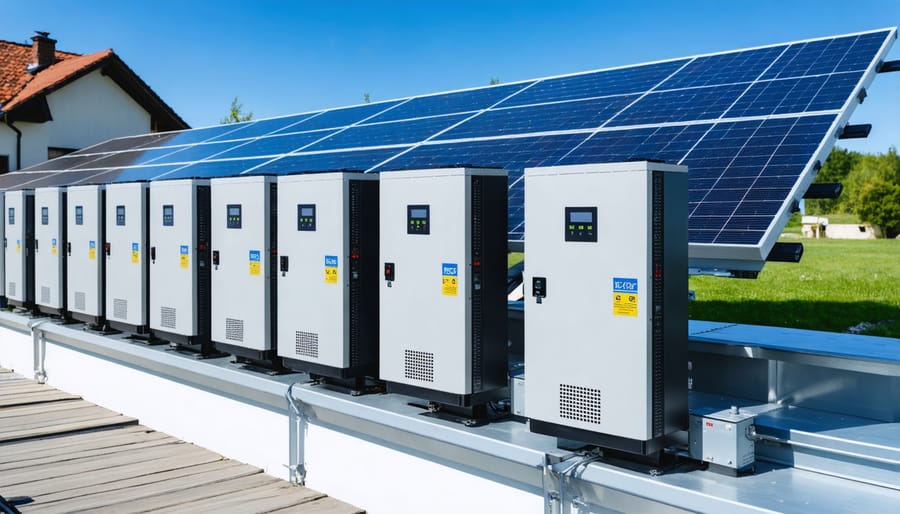
Several inverter manufacturers consistently lead the market with their high-efficiency products that have earned impressive CEC ratings. SMA’s Sunny Boy series, particularly their SB7.7-US model, maintains exceptional efficiency ratings above 97.5%, making it a top choice for residential installations. Enphase’s IQ8 microinverters have also earned recognition for their outstanding performance, with CEC efficiency ratings reaching up to 97%.
The Fronius Primo line, especially their single-phase inverters, demonstrates remarkable efficiency levels of 96.5% to 97%, while maintaining excellent reliability and smart features that homeowners appreciate. SolarEdge’s HD-Wave technology inverters have revolutionized the market with their lightweight design and impressive efficiency ratings of up to 99%.
Delta’s M series inverters have also earned their place among top performers, consistently achieving CEC efficiency ratings above 96.5%. These inverters offer an excellent balance of performance and value, making them particularly attractive for budget-conscious homeowners.
What sets these high-performing inverters apart isn’t just their efficiency ratings – they all offer robust warranty coverage, typically 10-25 years, and include advanced monitoring capabilities that help homeowners track their system’s performance. Many also feature built-in rapid shutdown capabilities and smart grid compatibility, making them future-proof investments for your solar system.
When selecting from these top performers, consider factors beyond just efficiency ratings, such as warranty terms, local supplier support, and compatibility with your specific solar panel configuration.
Size and Budget Considerations
When selecting a CEC efficiency inverter, it’s crucial to find the perfect balance between performance and cost-effectiveness. First, determine the right size for your home to avoid overspending on an oversized system or limiting your energy production with an undersized one.
While higher efficiency inverters typically come with a higher price tag, they often justify the initial investment through improved energy conversion and long-term savings. For example, an inverter with 98% CEC efficiency might cost more upfront than one with 96% efficiency, but the additional energy savings could offset this difference within a few years.
Consider your available installation space as well. More efficient inverters often have smaller footprints, making them ideal for homes with limited wall space. However, don’t compromise on quality just to save space or money. A slightly larger, high-efficiency inverter might prove more cost-effective over its lifetime than a compact but less efficient model.
Remember to factor in warranty periods and expected lifespan when calculating the total cost of ownership. Many premium inverters with higher CEC efficiency ratings come with extended warranties, providing better value and peace of mind despite their higher initial cost. Always compare the total lifecycle costs rather than just the purchase price when making your final decision.
Common Myths About Inverter Efficiency
Let’s clear up some common misconceptions about inverter efficiency that often confuse homeowners. First, many believe that higher CEC efficiency always means better performance, but the difference between a 96% and 98% efficient inverter might only result in minimal real-world energy savings. It’s important to consider this alongside other factors like reliability and warranty.
Another widespread myth is that CEC efficiency ratings directly reflect an inverter’s performance in all conditions. In reality, these ratings represent average efficiency across different power levels and operating conditions. Your actual results may vary depending on your specific installation and climate.
Some people mistakenly think that inverter efficiency is the only factor affecting solar system performance. While important, factors like panel quality, installation angle, and shading can have an equal or greater impact on overall system output.
There’s also a misconception that more expensive inverters automatically have better efficiency. While there’s often a correlation, some mid-range inverters offer excellent efficiency ratings at more competitive prices. The key is finding the right balance between cost and performance for your specific needs.
Lastly, don’t fall for the myth that CEC efficiency ratings are just marketing numbers. These ratings are determined through rigorous third-party testing and provide valuable information for comparing different inverter options.
Investing in a CEC efficient inverter is a smart choice that can significantly impact your solar system’s performance and your long-term energy savings. By choosing an inverter with high CEC efficiency ratings, you’re ensuring that more of the solar energy your panels capture is converted into usable electricity for your home. This translates directly into lower electricity bills and a smaller carbon footprint.
Remember that while the initial cost might be higher for premium inverters with better CEC ratings, the increased energy production and reliability make them a worthwhile investment. When selecting your inverter, focus on reputable manufacturers, verify CEC efficiency ratings, and consider factors like warranty coverage and after-sales support.
Take the next step toward maximizing your solar investment by consulting with qualified solar installers who can recommend the best inverter options for your specific needs. With the right CEC efficient inverter, you’ll be well-equipped to harness solar power effectively while contributing to a more sustainable future.