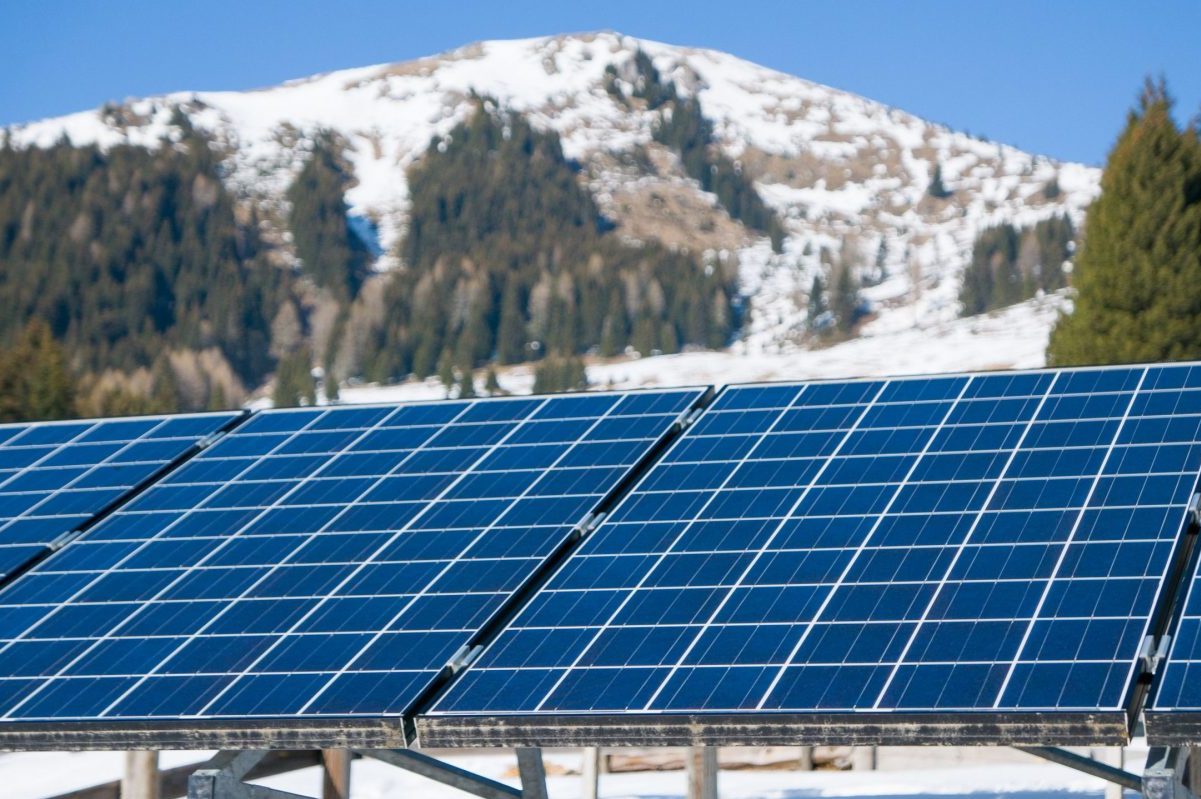
DIY Solar Air Conditioning Systems: How to Make a Solar Air Heater

Solar hot air collectors (AKA solar heating systems for homes that use passive solar heating) can directly heat individual rooms or can potentially pre-heat the air passing into a heat recovery ventilator or through the air coil of an air-source heat pump. Air collectors produce heat earlier and later in the day than liquid systems, so they may produce more usable energy over a heating season than a liquid system of the same size.

Also, unlike liquid systems, air systems do not freeze, and minor leaks in the collector or distribution ducts will not cause significant problems, although they will degrade performance. However, air is a less efficient heat transfer medium than liquid, so solar air heater collectors operate at lower efficiencies than solar liquid collectors. Solar air collectors are often integrated into walls or roofs to hide their appearance.

Room Air Heaters

Air collectors can be installed on a roof or an exterior (south facing) wall for heating one or more rooms. Although factory-built collectors for on-site installation are available, do-it-yourselfers may choose to build and install their own air collector. A simple window air heater collector can be made for a few hundred dollars.
solar air heater

The collector has an airtight and insulated metal frame and a black metal plate for absorbing heat with glazing in front of it. Solar radiation heats the plate that, in turn, heats the air in the collector. An electrically powered fan or blower pulls air from the room through the collector, and blows it back into the room.

Roof-mounted collectors require ducts to carry air between the room and the collector. Wall-mounted collectors are placed directly on a south-facing wall, and holes are cut through the wall for the collector air inlet and outlets.

Simple “window box collectors” fit in an existing window opening. They can be active (using a fan) or passive. In passive types, air enters the bottom of the collector, rises as it is heated, and enters the room.

A baffle or damper keeps the room air from flowing back into the panel (reverse thermosiphoning) when the sun is not shining. These systems only provide a small amount of heat, since the collector area is relatively small.

Transpired Air Collectors

Transpired air collectors use a simple technology to capture the sun’s heat to warm buildings: The collectors consist of dark, perforated metal plates installed over a building’s south-facing wall. An air space is created between the old wall and the new facade.
The dark outer facade absorbs solar energy and rapidly heats up on sunny days—even when the outside air is cold.

A fan or blower draws ventilation air into the building through tiny holes in the collectors and up through the air space between the collectors and the south wall. The solar energy absorbed by the collectors warms the air flowing through them by as much as 40°F. Unlike other space heating technologies, transpired air collectors require no expensive glazing.

Transpired air collectors are most suitable for large buildings with high ventilation loads, a fact which makes them generally unsuitable for today’s tightly sealed homes. However, small transpired air collectors could be used to pre-heat the air passing into a heat recovery ventilator or could warm the air coil on an air source heat pump, improving its efficiency and comfort level on cold days. However, no information is currently available on the cost effectiveness of using a transpired air collector in this way.
solar air heater system

DIY: Building a Solar Space Heater

This type of solar space heater works by drawing the air to be heated into the bottom can of a column of cans. The air is then heated inside the cans by the sun’s energy and the hot air within them rises upwards (thanks to convection) to be fed into a pipe which re-enters the building to be heated.

1° Building the Box – First of all make a box out of whatever scrap materials you have to hand. Set the dimensions to that the width of the interior of the box is exactly the same as the width of however many columns of cans you would like to use in your heater.

For increased efficiency, you may choose to insulate the box to prevent heat escaping (by conduction) through the plywood. If so, size your box so that the cans and insulation will fit snuggly.

2° Drilling the Cans – For the air to pass through a column of cans, holes must be drilled into them. Remember that there is already a hole at the top of each can out of which the drink is poured. That just leaves holes at the bottom of each can to be drilled.

In the bottom can of each column a 1/2 to 1 inch hole is drilled in the side. (see image below) – Drill a hole in the side of the bottom can of each column – The rest of the cans in the column have a similiarly sized hole drilled into the bottom. See image below)

3° Building the Can Columns and Painting – Then the cans of each column are glued together using caulk or silicon adhesive and painted using black paint to help them absorb the sun’s energy. Barbecue or fireplace/stove paint is excellent for this as it will not flake off, but any marine grade paint will do a similar job – just make sure it has a totally matt finish.

The inside of the box must also be painted with the same paint before the columns of cans are glued into position using caulk or silicon adhesive. The outside of the box should be treated with preservative, varnish, or paint to help it survive the elements for many years.

4° Sealing the Solar Heating Box – Ideally the whole unit will be sealed with a sheet of tempered glass – of the type used in car windscreens. This glass is very strong and resilient to heat. However, tempered glass (unless you can find and recycle a sheet) is also very expensive. Therefore plexi-glass (plastic) can be used, but it will degrade far more quickly and become opaque blocking out the sunlight.

A hole at the top of the box acts as the hot air outlet and can be connected to the building/room to be heated using an insulated pipe.

5° A PV Electric Solar Panel could be used to power a small fan (such as that used to cool the processor in a computer) to drive air through the snake. The final temperature achieved would be lower, but having a large quantity of 30 degree Celcius air entering a room is much better than a much smaller quantity of 50 degree Celcius air.

Photo Source:
http://sustainabledesignupdate.com
http://www.reuk.co.uk

{ 24 comments… read them below or add one }

thermal doc January 20, 2009 at 4:33 pm

I was looking for an alternative to building a heavy system that would require many helping hands. I found this Company in Boston that manufactures a Solar air heater system that is a modular array. You purchase a left and right starter kit and add as many inners to complete your required heat output….www.solarairsystems.com

admin January 21, 2009 at 6:13 am

Thank You for the comment. Had a look to the website You suggested and liked this:
http://www.solarairsystems.com/images/Solar%20Air%20Heater%20O.jpg

Nearly 500 $ is too much for me…better a DIY air heater ;-)

thermal doc January 21, 2009 at 7:01 am

I paid $995.95 for 4 of the Model 1536 and installed them Thanksgiving weekend. By my calculation they produce 3,775 BTU’s. Nice and cozy…. Free heat! Beats my propane bill.

admin January 22, 2009 at 7:41 am

Yes Sure, You’ll payback soon! But I continue to prefer the DIY option…solar air heaters are so easy to make that I want to have the pleasure to solar heat my rooms by my own work. :-)

Tom August 23, 2009 at 6:24 pm

I have a question: which would be more energy efficient: building a solar space heater as described above, or using solar panels to provide electricity to power a conventional space heater? I know electric space heaters use a lot of power, so I’m guessing that a solar space heater would be more efficient. Your thoughts?

Thanks,

Tom

admin August 23, 2009 at 8:31 pm

I suggest You a solar air heater.

If You have a solar heating panel for hot water you can use it to create a hot water circuit into the walls to heat rooms.

Hope it helps

Ricardo February 24, 2010 at 3:03 am

Nice project. I diddn’t understand why adding the hole in the side of each column? What effect? Cheers.

Cesar Lopez February 28, 2010 at 8:44 pm

how long will it last after sundown?
Regards,

admin February 28, 2010 at 9:21 pm

It depends….but consider an average of 1 hour.

Ricardo March 1, 2010 at 3:06 am

“In the bottom can of each column a 1/2 to 1 inch hole is drilled in the side. (see image below) – Drill a hole in the side of the bottom can of each column – The rest of the cans in the column have a similiarly sized hole drilled into the bottom. See image below)”

I can’t understand what’s the pretended effect of this.. Also, I neither can’t see any “image below” where this is covered.

Can you please explain better? Thanks.

admin March 1, 2010 at 12:20 pm

I mean see the video below sorry.

Please would you suggest me a better way to explain this?

Thank you

Ricardo March 2, 2010 at 1:04 am

Hi.Thank you for your answer.

I’ve seen the video several times, and I really don’t get what you mean by ” hole in the side of the bottom can of each column”..

From whay I’ve seen in several passive air heaters, the air should enter at the bottom and after being heated get out on the top.

You also mention “to drive air through the snake”, what make me wonder if you have the cans connected from side to side.
If so, how do you did this connection?

Regards

admin March 2, 2010 at 10:22 am

Thank you I’ll take a note.

Warm regards

Ricardo March 3, 2010 at 12:59 am

Hi.
What you mean by “take a note”?
Can you please explain me better/answer my questions?

I really would like to know.

Regards

freeheat March 14, 2010 at 5:32 pm

Hey all..you guys can see some awsome solar air heater build example using the solar air heater profiles from solarwindowheaters.com. I purchased 30 profiles 44.5 inches long and built my own 4 foot by 8 foot solar air heater. You can see pictures of my unit on thier Blog center. It was well worth the cost and they are real good people when it comes to technical support. Anyway, I’m happy and warm!

freeheat March 14, 2010 at 5:34 pm

FYI-the guy who owns solarwindowheaters.com is the inventor and holds 2 U.S. patents on solar air heaters. His other site was mentioned above in another post solarairsystems.com.

mark March 19, 2010 at 8:22 pm

Hay im just wondering if other items can be used to replace the cans like pipe (copper)
2 or 3 inch in some simmilar application of same length with bigger fan set on a temperature on/off thermostat switch all items in the box painted as shown in your box.?

arthur April 14, 2010 at 5:11 am

i’m gonna use this for my seinor project. If you have additional information send me an
email at Silicone_bob_17@yahoo.com

SolarLad June 4, 2010 at 1:59 pm

Great use of solar power for heating. It could be especially effective if coupled with passive solar design.

More info on passive solar can be found here:
http://www.solarpowerbeginner.com/passive-solar-energy.html

Mr. Flashlite July 9, 2011 at 1:18 pm

i wonder if you could you use aluminum gutter downspouts painted flat black. maybe insert some baffles to slow the airflow. just been thinking about trying to build a shop/shed that was heated with passive solar panels so i could work out there in the winter during the day without having to build a fire or burn propane.

Damir Reves Sabo September 15, 2011 at 4:50 am

What about summer? If you build a solar space heater, implement it on your house and it helps you in winter, but what when summer kicks in? How to prevent hot air coming in room? Could this system be used for cooling in hot summer days?
Thanks in advance!
Damir

Pat B November 2, 2011 at 2:28 pm

Hi everyone,

I recently completed a solar hot air panel that’s kicking out 130 degrees when the sun is on it…
I have it setup with a Snap Disk controller so Fan comes on automatically at 113 degrees and shuts off when the temp drops down to 90 degrees.

I built it out of pressure treated 2×4 frame / size is 4ft x 8 ft
I put 1/2 inch styrofoam with foil both sides on the inside of the box and on the inner sides of the box then covered the top with that rippled roof plastic you can purchase at Lowe’s or home depot. I have 2 4 inch tubes for supply and return. I also installed 2 baffles inside to force the air to move slower from one end to the other so it would heat up better.

My conclusion is that if you build one of these go with a 6 inch duct booster fan rather than a 4 inch booster fan. The 4 inch just wasn’t powerful enough to extract all of the heat out of the unit.
The 6 inch fan actually never shuts off either until the sun goes down so I might try changing it out with a 8 inch fan… but man what a heater this thing has proven to be.
Heavy as heck, but works super. I’m building a much lighter design one now.

I’m making the frame on the new one with steel commercial studs that they use in the commercial buildings instead of 2 x 4 wood studs. This new unit I’m using 2 x 6 metal studs. I purchased 2 10 footers and cut each one 2 ft from the end then folded them in to create a box 2 ft x 8 ft in size however because of the depth is deeper on this new metal box the sq footage volume of air will be almost as much as a 2 x4 pressure treated wood heater 4 x 8 ft in size..

I attached the clear plastic roofing material today for the sheathing and got it almost wired up for a test run tomorrow afternoon.

Write to my email anytime if you have any questions.

I purchased the snap disk controllers on Ebay
Purchased the 2 x 6 metal studs from a local commercial building supply store.

I forgot to mention I inserted aluminum flashing in the metal box first.. then 2 inch styrofoam insulation board, then more 2 ft wide flashing on top….// painted it flat back high heat paint and away ya go!

Pat B November 3, 2011 at 3:41 am

…forgot to enter my email. It’s web401@cox.net if anyone needs to reach me.

Thanks, and good luck with your self made hot air heating box ventures.

JERRY March 11, 2012 at 2:59 am

BUILT WINDOW BOX INSIDE WINDOW 55 CANS INSULATED BOX,4 INCH FAN,PLEXI COVER,ALLMOST DONE BUT WILL IT WORK??

Leave a Comment

{ 2 trackbacks }

Previous post:

Next post: