Going solar is one of the smartest investments you can make for your home and wallet, but the contract you sign determines whether you’ll enjoy decades of savings or face unexpected costs and limitations. Most homeowners feel overwhelmed when faced with dense legal documents filled with unfamiliar terms, payment structures, and long-term commitments. The good news? Solar contracts aren’t as complicated as they seem once you understand the three main types and know what red flags to watch for.
Whether you’re considering a purchase agreement, lease, or power purchase agreement, each contract type affects your savings, home value, and flexibility differently. The right choice depends on your financial goals, how long you plan to stay in your home, and your appetite for upfront costs versus monthly payments. This guide breaks down everything you need to know in plain language, from understanding ownership rights to spotting unfavorable clauses that could cost you thousands. You’ll learn exactly what questions to ask installers, which contract terms are negotiable, and how to ensure you’re getting a fair deal that delivers the financial and environmental benefits you’re seeking.
Why Solar Contracts Deserve Your Full Attention
Deciding to go solar isn’t like choosing a new appliance or even buying a car. When you sign a solar contract, you’re making a commitment that typically lasts 20 to 25 years, which is about as long as a mortgage. During that time, your solar system will be quietly working on your roof, generating clean energy and reducing your electricity bills. But here’s the thing: the financial benefits you’ve been promised only materialize if your contract is fair and transparent from the start.
Think about it. Over two decades, a lot can change in your life. You might renovate your home, decide to sell, or simply want to understand your monthly payments as they evolve. A solar contract that seems straightforward today could contain clauses that catch you off guard years down the road, like escalating lease payments, complicated buyout terms, or maintenance responsibilities you didn’t fully grasp.
The good news? Taking a few extra hours to thoroughly review your solar contract before signing protects you from unwelcome surprises and ensures those promised savings actually show up in your bank account. You’re not just signing paperwork; you’re setting the foundation for decades of energy independence and financial benefits. Understanding what you’re committing to means you can move forward with confidence, knowing your solar investment will deliver exactly what you expect.

The Three Types of Solar Contracts Homeowners Encounter
Cash Purchase Agreements
A cash purchase agreement is the most straightforward path to solar ownership. You pay the full system cost upfront, and the panels are yours from day one—no monthly payments, no interest charges, just immediate ownership. This contract typically includes the solar panels, inverter, mounting equipment, installation labor, permits, and often a 25-year performance warranty on the panels themselves.
The beauty of paying cash is simplicity. Once installed, you start saving on your electricity bills immediately, and you’ll capture the full value of any federal tax credits (currently 30% of your system cost) and local incentives. Over time, most homeowners recover their investment in 6-10 years through energy savings, then enjoy free electricity for decades.
This option works best if you have available funds and want maximum long-term returns without dealing with loan interest or lease complications. You’ll also increase your home’s value while maintaining complete control over your system. If you’re comfortable with the upfront investment and plan to stay in your home for several years, cash purchasing typically delivers the highest lifetime savings and the quickest path to energy independence.
Solar Loan Agreements
With a solar loan, you own your system from day one while spreading payments over time—typically 10 to 25 years. This arrangement gives you immediate access to all ownership benefits, including tax credits, increased home value, and any available rebates. Unlike leases, you’re building equity with every payment.
When reviewing solar financing options, pay close attention to the interest rate, loan term, and any prepayment penalties. Lower interest rates mean more savings over time, though longer terms reduce monthly payments. Some lenders offer zero interest solar loans for qualified homeowners, which maximize your financial benefit.
Watch for dealer fees hidden in the loan amount—these can inflate your total cost by 10-20%. Ask for a breakdown showing the actual system price versus financed amount. Also clarify whether your monthly payment includes any fees beyond principal and interest.
The good news? Once your loan is paid off, you enjoy decades of free electricity. Many homeowners find their energy savings cover monthly loan payments, making solar cash-flow positive from the start. Just ensure the terms align with your financial goals and timeline.
Solar Leases and Power Purchase Agreements (PPAs)
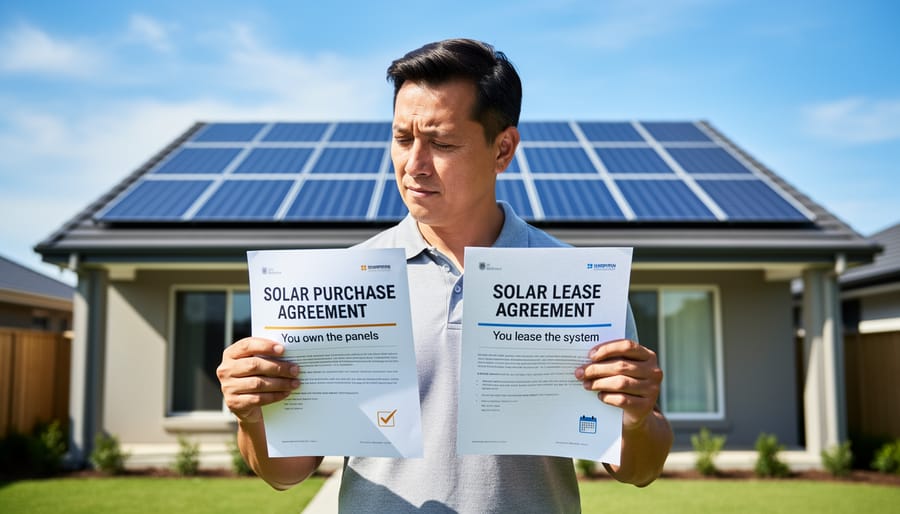
Not ready to buy solar panels outright? Solar leases and Power Purchase Agreements (PPAs) let you go solar with little to no upfront costs. Here’s the key difference: with a lease, you pay a fixed monthly fee to use the panels on your roof, while with a PPA, you only pay for the actual electricity the system produces at a predetermined rate.
Both options mean a solar company owns and maintains the equipment, which sounds appealing. However, there’s an important catch many homeowners miss—escalation clauses. These provisions allow your monthly payment (lease) or electricity rate (PPA) to increase annually, typically by 1-3%. Over a 20-year contract, this can significantly reduce your expected savings.
The biggest trade-off? You won’t qualify for federal tax credits or increased home value since you don’t own the system. Selling your home can also become complicated, as the new owner must agree to assume the contract or you’ll need to buy it out.
These agreements work best if you want predictable costs without maintenance responsibilities and plan to stay in your home long-term. Just make sure you understand the total cost over the contract’s lifetime, not just the attractive introductory rate.
Critical Elements Every Solar Contract Should Include
System Specifications and Performance Guarantees
Your solar contract should clearly spell out the specific equipment being installed and what you can expect it to deliver. Think of this as the blueprint for your solar investment.
First, look for detailed information about your solar panels themselves. The contract should list the manufacturer, model number, wattage rating, and efficiency percentage of each panel. This isn’t just paperwork—it’s your assurance that you’re getting quality equipment. Reputable manufacturers typically offer 25-year warranties on their panels, so make sure that’s documented too.
Your inverter is equally important since it converts the sun’s energy into electricity you can actually use in your home. The contract should specify whether you’re getting a single central inverter or individual microinverters for each panel, along with brand names and warranty coverage.
Here’s where it gets exciting: the expected energy production. Your installer should provide an estimate of how many kilowatt-hours your system will generate annually based on your location, roof orientation, and local weather patterns. This number helps you understand your potential savings.
Finally, insist on performance guarantees. Many quality contracts include production guarantees stating that if your system underperforms by a certain percentage, the company will make it right. This protection ensures your investment delivers the benefits you’re counting on.
Installation Timeline and Completion Terms
A clear installation timeline protects you from unnecessary stress and financial uncertainty. Your contract should specify a start date and a realistic completion window—typically 1-3 months for most residential projects, depending on local permitting and utility approval processes.
Minor delays happen and are often reasonable. Weather, equipment shortages, or permit processing times can push schedules back by a few weeks. What matters is that your contract outlines how you’ll be notified of delays and whether you’re entitled to compensation if the company misses deadlines significantly.
Look for contracts that specify consequences for extended delays beyond the contractor’s control versus delays caused by poor planning. Some agreements include penalty clauses that reduce your final cost if installation drags on unreasonably. Understanding the full solar installation process helps set realistic expectations.
If your contract lacks timeline details or consequences for missed deadlines, request these additions in writing. You deserve assurance that your investment will be completed promptly, allowing you to start enjoying those energy savings sooner rather than later.
Warranty Coverage Details
Your solar contract should clearly spell out warranty coverage to protect your investment for decades to come. Think of warranties as your safety net—they ensure your system performs as promised and gets fixed if something goes wrong.
Most solar installations come with three distinct warranties that should be explicitly detailed in your contract. Equipment warranties cover the panels themselves, typically for 25 years, guaranteeing they’ll maintain a certain power output level. Inverter warranties usually run 10-15 years and protect the equipment that converts solar energy into usable electricity for your home. Installation workmanship warranties, provided by your installer, cover labor and proper installation for anywhere from 5-25 years.
Your contract needs to specify who handles warranty claims—whether you contact the installer, the manufacturer, or both. This matters because you don’t want to play phone tag between companies when an issue arises. Look for clear language about response times and whether repairs include labor costs or just parts replacement.
The best contracts also outline what voids the warranty, such as unauthorized modifications or failure to perform routine maintenance. Understanding these responsibilities upfront prevents unpleasant surprises down the road and ensures your system stays protected throughout its lifetime.
Maintenance and Monitoring Responsibilities
Understanding who’s responsible for keeping your solar system running smoothly is essential before signing any contract. Most solar agreements clearly spell out maintenance duties, but the specifics vary significantly between purchase, lease, and PPA arrangements.
If you purchase your system outright, you’re responsible for system maintenance, though the good news is solar panels require minimal upkeep. Most manufacturers provide warranties covering equipment failures for 20-25 years. Basic tasks like occasional cleaning and visual inspections typically fall to homeowners.
With leases and PPAs, the solar company usually handles all maintenance and repairs at no extra cost to you. They’ll monitor system performance remotely and dispatch technicians if issues arise. Many providers include real-time monitoring apps so you can track your energy production.
Regardless of contract type, expect some basic homeowner obligations like keeping panels clear of debris and reporting any obvious damage promptly. Review exactly what monitoring services are included and whether there are response time guarantees for repairs.
Red Flags That Should Make You Pause
Vague Language and Missing Details
Watch out for contracts that use phrases like “estimated savings” without backing them up with specific calculations based on your home’s energy usage. Some contracts promise “premium equipment” without naming brands or model numbers, leaving you vulnerable to receiving subpar products. Vague timelines such as “installation within a reasonable timeframe” offer no real accountability—you deserve concrete dates.
Language around maintenance responsibilities can be particularly murky. If your contract says the company will handle “major repairs” without defining what qualifies as major versus minor, you could face unexpected costs down the road. Similarly, clauses about “system performance guarantees” mean little without specific kilowatt-hour production numbers tied to your system’s capacity.
The good news? Reputable solar companies provide crystal-clear contracts because they want you to feel confident. Insist on specific numbers, named equipment brands, exact dates, and detailed explanations of every fee. If something feels vague, ask for clarification in writing before signing. Specificity protects your investment and ensures your solar journey delivers the financial benefits you’re counting on.
Excessive Escalation Clauses
Some solar leases and power purchase agreements include escalation clauses that increase your payments each year, often between 2-5%. While a small annual increase might sound reasonable, these compounding costs can quickly eat into your savings, especially since electricity rates don’t always rise as predicted. A 3.9% annual escalator over 20 years means you’ll pay nearly double what you started with by the end of your contract.
The good news? You can negotiate these terms. Reasonable escalation typically stays at or below 2%, matching historical utility rate increases in most areas. Better yet, some providers offer fixed-rate agreements with no escalation at all, giving you predictable payments and guaranteed savings throughout your contract. Before signing, calculate your total payment over the full term with the escalator factored in, and compare it against your projected utility costs to ensure you’re actually saving money long-term.
Unrealistic Production Promises
Be cautious of contractors who promise your solar system will generate significantly more energy than independent calculators suggest. Reputable installers base estimates on your roof’s actual sun exposure, angle, shading, and local weather patterns. If someone guarantees you’ll eliminate your electric bill entirely without thoroughly assessing these factors, that’s a red flag. Ask for production estimates in writing and compare them with online solar calculators using your address. The best contractors provide conservative projections because real-world conditions like cloudy days, dust buildup, and seasonal changes affect output. Under-promising and over-delivering protects you from disappointment and ensures your financial calculations are based on realistic savings. Remember, a system that meets 80-90% of your energy needs is still a fantastic investment that pays dividends for decades. Quality installers want you delighted with actual results, not disillusioned by inflated promises.
Smart Questions to Ask Before You Sign
Taking control of your solar journey means getting clear answers upfront. Before signing any contract, request written responses to these essential questions—they’ll protect your investment and peace of mind.
Start with the money questions. What is the total cost, and exactly what does that include? If you’re financing, what’s the interest rate and total amount you’ll pay over the loan term? For leases or PPAs, what’s the price per kilowatt-hour, and how much will it increase each year? Understanding these numbers helps you calculate your real savings.
Next, dig into the details about your system. What’s the expected energy production in year one, and what happens if it falls short? How long will installation take from contract signing to system activation? What equipment brands are being used, and do you have any say in those choices?
Protection matters, so ask about warranties. Who covers what—panels, inverters, installation workmanship? What’s covered under each warranty, and for how many years? If the company goes out of business, are warranties still valid?
Don’t forget about the installer credentials and their track record. Are they licensed and insured? How many installations have they completed? Can they provide local references?
Finally, clarify the exit strategy. Can you cancel, and within what timeframe? If you sell your home, what happens to the contract? Are there any fees for early termination or transfer?
Getting these answers in writing isn’t pushy—it’s smart. Reputable solar companies expect these questions and will gladly provide clear documentation. If anyone hesitates or rushes you past these details, that’s your signal to keep shopping.
How Your Contract Affects Selling Your Home
Planning to sell your home shouldn’t keep you from going solar today. The good news is that solar systems can actually increase your property value, but how smoothly the process goes depends largely on your contract type.
If you own your system outright through a cash purchase, selling is straightforward. The solar panels stay with the house and typically add to its market value, just like an upgraded kitchen or new roof. Most buyers appreciate the energy savings they’ll inherit, making your home more attractive.
Financed systems with solar loans work similarly. You can either pay off the loan before selling or transfer it to the buyer if your lender allows. Many homeowners choose to pay it off using their home sale proceeds, delivering a paid-off system to the new owner.
Leases and power purchase agreements require the buyer to assume your contract or you to buy it out. This is where advance planning matters. Most solar companies have established transfer processes, but you’ll want to discuss this possibility upfront and understand the steps involved. The best approach is choosing a reputable solar provider with a solid track record of smooth contract transfers.
Before signing any solar contract, ask directly about the transfer process and get it in writing. Request information about transfer fees, requirements, and timelines. Real estate agents familiar with solar homes report that clear documentation and choosing well-known solar companies makes the transition seamless for both parties.

What Happens If Things Go Wrong
Even with the best planning, occasional issues can arise—and that’s completely normal. The good news? Quality solar contracts include clear processes for resolving problems, giving you peace of mind from day one.
Most reputable solar companies include dispute resolution clauses that outline step-by-step procedures for addressing concerns. These typically start with direct communication with your installer, escalating to mediation if needed, and only rarely proceeding to arbitration. Look for contracts that specify reasonable response times (usually 24-48 hours for urgent issues) and clearly define what qualifies as a warranty claim versus routine maintenance.
Well-written contracts also include performance guarantees, meaning if your system underperforms, the installer has a responsibility to make it right. This might involve system adjustments, panel replacements, or financial compensation. Many contracts also specify insurance requirements, ensuring the company maintains proper coverage to protect your investment.
Your realistic expectation should be this: minor issues like monitoring system glitches typically get resolved within days, while larger concerns like panel replacements might take a few weeks depending on parts availability. The key is having everything documented in writing.
If disputes can’t be resolved directly, many states offer solar consumer protection resources or renewable energy ombudsmen who can assist. Remember, established solar companies value their reputation and genuinely want satisfied customers. Problems are opportunities for them to demonstrate their commitment to your satisfaction. With clear contract language protecting you, most issues become manageable inconveniences rather than major headaches.
Understanding your solar contract isn’t just about protecting yourself—it’s about empowering yourself to make a smart investment in your home and the environment. The good news? Reputable solar companies actually prefer working with informed customers. When you ask thoughtful questions and take time to review the details, it shows you’re a serious buyer who values quality and transparency. Companies with nothing to hide will happily walk you through every clause and answer your concerns.
Take your time reviewing any agreement before signing. There’s no rush, despite what high-pressure sales tactics might suggest. Read the fine print, compare offers from multiple installers, and don’t hesitate to have a trusted friend or advisor review the contract with you. Remember, this is a long-term commitment that should work in your favor for decades to come.
Armed with the knowledge of what to look for and which red flags to avoid, you’re now ready to confidently explore solar options for your home. The journey to clean, affordable energy starts with understanding exactly what you’re signing up for—and you’ve already taken that crucial first step.