
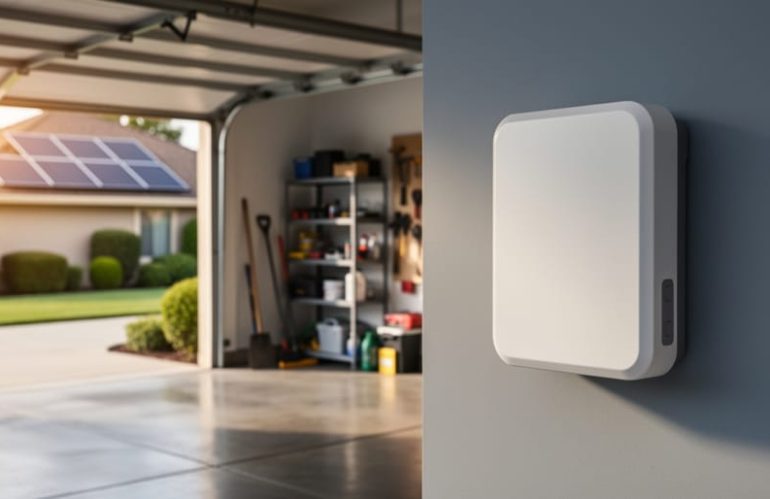
Check your state’s database of solar and battery incentives before making any purchase decision—most homeowners leave thousands of dollars unclaimed simply because they don’t know these programs exist. The federal Investment Tax Credit currently covers 30% of your battery system costs through 2032, effectively reducing a $15,000 installation to $10,500 overnight.
Green energy policies have transformed home battery storage from a luxury into a financially sensible investment for millions of American households. What once seemed like futuristic technology reserved for early adopters now comes with government backing that makes the math work in your favor. These aren’t abstract environmental initiatives—they’re concrete financial tools designed to put money back in your pocket while reducing your carbon footprint.
The landscape of incentives extends far beyond federal tax credits. Net metering policies let you sell excess solar energy back to the grid at retail rates in many states. Time-of-use rate programs reward you for using stored battery power during expensive peak hours instead of grid electricity. Local utility rebates can add another $1,000 to $3,000 to your savings, stacking on top of federal benefits.
Understanding which policies apply to your specific situation determines whether battery storage pays for itself in five years or fifteen. The difference between a smart investment and an expensive mistake often comes down to knowing which incentives you qualify for and how to claim them correctly. Recent policy changes have created a limited window where the financial benefits align perfectly for homeowners ready to act now.
The Policy Shift That Changed Everything for Homeowners
Federal Tax Credits: Your Direct Savings Explained
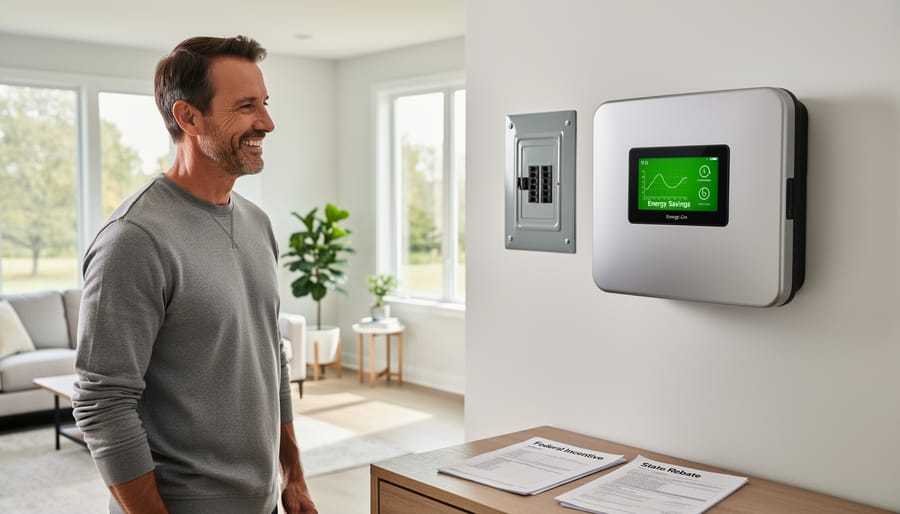
The Investment Tax Credit (ITC) is one of the most powerful financial incentives available to homeowners who install battery storage systems. Here’s the good news: as of 2023, the ITC now covers a full 30% of your total installation costs, and this applies to standalone battery systems, not just those paired with solar panels.
Let’s break this down with real numbers. Say you’re installing a solar panel backup battery system that costs $15,000. The ITC gives you a $4,500 credit directly off your federal taxes. That’s not a deduction that reduces your taxable income—it’s an actual dollar-for-dollar reduction in what you owe the IRS. Your effective cost drops to $10,500 right away.
Even better, there’s no cap on the credit amount. Whether your system costs $10,000 or $30,000, you’ll receive 30% back. The credit remains at this level through 2032, then steps down to 26% in 2033 and 22% in 2034.
To qualify, you simply need to own your home and have enough tax liability to claim the credit. If your credit exceeds what you owe in taxes for one year, you can roll the remaining amount forward to future tax years. This means virtually every homeowner can take full advantage of these savings.
State and Local Incentives Stacking Up in Your Favor
Federal tax credits are just the beginning. Many states and local utilities offer their own rebates and programs that you can combine with federal benefits, creating savings opportunities that can cover 50% or more of your battery storage investment.
Here’s how stacking works: Let’s say you’re installing a $15,000 battery system. The 30% federal tax credit gives you $4,500 back. But if your state offers an additional $2,000 rebate and your utility provides a $1,000 incentive for participating in their grid services program, you’ve now reduced your cost by $7,500—that’s half your investment.
California’s SGIP program, for example, has offered rebates exceeding $3,000 per system. New York’s Reforming the Energy Vision initiative provides substantial storage incentives. Colorado, Massachusetts, and Maryland all have active programs with varying benefit levels.
The key is timing. Many state programs operate on a first-come, first-served basis with annual funding caps. Check your state energy office website and contact your utility provider to discover what’s available in your area. These programs change frequently, and new ones launch regularly as states expand their clean energy commitments. Acting sooner rather than later ensures you don’t miss out on limited-time opportunities.
Why Batteries Are Becoming a Smart Investment (Not Just an Environmental Choice)

The Real Math Behind Battery Payback Periods
Let’s break down the numbers in plain English. Just five years ago, a typical home battery system might take 15-20 years to pay for itself—longer than many warranties lasted. Today, thanks to updated green energy policies, that timeline has shrunk dramatically.
Here’s a real-world example: A standard 10 kWh battery system costs around $10,000 before incentives. The federal Investment Tax Credit now covers 30% of that cost, bringing your actual expense down to $7,000. Many states add their own rebates—California’s SGIP program, for instance, can contribute another $2,000-$3,000.
Now factor in your savings. If you’re paying peak electricity rates of $0.40 per kWh and store energy during off-peak hours at $0.15 per kWh, you save $0.25 per kWh cycled through your battery. With one daily cycle, that’s about $900 annually. Add backup power value during outages (worth roughly $300-$500 per year to most homeowners), and you’re looking at $1,200-$1,400 in annual benefits.
Do the battery payback calculations: $4,000-$5,000 net cost divided by $1,200-$1,400 yearly savings equals a 3-4 year payback period. That’s a complete transformation from the old economics, making batteries a genuinely smart financial move for average homeowners rather than just an environmental luxury.
Protection from Grid Instability and Rising Rates
Battery storage systems offer something most homeowners overlook: financial protection against unpredictable utility costs. Electricity rates have historically increased faster than inflation, with many regions seeing annual jumps of 3-5% or more. When you store solar energy in batteries, you’re essentially locking in today’s energy prices for tomorrow’s use, insulating yourself from these inevitable rate hikes.
Beyond cost protection, batteries provide genuine energy security during grid outages. When storms or infrastructure failures knock out power, homes with battery backup maintain essential functions like refrigeration, heating, cooling, and internet connectivity. This isn’t just convenience; it’s peace of mind knowing your family stays safe and comfortable regardless of external circumstances.
The financial logic is straightforward: utilities charge premium rates during peak demand hours when everyone’s consuming electricity simultaneously. Battery systems automatically draw from stored energy during these expensive windows, helping you avoid the highest charges. In states with time-of-use rates, this strategy can reduce electricity bills by 20-40% annually.
Think of battery storage as an insurance policy that actually pays you back. While traditional insurance protects against unlikely disasters, battery systems deliver daily value through lower bills while simultaneously guarding against rate increases and outages. As green energy policies expand and grids face increasing strain from extreme weather events, this dual protection becomes more valuable every year. You’re not just saving money; you’re gaining independence from an aging infrastructure and volatile pricing structure.
How Net Metering Changes Are Accelerating Battery Adoption
What Net Metering Changes Mean for Your Energy Bills
Net metering once made solar panels a no-brainer investment. Homeowners generated excess electricity during sunny days, sent it back to the grid, and received full retail credit on their bills. But many utilities are changing the rules, and understanding these shifts is crucial for your wallet.
Across the country, utilities are reducing compensation for solar energy you sell back to the grid, sometimes by 50% or more. Instead of getting credited the full retail rate (what you normally pay per kilowatt-hour), you might only receive the wholesale rate, which is significantly lower. This means the electricity your panels produce becomes less valuable when exported.
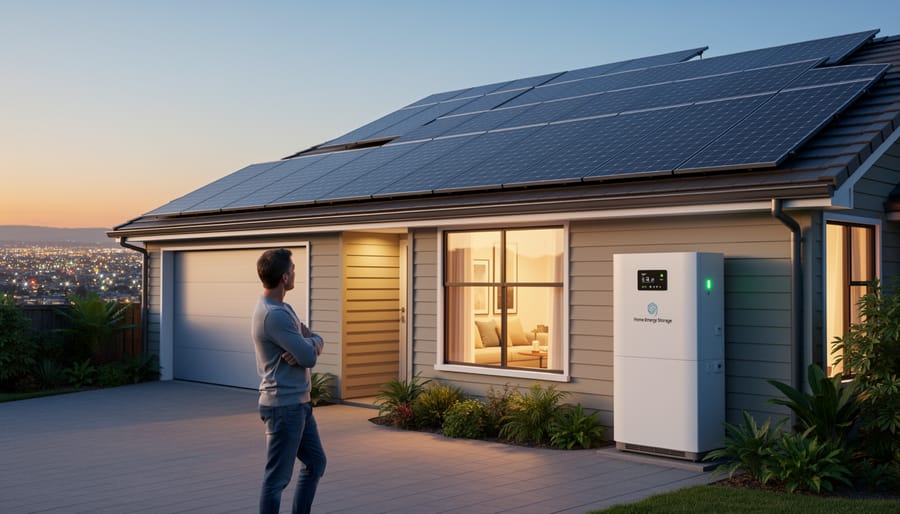
Here’s the good news: this policy shift actually strengthens the case for battery storage. When you store your excess solar energy instead of selling it back, you use that power during expensive evening hours when electricity rates peak. You’re essentially paying yourself the full retail rate rather than accepting the utility’s reduced buyback price.
Think of it this way: would you rather sell your homegrown tomatoes for pennies or keep them for dinner? The same logic applies to your solar energy. With batteries, you maximize the value of every ray of sunshine your panels capture, insulating yourself from both reduced net metering credits and rising electricity costs.
Batteries as the New Solar Companion
Just as solar panels transformed how homeowners think about electricity generation, batteries are now emerging as the essential next step in home energy independence. Recent policy shifts have fundamentally changed the economics of battery storage, making it a smart pairing with solar rather than an expensive add-on. New tax credits and rebates now cover a significant portion of battery costs when installed alongside solar panels, with some states offering additional incentives that can reduce your upfront investment by thousands of dollars. These solar battery storage systems allow you to store excess energy generated during sunny days and use it during evening peak hours or power outages, maximizing your solar investment. Time-of-use electricity rates in many areas also mean batteries help you avoid expensive peak pricing by drawing from stored energy instead of the grid. The result is a complete home energy solution that delivers greater savings, reliability, and environmental impact than solar panels alone.
Debunking the Battery Myths That Keep Homeowners Waiting
“Batteries Are Too Expensive” – Not Anymore
The upfront price tag used to be the biggest barrier to home battery adoption, but smart policies have changed the game. Thanks to federal tax credits, state rebates, and utility incentives, what you actually pay is often 30-50% less than the sticker price. The federal Investment Tax Credit alone covers 30% of your battery system costs through 2032, making this one of the best times to invest.
Many states sweeten the deal even further. California’s SGIP program can knock off thousands more, while Massachusetts offers additional performance incentives. Some utilities even pay you to install batteries through demand response programs, turning your system into a money-maker during peak hours.
When you factor in these incentives alongside energy bill savings and protection from rising electricity rates, the payback period has shrunk dramatically. Most homeowners now break even within 7-10 years, and batteries last 10-15 years or longer. The current battery costs, combined with available incentives, make this technology more accessible than ever before. The “too expensive” argument simply doesn’t hold up anymore when you look at the real numbers.
“Installation Is Complicated and Disruptive”
Good news: installing a residential battery system is far simpler than most people imagine. Thanks to recent green energy policies, the process has become significantly more standardized and homeowner-friendly. Most installations take just one to two days, with certified technicians handling everything from permitting to final inspection.
Policy-driven improvements mean installers now follow consistent protocols across different regions, reducing confusion and delays. Many utility companies have streamlined their interconnection processes, and digital permitting systems speed up approval times that once took weeks. The standardization also means contractors are better trained and equipped, minimizing disruptions to your daily routine.
You won’t need to oversee complicated electrical work or navigate bureaucratic red tape alone. Professional installers coordinate directly with your utility company and local authorities, managing paperwork and ensuring compliance with safety standards. The result? A hassle-free experience that transforms your home’s energy system in less time than a typical kitchen renovation.
“I’ll Wait for Better Technology”
Waiting for “perfect” technology means missing out on real savings today. Current battery systems already deliver proven results, and federal tax credits cover up to 30% of installation costs through 2032. While technology will continue improving, today’s systems typically pay for themselves within 7-10 years through energy bill savings and backup power value. Meanwhile, electricity rates keep climbing—the average household pays 15% more than five years ago. Early adopters are already banking savings and gaining energy independence. Plus, current incentives won’t last forever, and some states offer additional rebates that could disappear as programs reach capacity. The best technology is the one that starts saving you money now, not the theoretical system you might install years from now. Acting today means you begin capturing financial benefits immediately while still being able to upgrade components as technology advances.
What to Do Before These Policies Change or Expire
Key Deadlines and Phase-Out Schedules
Understanding key dates helps you plan your battery storage investment with confidence. The federal Investment Tax Credit (ITC) currently offers 30% back on battery systems installed through 2032, then gradually steps down to 26% in 2033 and 22% in 2034. This generous timeline means you don’t need to rush, but acting sooner maximizes your savings over the system’s lifespan.
State and local incentives often operate on different schedules. California’s Self-Generation Incentive Program (SGIP) remains active but allocates funds on a first-come, first-served basis within annual budgets. Similarly, programs in Massachusetts, New York, and other states may adjust rates or close to new applicants as funding goals are met.
The good news? These timelines give you plenty of opportunity to research options, gather quotes, and make an informed decision. Many homeowners find that waiting a few months to choose the right system actually works in their favor, as technology improves and installer experience grows. Focus on finding the best fit for your home rather than feeling pressured by deadlines. Most incentives offer sufficient runway for thoughtful planning while still delivering substantial financial benefits.
Your First Steps Toward Battery Adoption
Ready to explore whether battery storage makes sense for your home? Here’s how to get started without feeling overwhelmed.
Begin with a simple assessment of your current energy situation. Look at your utility bills from the past year to understand your usage patterns and costs. If you already have solar panels, you’re already ahead—batteries are particularly valuable for maximizing your solar investment by storing excess power for later use.
Next, check what incentives apply to you. Visit your state energy office website or the Database of State Incentives for Renewables & Efficiency to see available rebates and tax credits. Many homeowners are surprised to discover they qualify for thousands of dollars in savings.
Schedule consultations with at least two or three local installers. Reputable companies will assess your home for free and explain your options in plain language. They’ll help you understand system sizing, costs, potential savings, and payback timelines specific to your situation.
Don’t rush your decision, but don’t wait indefinitely either. Incentives can change, and the sooner you act, the sooner you start saving.
The landscape of residential battery storage has fundamentally shifted thanks to forward-thinking green energy policies. What was once a luxury reserved for early adopters and tech enthusiasts has become an accessible, practical investment for everyday homeowners. Through federal tax credits, state incentives, and utility rebates, governments have built a bridge between environmental responsibility and personal financial benefit—proving these two goals aren’t competing priorities but complementary pathways to a better future.
Today’s homeowners stand at a unique moment in history. The combination of declining battery costs, generous incentives, and rising electricity rates means the financial case for battery storage has never been stronger. You’re no longer choosing between doing what’s right for the planet and what’s right for your wallet. Green energy policies have aligned these interests, making it possible to reduce your carbon footprint while saving thousands of dollars over your battery’s lifetime.
Looking ahead, the trajectory is clear: energy independence is becoming increasingly attainable for average households. As policies continue to evolve and technology improves, residential batteries will transition from smart investments to essential home infrastructure. The homeowners who act now aren’t just early adopters—they’re pioneers in a broader movement toward resilient, sustainable, and financially sound energy solutions. The future of home energy is here, and it’s more accessible than ever before.