Interest-free solar panel loans exist, and they could save you thousands of dollars while eliminating your electric bill. These financing programs are offered by government agencies, utility companies, and solar providers who genuinely want to accelerate clean energy adoption by removing the biggest barrier: upfront costs.
The typical homeowner spends $15,000 to $25,000 on a solar installation. With an interest-free loan, you’ll pay back only the principal amount over 5 to 20 years, while traditional solar loans at 6-8% interest can add $5,000 to $12,000 in interest charges to your total cost. That’s money that stays in your pocket instead of going to a lender.
You’re probably skeptical, and that’s smart. Interest-free doesn’t always mean completely free of costs. Some programs offset the zero-interest benefit by charging higher upfront fees or requiring you to sacrifice certain tax credits. Others are legitimately subsidized by state programs or utility companies meeting renewable energy mandates. Understanding which type you’re dealing with determines whether these loans deliver real savings or simply shift costs around.
The key question isn’t just about financing terms. It’s about if solar is worth it for your specific home, energy usage, and financial situation. Interest-free financing makes solar accessible, but the right loan structure ensures you maximize your return on investment while going green.
What Interest-Free Solar Loans Actually Are (And Why They Exist)
Yes, interest-free solar loans really do exist, and they’re not too good to be true. These are genuine financing programs where you can borrow money to install solar panels without paying any interest on your loan. Instead of the typical 5-8% APR you’d see with most solar financing, you pay back exactly what you borrowed, nothing more.
So who actually offers these deals? You’ll find 0% APR solar loans from several sources. Some electric utilities run these programs, particularly in states with aggressive clean energy goals. Solar panel manufacturers occasionally offer promotional financing to move inventory or gain market share. State and local governments create programs to help residents go solar, often funded through green energy initiatives or environmental bonds. Nonprofit organizations focused on sustainability sometimes partner with financial institutions to provide affordable solar access to their communities.
These programs exist for straightforward reasons. Governments and utilities face regulatory requirements to reduce carbon emissions and increase renewable energy adoption. Offering interest-free loans helps them meet these targets faster than waiting for market forces alone. Manufacturers benefit from increased sales volume, even if they subsidize the interest costs. For nonprofits and community organizations, these loans advance their environmental missions while helping residents save money long-term.
Typical loan terms range from 5 to 12 years, though some programs extend to 20 years. You’ll generally find loan amounts between $10,000 and $40,000, which covers most residential solar installations. The catch is that these programs usually have stricter eligibility requirements than conventional loans. You’ll typically need a credit score of at least 650, though some programs require 700 or higher. You must own your home, and some programs have income restrictions or geographic limitations.
Most interest-free solar loan programs also require you to assign your federal solar tax credit to the lender or make a lump sum payment equal to the credit amount within 12-18 months of installation. This reduces the lender’s risk and makes the 0% rate financially viable for them. Despite these requirements, these loans remain one of the most cost-effective ways to finance solar panels if you qualify.
The Real Cost Difference: Interest-Free vs. Traditional Financing
Let’s break down the real numbers to see how much you could save with an interest-free solar loan compared to other financing options. We’ll use a typical $20,000 solar panel system as our example.
With an interest-free loan paid over five years, you’d make monthly payments of approximately $333, and your total cost would be exactly $20,000. Simple as that. No surprises, no hidden costs adding up over time.
Now compare that to a traditional solar loan at 6.99% interest over the same five-year period. Your monthly payment jumps to around $400, and by the time you’ve paid off the loan, you’ll have spent about $23,960. That’s nearly $4,000 going straight to interest instead of into your pocket or back into your home.
Home equity loans or lines of credit might seem attractive at first, especially if you’re seeing rates around 8%. But here’s what that looks like: monthly payments of roughly $405 and a total cost of approximately $24,300. You’re now looking at over $4,300 in interest charges for the same solar system.
The savings become even more impressive when you factor in your reduced electricity bills. If your solar panels save you $150 monthly on energy costs, an interest-free loan means you’re actually coming out ahead by about $183 each month after making your payment. With a traditional loan, that monthly benefit drops to just $95, and with a home equity option, you’re looking at around $90.
Over five years, that difference adds up to thousands of dollars that stay in your budget rather than going to a lender. The math is straightforward: interest-free financing means every dollar you pay goes directly toward owning your solar system, making clean energy truly affordable from day one.
Where to Find Interest-Free Solar Financing in Your Area
Finding interest-free solar financing in your area requires a bit of detective work, but the rewards are worth the effort. Start with your state energy office or public utility commission website. Many states run affordable solar programs that include zero-interest financing options, especially for middle and lower-income households. California’s SASH program, New York’s Green Jobs program, and similar initiatives in Massachusetts and Connecticut have all offered interest-free terms in recent years.
Your local utility company is another excellent starting point. Call their customer service line and ask specifically about solar incentive programs and financing assistance. Some utilities partner with approved solar installers to offer promotional interest-free periods or rebates that effectively eliminate interest costs. Don’t be shy about asking multiple questions—these programs exist to encourage solar adoption, and representatives should be happy to help.
Check with solar installation companies directly. Reputable installers often have relationships with lenders offering promotional zero-interest financing, sometimes for 12 to 18 months. While you’ll need to pay off the balance before the promotional period ends to avoid interest charges, this can work well if you’re expecting a bonus, tax refund, or other windfall. Always read the fine terms carefully to understand what happens after the promotional period.
Community solar programs and local nonprofits focused on sustainability sometimes administer financing programs you won’t find advertised widely. Search for clean energy nonprofits in your county or municipality. Organizations like Grid Alternatives or regional equivalents often know about lesser-known financing options.
The Database of State Incentives for Renewables and Efficiency (DSIRE) is your best research tool. This comprehensive online resource catalogs every solar incentive program by state and locality, including financing options. Simply enter your zip code to see what’s available near you.
Finally, don’t overlook Property Assessed Clean Energy (PACE) programs. While not technically interest-free, some PACE programs offer rates so low they’re nearly equivalent, especially when you factor in tax benefits. Your county treasurer’s office can tell you if PACE financing is available locally.
Take action today by making three phone calls: one to your state energy office, one to your utility company, and one to a local solar installer. You might be surprised by what’s available.
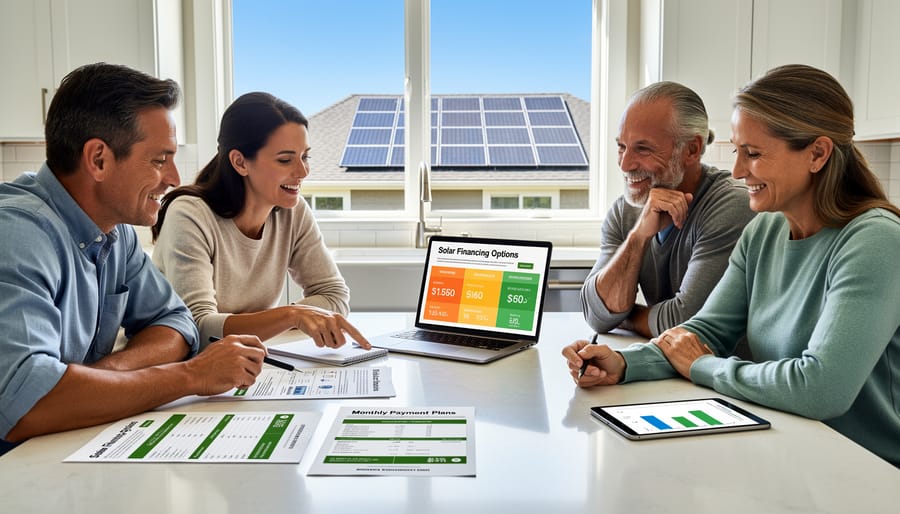
How Interest-Free Loans Stack Up With Other Solar Incentives
Interest-free solar loans work beautifully alongside other solar savings programs, creating a powerful combination that makes going solar more affordable than ever. The best part? You can typically stack multiple incentives together to maximize your savings.
The federal solar Investment Tax Credit (ITC) remains your biggest ally, covering 30% of your total solar system costs. Here’s what makes this particularly attractive with interest-free loans: you can finance your entire system upfront, then use your tax credit refund to pay down the principal. For a $20,000 system, that’s $6,000 back in your pocket at tax time.
State and local rebates add another layer of savings. Many states offer cash rebates ranging from $500 to $5,000, which you can apply directly to your loan balance. Combined with government solar incentives, you’re looking at substantial upfront cost reduction.
Net metering programs let you earn credits for excess electricity your panels send back to the grid, effectively lowering your monthly energy bills while you’re paying off your loan. This means your solar investment starts paying dividends immediately.
Solar Renewable Energy Certificates (SRECs) available in certain states provide ongoing income. You earn one SREC for every 1,000 kilowatt-hours your system produces, which you can sell for additional cash flow.
Here’s a practical example: On that $20,000 system with an interest-free loan, you’d receive $6,000 from the federal tax credit, potentially $2,000 in state rebates, and save roughly $150 monthly through net metering. Apply the tax credit and rebate to your loan, and your actual financed amount drops to $12,000 while you’re already saving on electricity.
The key is planning ahead. Know which incentives you qualify for before signing loan documents, and structure your repayment strategy to incorporate these windfalls. This stacking approach transforms solar from a long-term investment into an immediate financial win.
Common Myths About Interest-Free Solar Financing (Debunked)
When something sounds this good, it’s natural to be skeptical. Let’s clear up the most common misconceptions about interest-free solar financing so you can make an informed decision.
Myth 1: There must be hidden fees somewhere.
Not necessarily. Many legitimate interest-free programs are subsidized by utility companies, state governments, or manufacturers who want to encourage solar adoption. They’re essentially paying the interest cost to make solar accessible. That said, always read the fine print and ask about origination fees, dealer fees, or prepayment penalties. Reputable lenders will disclose all costs upfront.
Myth 2: Only people with perfect credit qualify.
While good credit certainly helps, many programs accept a range of credit scores. Some government-backed or utility-sponsored programs have more flexible requirements because their goal is widespread solar adoption, not just serving prime borrowers. You might be surprised at what you qualify for, especially if you have steady income and manageable debt levels.
Myth 3: The solar panels must be inferior quality.
The financing terms have nothing to do with equipment quality. Interest-free loans are a marketing strategy and incentive structure, not a reflection of the panels themselves. You’ll typically choose from the same high-quality equipment available with traditional financing. Always verify that installers use tier-one panels with solid warranties, regardless of how you’re paying.
Myth 4: It’s too good to be true.
Interest-free financing exists in many industries, from cars to appliances, during promotional periods. Solar programs often run longer because governments and utilities have long-term goals around renewable energy adoption. The benefit to them is reducing grid demand and meeting clean energy targets. The benefit to you is genuine savings. Just ensure you understand the promotional period length and what happens when it ends if you haven’t paid off the balance.
What to Watch Out For: The Fine Print That Actually Matters
Interest-free solar loans are genuine opportunities, but understanding what you’re signing protects your investment. Let’s look at what matters most.
First, promotional periods have deadlines. Many interest-free offers require full payment within 18-24 months. Miss that deadline, and you could face retroactive interest charges on the entire original balance. Before signing, confirm the exact timeframe and whether it aligns with your repayment plan.
Some loans advertise 0% interest but include dealer fees that inflate the total cost. Ask for the total amount you’ll pay versus the cash price. True zero-interest financing should match or come very close to paying upfront. If there’s a significant markup, you’re essentially paying interest through higher pricing.
Credit requirements matter. These loans typically need good to excellent credit scores, usually 650 or higher. Applications affect your credit score, so ask whether they perform a soft or hard credit check initially. Bundling multiple applications within a short window minimizes credit impact.
Prepayment expectations sometimes catch borrowers off guard. While interest-free, some programs expect you to pay off the balance before receiving certain tax credits or rebates. Clarify who receives these incentives and when payments are due.
Equipment warranties and maintenance requirements can be tied to financing agreements. Some lenders require specific insurance coverage or maintenance contracts. Understanding these obligations upfront prevents surprises.
The right questions to ask include: What happens if I miss the promotional deadline? Are there dealer fees? What credit score do I need? Who receives tax incentives? What are my ongoing obligations?
These aren’t reasons to avoid interest-free solar financing—they’re simply smart consumer considerations that help you choose the best option for your situation.
Is an Interest-Free Solar Loan Right for Your Home?
Before jumping into an interest-free solar loan, take a moment to evaluate whether it’s the best fit for your specific situation. Start by asking yourself a few key questions that can guide your decision.
First, consider your timeline. Can you move forward with the solar installation process within the program’s application window? These loans often have limited availability or seasonal deadlines.
Next, review your monthly budget. Interest-free loans typically require higher monthly payments since you’re repaying the principal faster without interest extending the term. Calculate whether you can comfortably manage these payments alongside your current expenses.
Your tax situation matters too. Many interest-free programs require you to assign your federal solar tax credit to the lender as a lump-sum payment. If you don’t have enough tax liability to claim the full credit, this arrangement might not work in your favor.
Think about your home ownership plans as well. If you’re planning to move within the next few years, you’ll need to either pay off the loan or transfer it to the new homeowner, which can complicate selling your home.
Finally, compare your options. Sometimes a low-interest loan with more flexible terms provides better long-term value than an interest-free option with stricter requirements. The right choice depends on your financial comfort level and personal circumstances, not just the advertised rate.
Interest-free solar panel loans truly break down one of the biggest obstacles standing between homeowners and clean energy: upfront costs. These programs prove that going solar doesn’t require emptying your savings account or accepting years of interest charges. By eliminating interest, you’re simply paying for the equipment itself while immediately enjoying lower electricity bills and contributing to a healthier planet.
The good news? These opportunities exist right now through government initiatives, utility companies, and nonprofit organizations across the country. You don’t need perfect credit or extensive financial knowledge to take advantage of them—you just need to know where to look and be willing to ask questions.
Your next step is straightforward: start researching programs available in your area. Contact your local utility provider, check state energy office websites, and reach out to reputable solar installers who can guide you through available financing options. Many offer free consultations to assess your home’s potential and explain your choices without pressure.
Going solar is more accessible than ever before, and interest-free financing makes it even easier to join the clean energy movement while keeping more money in your pocket.