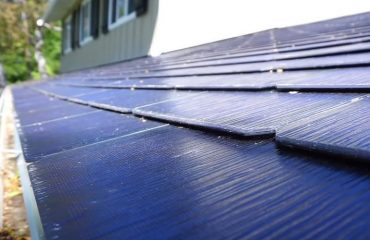
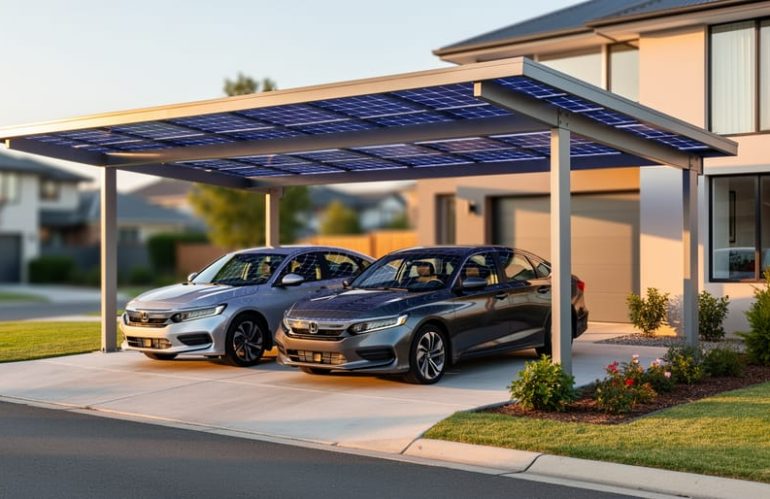
Your parking space is sitting empty when it could be generating thousands of dollars in electricity savings. Solar carports transform ordinary parking areas into power-producing structures that shelter your vehicles while slashing your energy bills by 50% or more.
Unlike rooftop installations that depend on your home’s structural integrity and south-facing orientation, carports offer flexibility. Install them over driveways, patios, or open yard spaces where your roof might not be ideal. They provide covered parking that protects your car from hail, sun damage, and snow while producing the same clean energy as traditional panels.
The installation process follows a straightforward path. Your contractor builds a sturdy metal framework designed to support both snow loads and solar panels, then mounts the photovoltaic system on top. Most projects take just 2-3 days once permits clear, and you’re generating power immediately after connection to your electrical system.
Cost concerns often hold homeowners back, but solar carports qualify for the same 30% federal tax credit as rooftop systems. While the structural framework adds $3,000-$8,000 to typical solar costs, you’re getting a valuable covered parking structure included. Many homeowners find this two-in-one solution more cost-effective than building a traditional carport and installing separate rooftop panels.
Whether your roof faces the wrong direction, lacks adequate space, or simply can’t support panels, carports deliver the same environmental benefits and financial returns without compromise.
What Makes Solar Carports Different from Rooftop Panels
Solar carports offer a compelling alternative to traditional rooftop installations, and they’re often misunderstood as a second-best option. The reality is quite different. These structures provide distinct advantages that can actually make them the smarter choice for many homeowners.
The most obvious benefit is dual-purpose functionality. While your panels generate clean energy, your vehicles enjoy protection from sun, rain, snow, and hail. This covered parking space adds real value to your property while extending your car’s lifespan by reducing weather-related wear and tear.
Here’s where carports shine compared to rooftop systems: installation flexibility. With a carport, you’re not constrained by your roof’s angle, direction, or condition. Installers can orient panels at the optimal tilt and direction for maximum sun exposure, regardless of how your house faces. This often results in better energy production than roof-mounted panels that must work with whatever angle your roof provides.
Maintenance accessibility is another practical advantage. Unlike rooftop panels that require climbing or professional help for solar panel maintenance, carport panels sit at a comfortable height for easy inspection and cleaning. This convenience means you’re more likely to keep them performing at peak efficiency.
Perhaps most importantly, carports avoid roof complications entirely. There’s no need to modify your existing roof structure, no concerns about voiding warranties, and no potential leak points. For homes with older roofs, shaded rooftops, or complex architectural features, carports provide an ideal solution. They’re also excellent space-saving solar solutions when roof space is limited or already spoken for.
The myth that carports produce less energy than rooftop systems simply doesn’t hold up. When properly designed with optimal orientation, they frequently outperform roof installations. The key difference isn’t effectiveness but application, and for many homeowners, that application makes carports the superior choice.
Types of Solar Carport Structures for Your Home
Single vs. Double Carport Configurations
Choosing between a single and double carport configuration depends on your parking needs, available space, and energy goals. A single carport typically covers one vehicle and requires about 120-180 square feet, while a double carport spans 240-360 square feet to accommodate two cars.
From a cost perspective, single carports generally range from $8,000 to $15,000 installed, making them an accessible entry point for solar adoption. Double carports cost between $15,000 and $30,000, but the price per square foot often decreases, giving you better value. The larger surface area of double carports means more room for solar panels, typically generating 3-6 kilowatts compared to 1.5-3 kilowatts for single setups.
Here’s the good news: both configurations qualify for the federal solar tax credit, reducing your upfront investment by 30%. A double carport makes financial sense if you have multiple vehicles or want to maximize energy production on a single structure. However, if space is limited or you’re testing the solar waters, a single carport provides meaningful energy savings while protecting your vehicle from the elements. Consider your household’s vehicle count, available yard space, and long-term energy needs when making your decision.
Freestanding vs. Home-Attached Designs
When choosing between freestanding and home-attached solar carports, understanding each option helps you make the best decision for your property and budget.
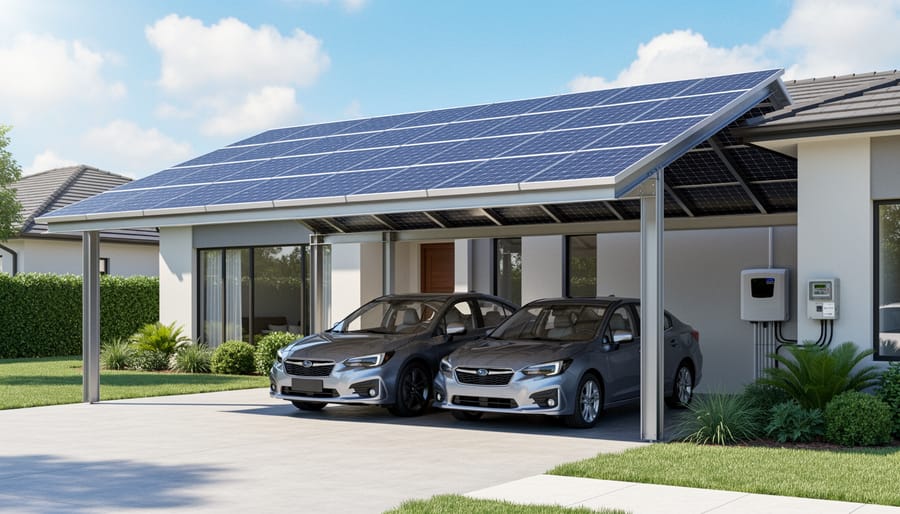
Freestanding carports stand independently from your home, offering excellent flexibility in placement. You can position them wherever your property gets the most sunlight, even if that’s away from your house. This design works beautifully for larger properties and doesn’t require your home’s structure to support additional weight. The installation is straightforward since contractors aren’t connecting to your existing building, which often means fewer complications and potentially lower costs. However, you’ll need adequate open space, and the structure will be more visible across your property as a standalone feature.
Home-attached carports connect directly to your house or garage, creating a seamless extension of your living space. This approach typically requires less total square footage since you’re using an existing wall for support. Many homeowners appreciate how attached designs can complement their solar-integrated design, blending naturally with their home’s architecture. The covered walkway from car to door is a practical bonus during rainy weather. Keep in mind that installation involves structural assessment of your home’s ability to support the added weight, and your existing building’s condition may affect overall project costs.
Both options generate the same clean energy and financial savings. Your choice ultimately depends on your property layout, aesthetic preferences, and how you envision using the space. Either way, you’re investing in sustainable energy independence while protecting your vehicles.
The Installation Process: What to Expect
Site Assessment and Foundation Requirements
Before installation begins, qualified installers will visit your property to evaluate whether your site is suitable for a solar carport. This assessment involves examining your parking area’s layout, measuring available space, and checking sun exposure throughout the day to determine the best placement for maximum energy production. Think of it like finding the perfect spot where your carport will catch the most sunlight while still serving its practical purpose.
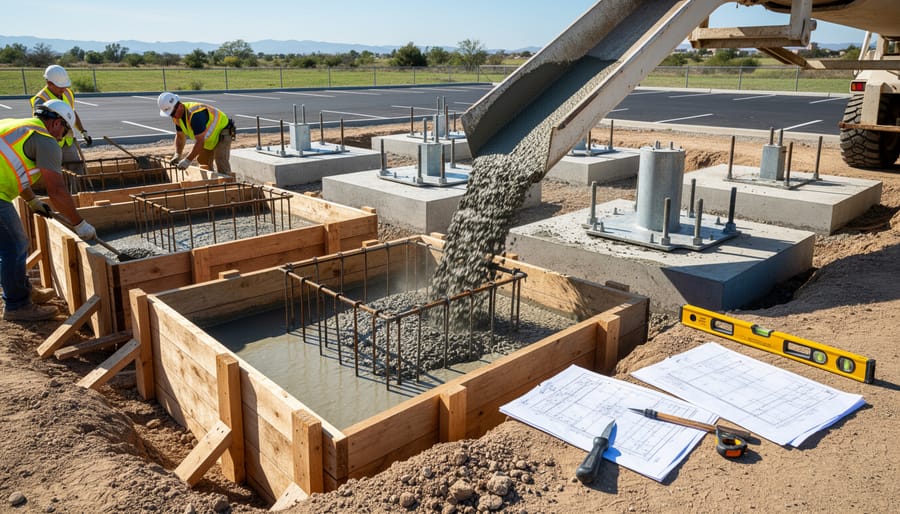
Next comes the foundation work, which is crucial for stability. Installers typically conduct soil testing to understand ground conditions and determine what type of support your carport needs. Most installations require concrete footings buried several feet deep, similar to what you’d need for a sturdy deck or patio cover. The good news is that this groundwork, while thorough, is straightforward and follows established building practices.
During this phase, professional solar inspections help ensure everything meets local codes and safety standards. Your installer will also check for underground utilities and drainage patterns to avoid complications. This careful planning stage typically takes just a day or two and sets the stage for a smooth installation process.
Structural Assembly and Panel Installation
Once your site is ready, the installation team begins assembling your solar carport’s structural frame. Professional installers securely anchor the metal support posts into the foundation, ensuring everything is perfectly level and aligned. The overhead beams are then attached, creating a sturdy framework designed to support both the solar panels and withstand local weather conditions like wind and snow loads.
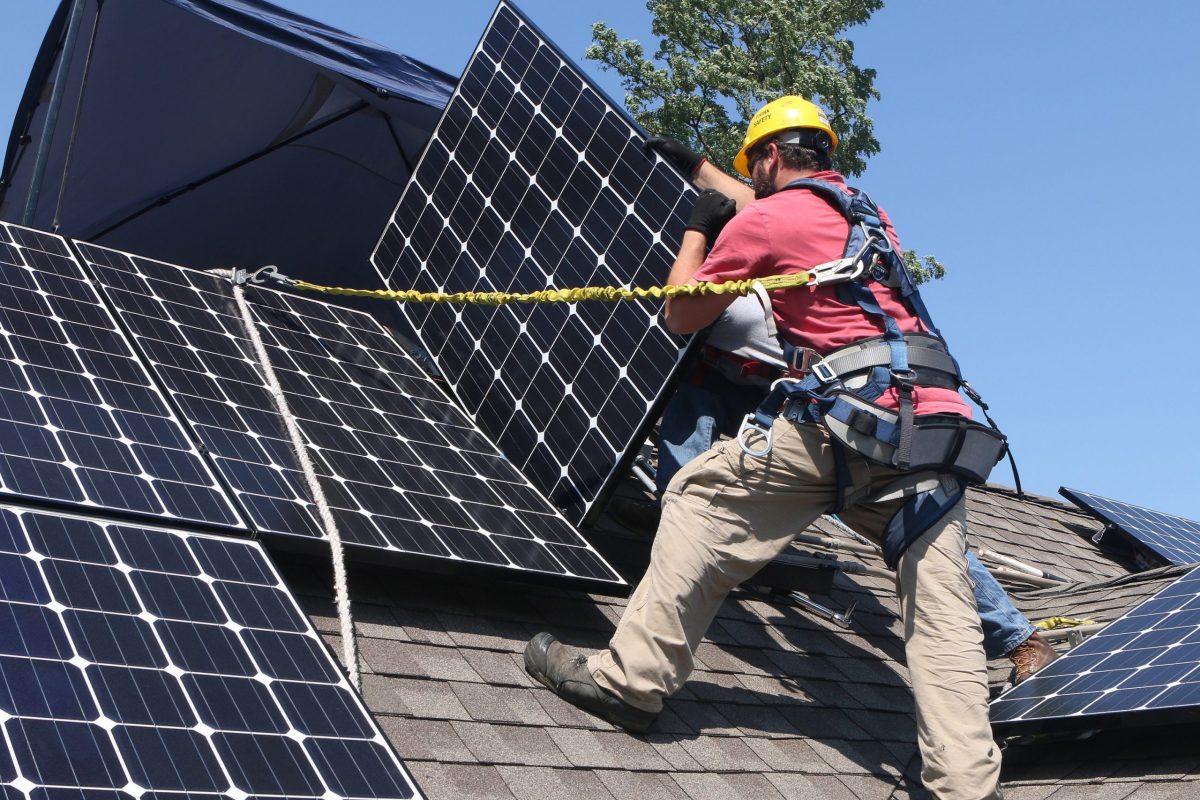
Next comes the exciting part: mounting the solar panels. Certified technicians carefully position each panel onto the carport’s roof structure using specialized racking systems. These mounting systems allow for optimal tilt angles to capture maximum sunlight throughout the year. This is where proper solar installation techniques really matter—correctly positioned panels generate more electricity and last longer.
Finally, licensed electricians make all the necessary electrical connections, linking your panels to inverters and your home’s electrical system. They’ll ensure everything meets local codes and safety standards. Most installations are completed within one to three days, depending on the carport’s size. Throughout the process, professionals handle all the heavy lifting and technical work, so you can simply watch your renewable energy solution take shape.
Timeline and Disruption to Your Daily Life
Good news: solar carport installation is surprisingly quick and causes minimal disruption to your daily routine. Most projects take between three to five days from start to finish, depending on the size and complexity of your carport. Unlike rooftop installations that might require workers above your living space, carports are built in your parking area, so you can go about your normal activities inside your home.
Before installation begins, you’ll need to keep your parking spaces clear for about a week. Your installer will coordinate with you on the best timing to minimize inconvenience. The actual construction happens in stages: first, the support structure goes up in a day or two, followed by electrical work and panel installation. You might hear some drilling and construction noise during working hours, but it’s temporary and confined to outdoor spaces.
Most homeowners find they can park in alternate spots or use street parking during the process without major hassle. Once complete, you’ll have both covered parking and clean energy without ever having dealt with the mess or intrusion of interior renovations.
Making Your Solar Carport Work Harder
EV Charging Integration
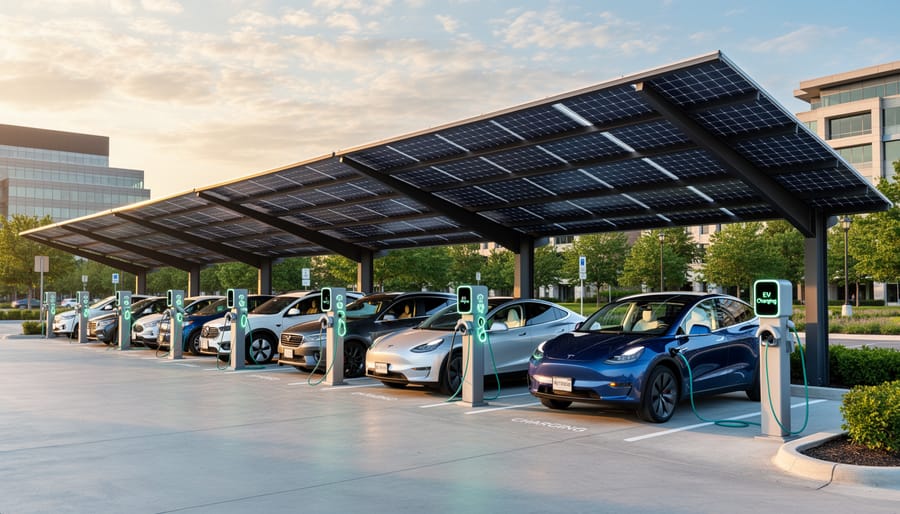
Solar carports and electric vehicles are a match made in sustainability heaven. By adding EV charging stations to your solar carport, you create a convenient spot to power your car directly from the sun while it’s parked. This means you’re driving on clean energy you generated yourself, eliminating trips to gas stations and reducing your carbon footprint even further.
The financial benefits stack up quickly. Instead of paying for electricity to charge your EV at home rates, or paying premium prices at public charging stations, you’re using free solar energy. Many homeowners find that the electricity their carport generates during the day easily covers their vehicle’s charging needs, with plenty left over for household use.
Installation is straightforward since the electrical infrastructure for your carport can be designed to accommodate charging stations from the start. You’ll simply need a Level 2 charger installed, which can fully charge most EVs overnight or during the workday. This integrated approach transforms your parking space into a complete clean energy ecosystem, where your car becomes part of your home’s renewable energy solution rather than a separate expense.
Battery Storage and Backup Power Options
Adding battery storage to your solar carport transforms it from a simple energy generator into a complete power resilience system. While your carport panels produce electricity during sunny days, batteries capture excess energy that would otherwise go unused, storing it for when you need it most.
The real game-changer comes during power outages. Instead of sitting in the dark like your neighbors, you’ll have backup power to keep essential appliances running, charge devices, and maintain comfort. This peace of mind is increasingly valuable as extreme weather events and grid instability become more common.
Modern battery systems are surprisingly user-friendly. Most operate automatically, seamlessly switching to stored power when the grid goes down. You won’t need to flip switches or run extension cords. Many systems even include smartphone apps that let you monitor your energy usage and storage levels in real time.
The financial benefits extend beyond emergency preparedness. Battery storage allows you to use your solar power during evening hours when electricity rates are typically highest, maximizing your savings. Some utility companies offer additional incentives for homeowners with battery backup systems, recognizing their value in reducing strain on the grid during peak demand.
While adding batteries increases your upfront investment, federal tax credits apply to battery systems installed alongside solar panels, helping offset the cost. Consider your local climate, typical outage frequency, and energy needs when deciding whether battery storage makes sense for your solar carport project.
Costs, Savings, and Return on Investment
Let’s get straight to the good news: solar carports are more affordable than many people think, especially when you consider the long-term financial benefits. While it’s true that carport installations typically cost slightly more than traditional rooftop systems due to the additional structural requirements, the difference is often smaller than you’d expect, and the return on investment can be just as compelling.
A typical residential solar carport installation ranges from $25,000 to $45,000 for a two-car structure, depending on your location, system size, and design preferences. Yes, this is roughly 10-20% more than a comparable rooftop system, but you’re getting a dual-purpose structure that provides both shade for your vehicles and clean energy for your home. Think of it as building a covered parking area that pays for itself over time.
Here’s where the math gets exciting. Federal tax credits currently cover 30% of your total installation costs, immediately reducing that price tag by thousands of dollars. Many states and utilities offer additional rebates and incentives that can shave off another 10-25%. Some areas even provide performance-based incentives that pay you for the electricity your system produces.
Your energy savings begin the moment your system goes live. Most homeowners see their electricity bills drop by 50-100%, translating to annual savings of $1,000 to $2,500 depending on your energy usage and local rates. With these savings, typical payback periods range from 8 to 12 years, and your system will keep producing free electricity for 25-30 years or more.
Don’t forget the less obvious financial perks: protection from rising energy costs, increased property value, potential electric vehicle charging integration, and in some cases, the ability to sell excess power back to your utility through net metering programs. When you add it all up, solar carports aren’t an expense, they’re an investment that delivers returns for decades.
Permits, Codes, and HOA Considerations
Navigating permits and regulations might sound intimidating, but here’s the good news: it’s typically much simpler than you’d expect, and your installer will handle the heavy lifting. Think of it as paperwork that happens behind the scenes while you focus on the exciting part—going solar.
Most solar carport installations require a building permit from your local municipality. This ensures your structure meets safety standards for wind loads, snow loads, and electrical connections. Your installer will submit detailed engineering plans and handle the permit application process on your behalf. They’re familiar with local requirements and know exactly what documentation officials need to see.
Building codes vary by location, but common considerations include setback requirements (how far your carport must sit from property lines), height restrictions, and electrical code compliance. Some areas classify solar carports differently than regular carports, which can actually work in your favor with more lenient rules. Your installer will verify these specifics during the site assessment.
Homeowners associations deserve special mention. If you live in an HOA community, you’ll need approval before installation. Many states have “solar rights” laws that prevent HOAs from unreasonably blocking solar installations, though they can set reasonable aesthetic requirements. Submit your plans early and communicate the benefits—modern solar carports often enhance property appearance and may even increase community property values.
The timeline for approvals typically ranges from two to six weeks, depending on your location and HOA responsiveness. While this adds time to your project, experienced installers navigate these processes daily. They’ll keep you informed at each step and manage follow-up communications, turning what seems complex into a straightforward path toward clean energy independence.
Solar carport installation represents one of the smartest investments you can make for your property. By combining practical vehicle protection with clean energy generation, you’re solving two challenges with a single solution. Your cars stay cooler and shielded from the elements while your energy bills drop month after month. It’s a win-win that few home improvements can match.
The financial case is compelling. Between federal tax credits, state incentives, and the ongoing electricity savings, most homeowners see their investment pay for itself within several years. After that, you’re enjoying free power generated right in your driveway while your property value increases. The return on investment speaks for itself.
Beyond the dollars and cents, there’s something satisfying about generating your own clean energy. Every sunny day becomes an opportunity to power your home sustainably while reducing your carbon footprint. You’re not just saving money; you’re taking meaningful action toward a cleaner future.
Is your property a good fit for solar carport installation? The answer often depends on your available space, sun exposure, and local regulations. Many homeowners are surprised to discover their driveway or parking area is actually ideal for solar panels, even when their roof isn’t. If you’re curious whether this solution works for your situation, a quick consultation can provide clarity. Exploring your options costs nothing and could unlock significant benefits for years to come.