Your roof isn’t the only place solar panels can thrive. If shading, structural concerns, or simply a less-than-ideal roof orientation is holding you back from going solar, pole-mounted systems offer a practical alternative that many homeowners overlook.
An 8 solar panel pole mount configuration typically generates between 2,400 to 3,200 watts of power—enough to offset a significant portion of most household energy bills. These systems position your panels on a sturdy pole structure in your yard, where you control the angle, direction, and placement for maximum sun exposure throughout the day.
The beauty of pole mounting lies in its flexibility. You can install panels in the sunniest spot on your property, adjust tilt angles seasonally for optimal performance, and easily access panels for cleaning and maintenance—all without climbing on your roof. Ground-level accessibility means simpler installation and upkeep, often translating to lower long-term costs.
Many homeowners assume pole mounts are more expensive or complicated than rooftop systems, but that’s not always the case. When factoring in roof reinforcement costs, complicated penetrations, or efficiency losses from poor roof angles, pole mounting often becomes the more economical choice. Plus, you’re not limited by roof size, orientation, or condition.
Whether you’re exploring solar solutions beyond your roof or comparing mounting options, understanding pole-mounted systems helps you make the smartest investment for your property and energy goals.
What Exactly Is an 8-Panel Solar Pole Mount?
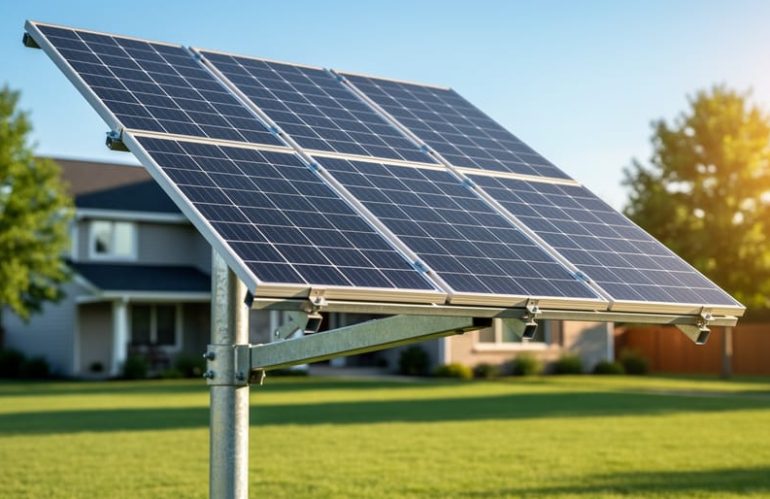
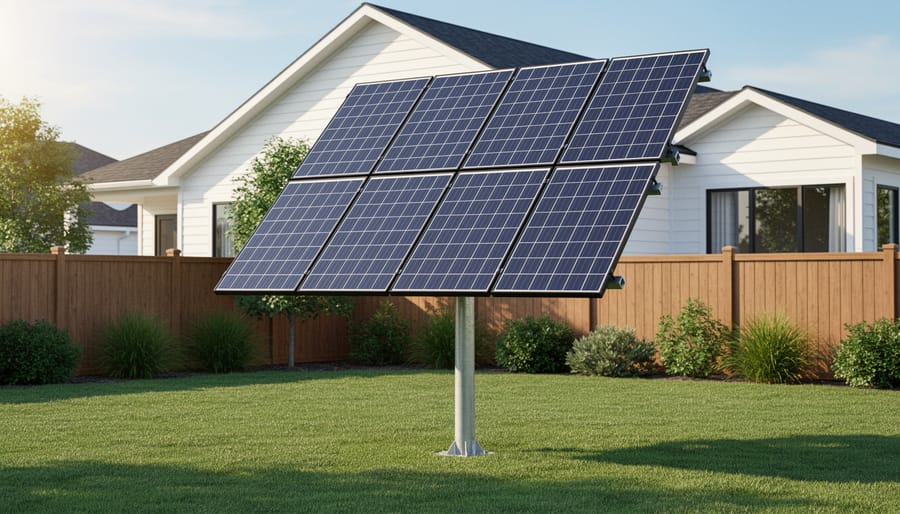
Think of a pole mount solar system as a freestanding solar array that sits on one or more sturdy metal posts planted firmly in your yard, rather than attached to your rooftop. Instead of drilling into your shingles, the solar panels get mounted on a ground-level structure that extends upward, kind of like a sophisticated flagpole designed specifically to hold your panels at the perfect angle for capturing sunlight.
The “8-panel” specification simply means the system is designed to support eight solar panels. For most homeowners, this translates to a system generating between 2,400 and 3,200 watts of power, depending on the individual panel efficiency you choose. To put this in everyday terms, an 8-panel system typically produces enough electricity to cover your refrigerator, washing machine, air conditioning, lighting, and most everyday appliances. Many homeowners find this size handles 30-50% of their total energy needs, sometimes more if you’re particularly energy-conscious.
The key difference between pole mounts and roof installations comes down to flexibility and accessibility. While roof mounts utilize existing space on your home, pole mounts give you freedom to position your panels wherever sun exposure is best on your property. They’re also significantly easier to clean, maintain, and adjust since you can reach them from ground level without climbing onto your roof.
Pole mount systems work beautifully for properties with shaded roofs, homes with aging or complex roof structures, or situations where you simply want your solar investment separate from your house. They’re also excellent if you’re planning future roof replacement and don’t want to deal with temporarily removing rooftop panels.
When Pole Mounts Make More Sense Than Roof Installation
Your Roof Isn’t Solar-Ready (And That’s Okay)
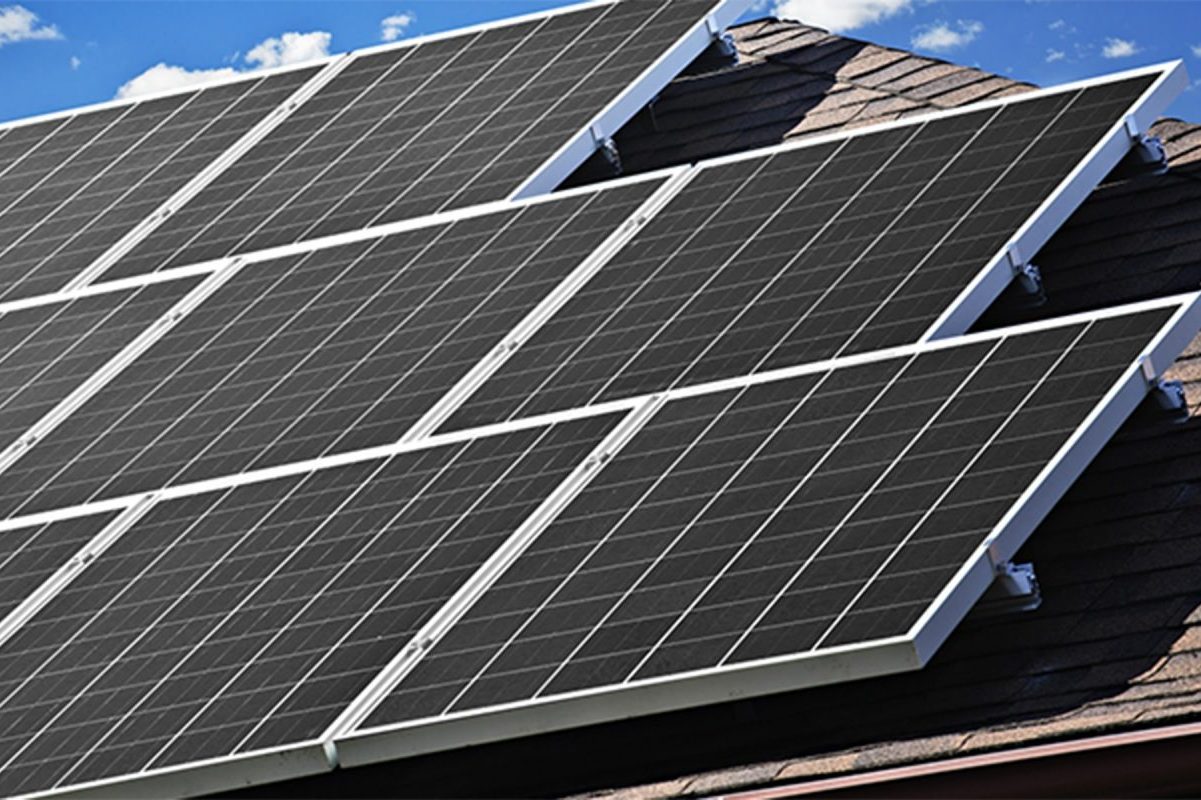
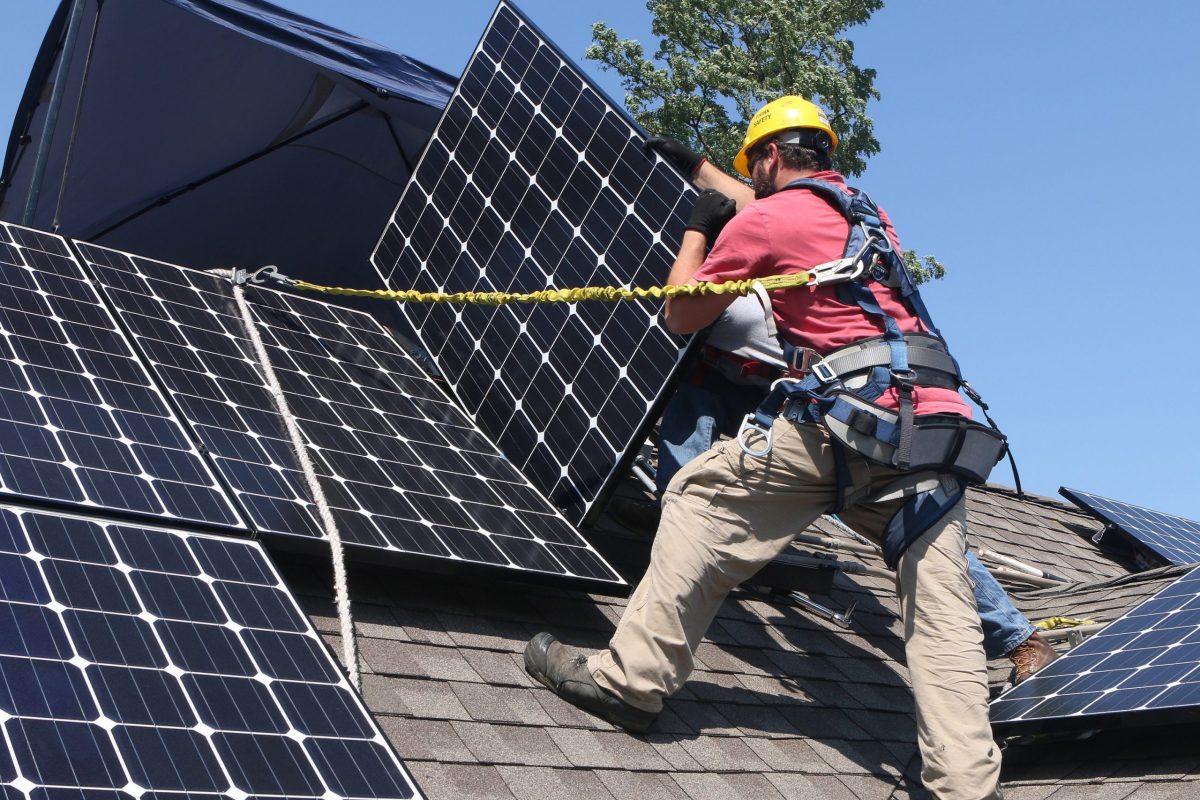
Not every roof is ready for solar panels, and that’s completely normal. If your roof is nearing the end of its lifespan, you’d need to replace it before installation anyway—which means extra costs and timing hassles. Some roofing materials like slate, cedar shake, or certain metal panels can make traditional mounting complicated or even impossible without risking damage.
Older homes might have structural concerns too. Your roof framing may not support the additional weight of panels and racking systems without reinforcement, which adds unexpected expenses to your project. Shading from nearby trees, unusual roof angles, or a less-than-ideal orientation can also reduce your system’s efficiency significantly.
Here’s the good news: pole mounts bypass all these issues entirely. You’re not locked out of solar energy just because your roof isn’t ideal. Instead of viewing roof limitations as roadblocks, think of them as a nudge toward a solution that might actually work better for your property. Pole-mounted systems offer flexibility that roof installations simply can’t match, letting you position your panels exactly where they’ll perform best.
Ground Space as Your Solar Advantage
That open yard space you’ve been wondering what to do with? It could be your secret weapon for solar success. Unlike roof installations that work around your home’s existing structure, ground-mounted pole systems let you make the most of whatever land you have available.
Think of it this way: your roof placement is fixed, but ground space gives you control. You can position your panels at the perfect angle to catch maximum sunlight throughout the day, regardless of which way your house faces. Got some shade from trees hitting your roof in the morning? No problem. Your pole mount can go in that sunny spot across the yard instead.
The practical benefits don’t stop there. When your panels are mounted at ground level on poles, maintenance becomes remarkably simple. No ladders, no safety concerns, and no need to hire someone just to clean off some leaves or snow. You can walk right up to your system, inspect it easily, and keep it running at peak efficiency with minimal effort.
Available yard space also means flexibility for future expansion. Starting with eight panels but thinking you might want more down the road? Ground installations make adding capacity much more straightforward than modifying a roof system. Your open land becomes a genuine asset that works for you, generating clean energy while staying easily accessible.
The Shading Problem Solved
One of the biggest challenges with rooftop solar is dealing with shade from trees, chimneys, vents, or nearby buildings. Even partial shading on just one panel can significantly reduce your entire system’s output. This is where pole-mounted systems truly shine.
With a ground-based pole mount, you have complete freedom to choose the perfect location on your property. You can position your eight panels in the sunniest spot available, far away from shade-casting obstacles that would be unavoidable on your roof. This flexibility means your panels can generate electricity at peak efficiency throughout the day.
Many homeowners discover that while their roof faces the wrong direction or sits in afternoon shade, an open area of their yard receives unobstructed sunlight for most of the day. Moving your solar array to a pole mount in that sunny location can dramatically increase your energy production compared to a compromised roof installation.
The ability to achieve optimal panel positioning means you’re not settling for second-best. You’re maximizing your investment by ensuring every ray of sunshine gets converted into usable electricity and savings on your energy bill. This strategic placement advantage often makes pole mounts more productive than roof systems, even when both use identical panels.
Real Benefits You’ll Actually Notice
Better Energy Production Means Better Savings
When you tilt your solar panels to match the sun’s path throughout the year, you capture significantly more energy than panels stuck at a fixed angle. This difference shows up directly on your electricity bill. For example, a homeowner in Colorado adjusting their pole-mounted panels seasonally might produce 25-35% more electricity compared to a flat roof installation that can’t be optimized. That extra production means you’re buying less power from the grid each month.
Here’s what this looks like in real numbers: if your household typically pays $150 monthly for electricity, optimized pole-mounted panels could reduce that bill by $100 or more during peak production months. Over a year, those savings add up to hundreds or even thousands of dollars back in your pocket. The beauty of pole mounts is that you control the positioning, so you’re not limited by your roof’s orientation. If your roof faces north or sits in shade part of the day, a pole mount placed in your sunniest yard spot will outperform a roof installation every time, translating to better energy production and genuinely lower costs month after month.
Maintenance That Won’t Give You Nightmares
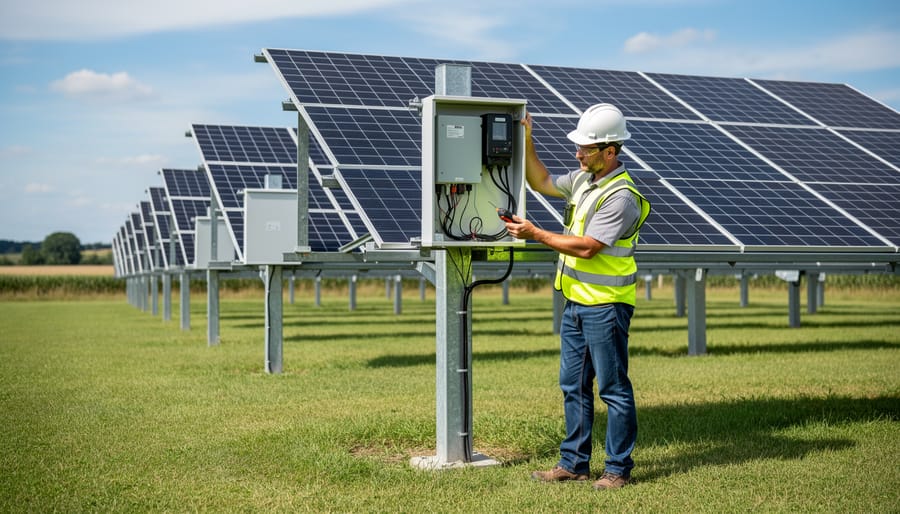
Here’s the truth about maintenance: would you rather clean panels from a sturdy position at ground level or teeter on your roof with a hose and squeegee? Pole-mounted solar panels make cleaning solar panels surprisingly simple. You can walk right up to them, inspect every inch without breaking a sweat, and spot potential issues before they become expensive problems.
No ladders. No anxiety. No calling professionals for basic maintenance tasks you can easily handle yourself. During winter, brushing off snow becomes a five-minute job instead of a dangerous expedition. Bird droppings? Just walk over and wipe them away. This accessibility means your panels stay cleaner more consistently, which translates directly to better energy production year-round.
Think of it as maintaining garden equipment rather than mountaineering. Your back will thank you, your wallet will appreciate the savings on professional cleanings, and you’ll actually stay on top of upkeep because it’s genuinely convenient. Safety and simplicity working together to protect your investment.
Your Roof Stays Untouched
One of the most appealing benefits of pole-mounted solar panels is that your roof remains completely untouched. Unlike traditional rooftop installations that require drilling holes and mounting brackets, pole mounts keep your home’s structure intact.
This means your roof warranty stays valid. Many homeowners don’t realize that roof penetrations can void manufacturer warranties or create complications down the line. By choosing a ground-based pole mount system, you sidestep this issue entirely.
You’ll also eliminate any worry about potential leaks. Even with professional installation, rooftop solar systems create penetration points that could become vulnerable over time, especially during heavy rain or snow. Pole mounts remove this concern completely, giving you peace of mind that your home’s weather protection remains as strong as ever.
If you have an older roof that might need replacement in the next several years, pole mounts are particularly smart. You won’t face the hassle and expense of removing and reinstalling panels when it’s time for roof work. Your solar system operates independently from your home’s structure, making future maintenance much simpler and more affordable.
What to Expect: Installation and Setup
Installing an 8-panel pole mount system is more straightforward than many homeowners expect, though it does require professional expertise to ensure everything works safely and efficiently. Here’s what the process typically looks like from start to finish.
The entire installation usually takes one to three days, depending on your property conditions and local permitting requirements. Before any equipment arrives, your installer will assess your yard to determine the best pole location. They’ll consider factors like sun exposure throughout the day, soil composition, and how far the mount needs to be from your home’s electrical panel.
Site preparation is the first hands-on step. Your installer will dig a foundation hole, typically three to five feet deep, to anchor the pole securely. This involves some temporary disruption to your yard, but the footprint is surprisingly small compared to ground-mounted arrays that spread across larger areas. Concrete is poured to create a stable base, which needs 24 to 48 hours to cure properly.
Once the foundation is set, the professional solar installation team erects the pole and mounting hardware. The eight solar panels are then attached to the racking system, positioned at the optimal angle for your latitude. Finally, installers run electrical wiring from the pole to your home, connecting the system to your inverter and electrical panel.
Your installation team handles all the technical aspects, including obtaining necessary permits, scheduling inspections, and coordinating with your utility company for net metering setup. You won’t need to navigate this bureaucracy yourself.
Most homeowners are pleasantly surprised by how minimal the disruption is. While you’ll have a work crew on-site for a few days, the actual impact on your daily routine is manageable. The result is a clean, efficient solar system that transforms sunlight into savings without cluttering your roof.
The Investment Breakdown
Let’s talk money. Most homeowners find that an 8-panel pole mount system costs roughly 10-30% more upfront than a comparable roof installation. That translates to an additional $1,500 to $4,000 for most residential setups, though your actual costs will vary based on several factors.
What drives the price? Soil conditions play a significant role. Rocky terrain or areas requiring concrete foundations will increase installation expenses. Your location matters too—remote properties may incur higher labor costs, while some regions require additional permitting fees. Speaking of permits, budget anywhere from $200 to $800 for local approvals, depending on your municipality’s requirements.
Here’s the good news: that extra upfront investment often pays for itself faster than you’d think. Ground-mounted systems typically produce 10-15% more energy than their roof-mounted counterparts because you can optimize the angle and direction perfectly. Better production means faster payback periods and greater lifetime savings on your electric bills. The return on investment becomes even more attractive when you factor in easier maintenance access and the potential for system expansion down the road.
Many homeowners finance their solar projects through low-interest solar loans, home equity lines, or lease agreements that require little to no money down. Several financing programs are specifically designed to make solar accessible, with monthly payments often lower than your current electricity bill. The federal solar tax credit can also reduce your total system cost by 30%, making that initial price difference between pole mounts and roof installations even less significant.
Think long-term value, not just sticker shock. Your pole mount investment is buying you energy independence and decades of savings.
Common Concerns Homeowners Ask Us
Will It Look Out of Place in My Yard?
Modern pole mounts have come a long way from the bulky industrial designs you might imagine. Today’s systems are sleek and low-profile, often blending surprisingly well with landscaping when positioned thoughtfully. The key is strategic placement—many homeowners tuck them along property lines, behind garages, or integrate them into garden areas where they’re partially screened by shrubs or decorative fencing.
You have flexibility most roof systems don’t offer. Unlike rooftop panels that are visible from the street, you can choose a backyard location that’s practical for sun exposure while remaining discreet from your home’s curb appeal. Some homeowners even use lattice or climbing plants around the pole base to soften the look. The panels themselves are typically dark-framed and reflective, similar to modern architectural glass, making them less obtrusive than you’d expect. With a bit of planning, your pole mount can generate clean energy without dominating your landscape.
Can It Withstand Severe Weather?
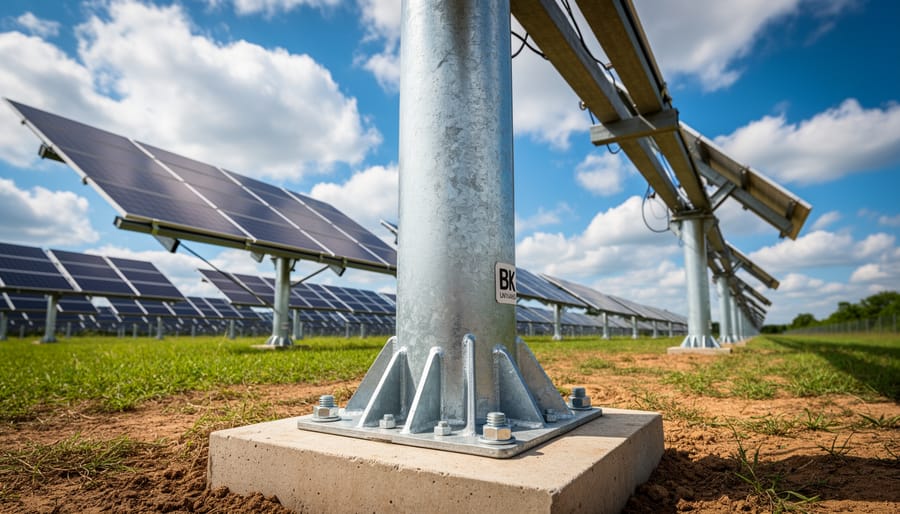
Good news—these systems are built tough. Reputable 8-panel pole mounts are engineered to meet strict building codes and weather standards used throughout the industry. Most quality mounts are tested to withstand wind speeds of 90 mph or higher, which covers the vast majority of weather conditions you’ll encounter.
The key is proper installation and choosing a system designed for your local climate. Your installer will assess factors like typical wind patterns and snow loads in your area, then select appropriately rated materials and anchoring methods. The pole itself is typically made from galvanized steel or aluminum that resists rust and corrosion for decades.
Think of it this way: these mounts hold expensive solar panels, so manufacturers have every incentive to make them incredibly durable. While extreme weather events like tornadoes can damage any structure, a properly installed pole mount will handle regular storms, heavy snow, and strong winds without issue. Many come with warranties covering structural integrity for 10-25 years, giving you added peace of mind.
What About Property Value?
Good news for homeowners considering solar: adding solar panels can actually boost your property value. Studies consistently show that homes with solar installations sell faster and command higher prices than comparable homes without them. Buyers appreciate the immediate energy savings and the environmentally-friendly feature that comes with the home.
Pole-mounted systems can be particularly appealing because they’re often more visible than roof installations, making your commitment to clean energy clear to prospective buyers. They’re also easier to maintain and upgrade, which adds to their long-term value proposition. Plus, because pole mounts don’t affect your roof structure, you avoid any concerns buyers might have about potential roof damage or warranty issues.
The key is ensuring your system is professionally installed and properly permitted. Well-maintained solar installations are increasingly viewed as premium home features rather than experimental add-ons, especially as energy costs continue rising and environmental awareness grows among homebuyers.
Is an 8-Panel Pole Mount Right for Your Home?
An 8-panel pole mount might be perfect for your home if you’re facing a few specific situations. First, consider your roof. If your roof is shaded by trees, faces the wrong direction, or needs repairs in the next few years, a pole mount could be a smarter choice than waiting or compromising on efficiency. Ground-based systems also shine when your property has plenty of open space, especially in sunny spots away from your house.
Think about your energy needs too. Eight panels typically generate between 2,400 and 3,200 watts, which covers roughly 30-50% of an average household’s electricity use. This makes them ideal if you’re looking to significantly reduce your bills without going all-in on a full solar installation, or if you’re starting smaller with plans to expand later.
Property characteristics matter as well. Pole mounts work beautifully on rural properties, hobby farms, or homes with large yards where ground space isn’t at a premium. They’re also great for DIY enthusiasts who enjoy hands-on projects, since installation can be more straightforward than roof mounting.
That said, every home is different. Local zoning regulations, soil conditions, and your specific energy consumption all play a role in determining if this setup makes sense for you. The best approach is to assess your situation honestly: do you have adequate sunny ground space, and does your roof present challenges? If you’re nodding yes, it’s worth exploring further with a solar professional who can evaluate your unique circumstances and confirm whether an 8-panel pole mount aligns with your goals.
Choosing an 8 solar panel pole mount is more than just a smart energy decision—it’s a powerful step toward building a cleaner, more sustainable future for yourself and generations to come. You’re not just installing panels; you’re taking control of your energy costs, reducing your carbon footprint, and proving that environmental responsibility and financial savings can work hand in hand.
The beauty of pole mount systems lies in their flexibility. Whether your roof isn’t suitable, you want optimal sun exposure, or you simply prefer keeping your roofline untouched, this solution puts renewable energy within your reach. You’ll enjoy lower electricity bills month after month, increase your property value, and gain energy independence that protects you from rising utility rates.
Every kilowatt-hour your system generates is a small victory for the planet. You’re directly reducing greenhouse gas emissions, decreasing reliance on fossil fuels, and contributing to the clean energy movement that’s reshaping how we power our homes. These aren’t abstract benefits—they’re real, measurable impacts that start the moment your system goes live.
The journey to solar doesn’t have to feel overwhelming. With the right guidance and a clear understanding of your options, you can confidently move forward knowing you’re making a choice that benefits your wallet, your home, and the environment. The future is brighter with solar energy, and that future starts with your decision today. Take the next step and discover how accessible and rewarding clean energy can be.