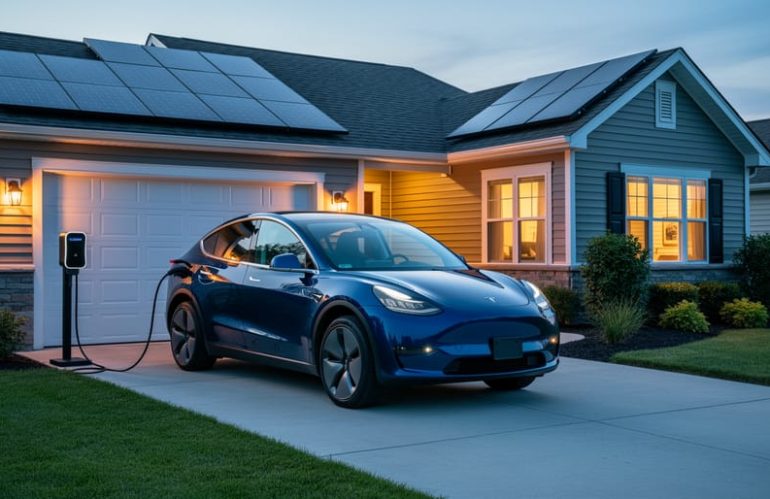
Your electric vehicle can do more than drive—it can power your home, slash your energy bills, and give you control over rising electricity costs. Bidirectional EV charging transforms your car’s battery into a massive energy storage system, letting electricity flow both ways: from the grid to your vehicle, and from your vehicle back to your home when you need it most.
Think of it as having a backup generator that recharges itself while you’re at work. When electricity rates spike during peak hours or the grid goes down during a storm, your EV seamlessly kicks in to keep your lights on, refrigerator running, and air conditioning humming. For homeowners with solar panels, this technology creates a complete energy independence loop—capture sunlight during the day, store it in your car’s battery, and use that clean power at night without paying premium rates to your utility company.
The concept is surprisingly straightforward. Your EV already has a battery large enough to power an average home for two to three days. Bidirectional charging simply adds the capability to reverse that flow, turning your vehicle into the world’s most practical home battery. Unlike dedicated home battery systems that can cost $10,000 or more, you’re leveraging an asset you already own.
This isn’t futuristic technology—it’s available right now, and it’s changing how smart homeowners think about energy. The question isn’t whether bidirectional charging works, but whether you’re ready to turn your driveway into your personal power station.
What Is Bidirectional EV Charging?
The Difference Between Regular and Bidirectional Charging
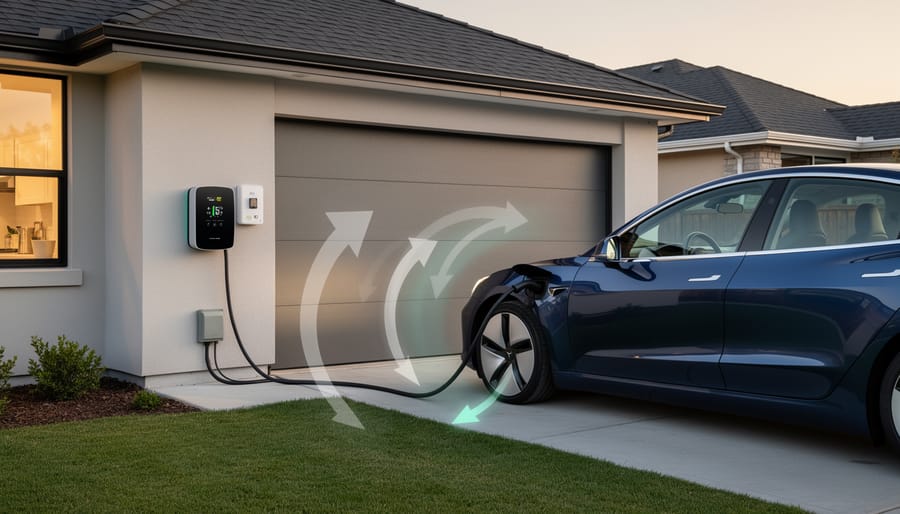
Think of traditional EV charging like a one-way street. Your car sits in the garage, plugs into the power grid, and electricity flows in just one direction—from the grid to your vehicle’s battery. Once that energy is stored, it stays locked in your car until you drive somewhere.
Bidirectional charging flips this concept on its head by turning that one-way street into a two-way highway. Your EV battery doesn’t just receive power—it can send electricity back to your home or even the grid when you need it. This means your car becomes a mobile power station, storing energy when it’s cheap or abundant (like during sunny afternoons if you have solar panels) and releasing it when electricity rates spike or during power outages.
This simple shift changes everything. Instead of your EV being just another appliance that drains energy, it becomes an active participant in your home’s energy ecosystem—helping you save money, gain backup power, and reduce reliance on the traditional grid.
Why This Technology Matters Now
Energy bills keep climbing while extreme weather events put increasing strain on our power grid. If you’ve experienced rolling blackouts or watched your electricity costs spike during peak hours, you’re not alone. Millions of homeowners face these same frustrations, searching for practical solutions that offer more control over their energy future.
Bidirectional EV charging arrives at exactly the right moment. This technology transforms your electric vehicle from simply a mode of transportation into a powerful backup battery for your home. When paired with home energy systems, it creates a safety net against grid outages while helping you avoid expensive peak-rate charges. Instead of feeling vulnerable during power disruptions or helpless about rising costs, you gain genuine control.
The timing matters because both EV adoption and grid challenges are accelerating. More people drive electric vehicles than ever before, and utility companies increasingly struggle to meet demand. Bidirectional charging bridges these realities, turning what you already own into a solution that saves money, provides peace of mind, and reduces your environmental footprint simultaneously.
How Your EV Becomes a Home Battery
Pairing with Your Solar Panels
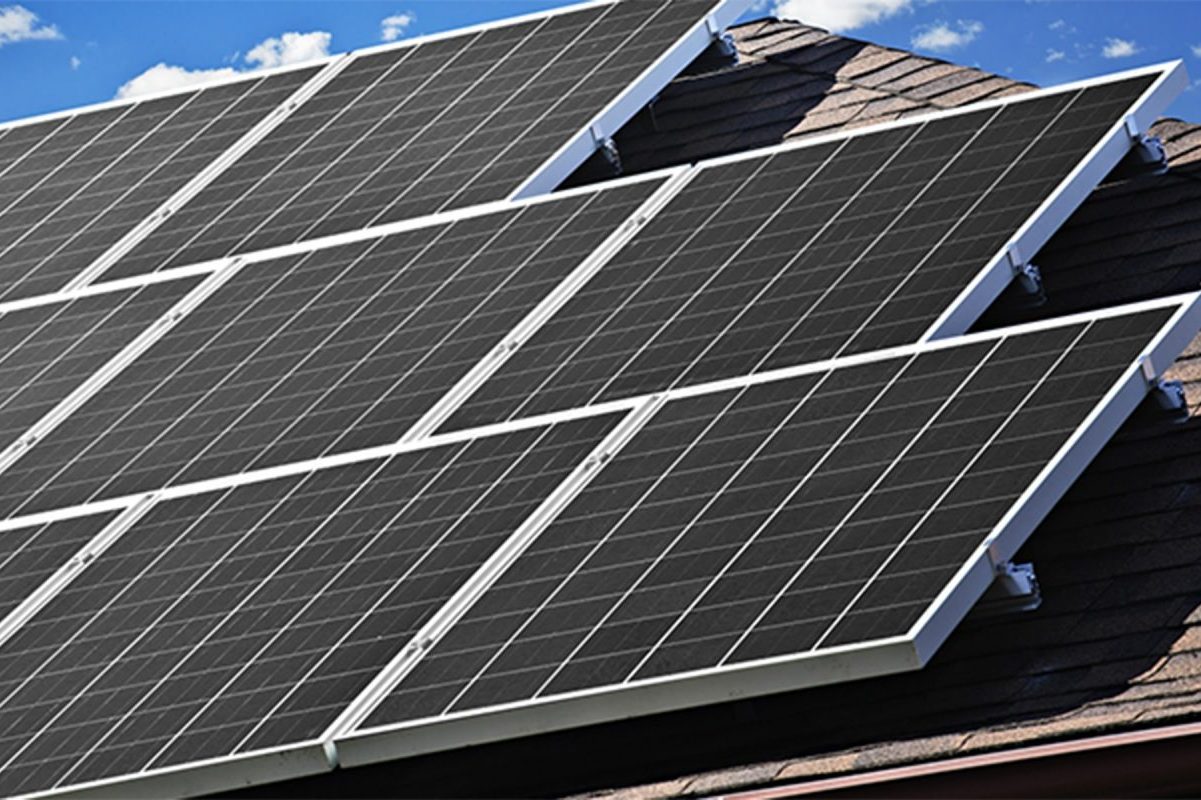
If you already have solar panels on your home—or you’re thinking about adding them—bidirectional EV charging creates a powerful partnership that takes your energy independence to the next level.
Here’s how it works: During sunny days, your solar panels generate electricity that powers your home and charges your EV battery. When your panels produce more energy than you’re using, that excess power flows into your car instead of just feeding back to the grid. Think of your vehicle as a large, mobile battery bank that stores all that free solar energy for later use.
The real magic happens when the sun goes down. Rather than buying expensive electricity from the utility company during evening peak hours, you can tap into the solar energy you stored in your EV during the day. This means you’re using your own clean energy around the clock, not just when the sun is shining.
This combination also shields you from time-of-use electricity rates. Many utility companies charge significantly more during peak demand periods, typically early morning and evening. With stored solar energy in your EV, you can avoid these premium rates entirely, keeping more money in your pocket while reducing your carbon footprint. It’s a win-win that transforms your car from a simple vehicle into an integral part of your home energy system.
Power During Outages
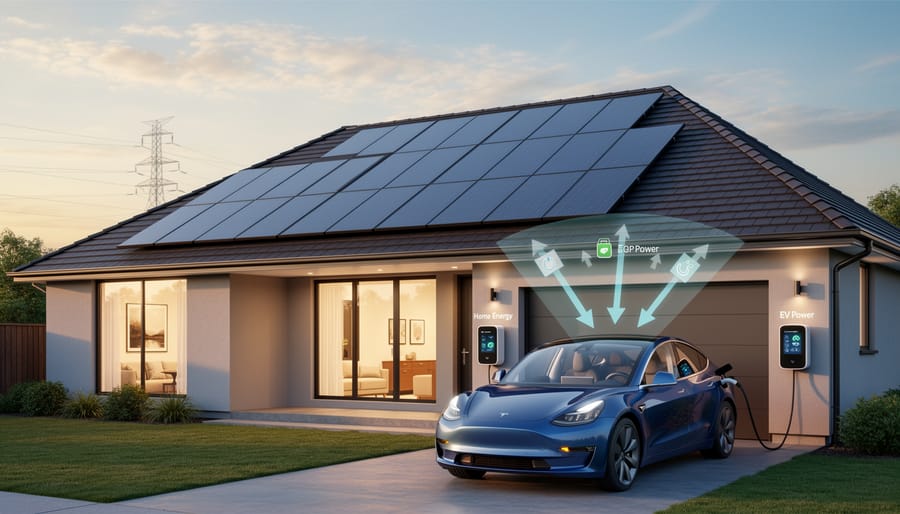
When the grid goes down, your electric vehicle can become a powerful home battery on wheels. With bidirectional charging, you’re not just investing in transportation—you’re gaining one of the most practical backup power solutions available today.
The numbers tell an impressive story. A typical EV battery holds between 60-100 kilowatt-hours of energy. That’s enough to power your entire home for 2-3 days during an outage, or stretch even longer if you’re selective about usage. Your refrigerator, lights, phone chargers, and internet router can run for a week or more on a single charge.
During real emergencies, this capability proves invaluable. Families have kept medical equipment running, preserved hundreds of dollars worth of food, maintained heating or cooling systems, and stayed connected when neighbors went dark. One homeowner in Texas reported powering essential appliances for five days during the 2021 winter storm crisis, using just their EV battery.
The beauty of this system is its simplicity. Unlike traditional generators, there’s no fuel to store, no maintenance schedules, and no loud engine noise. Your EV quietly supplies clean power exactly when you need it most. For those living in areas prone to wildfires, hurricanes, or grid instability, this peace of mind becomes a major selling point—transforming your vehicle from a convenient transportation option into a critical home resilience tool.
The Financial Benefits for Homeowners
Cutting Your Energy Bills
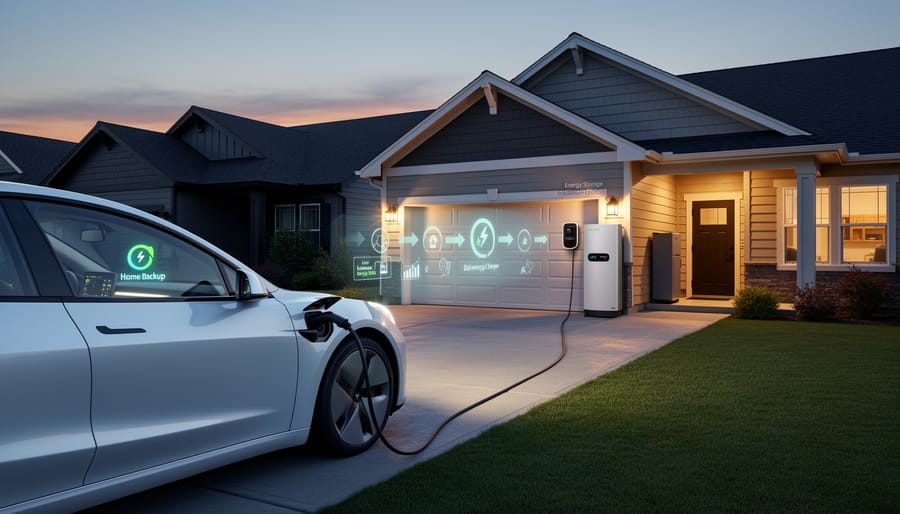
Here’s where bidirectional charging gets exciting for your wallet. Instead of paying premium prices for electricity during peak hours (typically 4-9 PM when rates can be 3-4 times higher), you can use the power stored in your EV battery to run your home.
Think of it this way: charge your car overnight when electricity costs are lowest, then use that stored energy during expensive peak hours. The average household uses about 30 kilowatt-hours daily, and a typical EV battery holds 60-100 kilowatt-hours, giving you plenty of cushion.
Real savings vary by location and your utility’s rate structure, but homeowners commonly save $50-150 monthly by avoiding peak rates. In California, where peak rates can exceed $0.50 per kilowatt-hour compared to overnight rates around $0.15, the math becomes compelling quickly. Over a year, that’s $600-1,800 back in your pocket simply by smartly timing when you draw power from the grid versus your vehicle. Add solar panels to the mix, and you’re charging your car with free sunshine while maximizing your energy independence.
Making Money from Your Car
Here’s the exciting part: your electric vehicle can actually make you money. During peak demand periods—typically early evenings when everyone comes home and cranks up their air conditioning—electricity becomes more valuable. With bidirectional charging, you can sell the stored power in your EV battery back to the grid when prices are highest, earning credits or direct payments from your utility company.
Think of it as a side hustle that requires zero effort on your part. Your EV charges overnight when electricity rates are lowest, then you drive to work with plenty of range to spare. The remaining battery capacity sits available for grid services during high-demand hours. Many utility programs pay $20 to $100 per month for this service, and some homeowners report earning several hundred dollars annually.
The best part? Modern bidirectional systems handle everything automatically. You set your preferences—like ensuring your car always maintains enough charge for your daily commute—and the technology does the rest. Your vehicle still serves its primary purpose while generating passive income in your driveway.
Maximizing Your Solar Investment
If you’ve already invested in solar panels, bidirectional EV charging can significantly boost your return on investment. Here’s the exciting part: your electric vehicle essentially becomes a mobile battery bank, eliminating or reducing the need to purchase expensive standalone home battery storage systems.
During sunny days, your solar panels charge your EV while powering your home. Then, when the sun sets or during cloudy weather, your car’s battery supplies electricity back to your house. This means you’re storing solar energy without the $10,000 to $15,000 price tag of a dedicated battery system.
The financial benefits multiply quickly. You’re maximizing your solar production by using every kilowatt-hour generated, avoiding peak electricity rates, and potentially earning credits through utility programs. Many EV batteries hold 60-100 kilowatt-hours of energy, enough to power an average home for several days. That’s substantial storage capacity you’ve already paid for when you bought your vehicle, now working double duty to increase your energy independence and savings.
What You Need to Get Started
Compatible Electric Vehicles
Right now, the list of bidirectional-capable EVs is growing but still selective. The good news? More models are coming soon. Currently, the Nissan Leaf has been a pioneer in this space, along with the Ford F-150 Lightning, which has made headlines for its impressive home backup capabilities. The Hyundai Ioniq 5 and 6, Kia EV6, and Genesis GV60 also support bidirectional charging in certain markets.
Looking ahead, major automakers including GM, Volkswagen, and Tesla are developing bidirectional features for upcoming models. Tesla’s Cybertruck is expected to include this capability, and the company has hinted at expanding it across their lineup.
Here’s what matters for you: if you’re shopping for an EV now and want bidirectional charging, confirm this feature with your dealer, as availability varies by region and trim level. If you already own an EV without this capability, you’re not out of luck—your next vehicle will likely have it as the technology becomes standard. Think of it as buying a home before solar panels were common; early adopters paved the way, and now it’s becoming the norm.
The Right Charging Equipment
To enable bidirectional charging at your home, you’ll need specialized equipment that can handle two-way power flow. Unlike standard EV chargers that only send electricity to your car, bidirectional chargers allow energy to flow both ways—from the grid to your vehicle and back again.
The main component is a bidirectional charger, sometimes called a vehicle-to-home (V2H) or vehicle-to-grid (V2G) charger. These units typically cost between $3,000 and $7,000, depending on features and capacity. While this is more expensive than standard Level 2 chargers, prices are steadily decreasing as the technology becomes more widespread.
You’ll also need a compatible EV that supports bidirectional charging. Many newer electric vehicles include this capability, though it’s worth checking your specific model’s features.
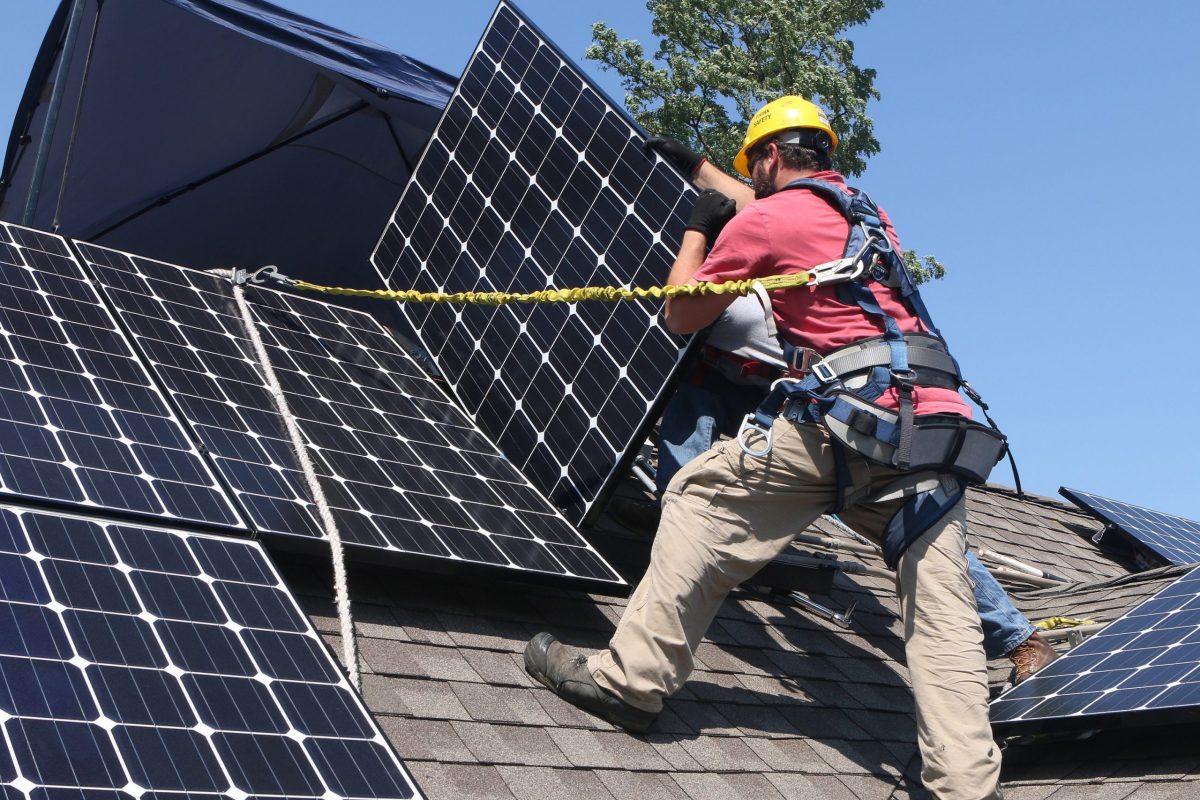
Installation requires a licensed electrician to integrate the charger with your home’s electrical panel. This ensures safe operation and proper connection to your household circuits. If you have solar panels, the integration becomes even more powerful—you can store excess solar energy in your EV during the day and use it to power your home at night, maximizing your energy independence.
Most bidirectional charging systems include smart software that manages when to charge your vehicle and when to discharge energy back to your home, optimizing for cost savings and ensuring your car has enough charge for your daily driving needs. The whole setup typically takes just one day to install.
Common Myths About Bidirectional Charging
Does It Damage Your EV Battery?
Here’s the good news: modern EV batteries are designed with bidirectional charging in mind, and the technology won’t harm your battery any more than regular driving and charging would. Your EV’s sophisticated battery management system actively monitors and controls every charge and discharge cycle, protecting against the conditions that cause premature wear.
Think of it this way: your battery already handles daily charging and the significant power demands of acceleration and highway driving. Bidirectional charging simply adds controlled, moderate discharging to your routine. In fact, many studies show that keeping your battery in the middle range of charge (rather than constantly charging to 100%) can actually be better for long-term health.
Modern lithium-ion batteries are built to last hundreds of thousands of cycles. Using your EV for home backup or energy arbitrage typically adds only minimal extra cycles compared to your regular driving routine. Most manufacturers warranty their batteries for 8-10 years or 100,000+ miles, and these warranties increasingly cover bidirectional use.
The bottom line? Battery degradation from bidirectional charging is minimal and manageable, especially when weighed against the financial savings and energy independence you’ll gain. Your smart battery system has your back.
Is It Too Complicated to Set Up?
Here’s the good news: setting up bidirectional EV charging isn’t as complicated as you might think. Modern systems are designed with homeowners in mind, featuring intuitive interfaces and straightforward controls that anyone can manage. You won’t need an engineering degree to operate your system day-to-day.
The installation process does require professional support, but that’s actually a benefit. Certified installers handle all the technical details, from ensuring your home’s electrical system can support the equipment to configuring the software correctly. They’ll walk you through how everything works before they leave, so you feel confident from day one.
Most manufacturers offer comprehensive setup packages that include the charger, installation services, and ongoing customer support. Think of it like getting solar panels installed—you work with professionals who manage the complexity for you. Many homeowners report that the entire process, from initial consultation to first use, takes just a few days.
The technology continues to become more user-friendly as it evolves. Today’s systems often connect to smartphone apps that make monitoring and controlling your energy flow remarkably simple. If you can manage a smart thermostat, you can handle bidirectional charging.
Creating Your Energy Independence Plan
Ready to take control of your home’s energy future? Building your energy independence plan with bidirectional EV charging is easier than you might think.
Start by assessing your current energy setup. If you already have solar panels, you’re halfway there. If not, consider adding them alongside your bidirectional charging system for maximum savings. Next, check if your EV supports vehicle-to-home technology. Many newer electric vehicles come ready for bidirectional charging, though you may need a compatible charger installed by a licensed electrician.
Calculate your home’s typical energy usage during peak and off-peak hours. This helps you understand how much battery capacity you’ll need and when your EV can best serve as backup power. Most households find that even using 50 percent of their EV’s battery provides ample emergency power while leaving plenty for daily driving.
Work with a certified installer to ensure proper permits and grid connections. Some utility companies offer incentives for bidirectional systems, so explore available rebates in your area. Many homeowners also pair their setup with a home battery for additional storage capacity.
Finally, start small if needed. You don’t have to implement everything at once. Begin with solar panels or the bidirectional charger, then expand your system as budget allows. The key is taking that first step toward true energy independence.
Bidirectional EV charging represents more than just a technological advancement—it’s a practical pathway toward greater energy independence and a more sustainable lifestyle. By transforming your electric vehicle into a backup power source and energy storage system, you’re taking control of your energy costs while reducing your environmental footprint. The potential savings on electricity bills, combined with increased resilience during outages, make this technology particularly compelling for homeowners already thinking about their energy future.
The beauty of bidirectional charging lies in its flexibility. Whether you’re looking to maximize your solar panel investment, protect your home during grid disruptions, or simply lower your monthly expenses, this technology adapts to your specific needs and goals. As more automakers embrace vehicle-to-home capabilities and infrastructure continues to expand, the barriers to entry are steadily decreasing.
Now is the perfect time to explore whether bidirectional charging aligns with your vision for sustainable living. Start by researching compatible EV models, checking with your utility company about time-of-use rates, and consulting with qualified electricians about installation requirements. You don’t need to rush into any decisions, but understanding your options empowers you to make informed choices about your energy future. The combination of financial benefits, environmental impact, and energy security makes bidirectional charging worth serious consideration as you plan your next steps toward a more sustainable home.