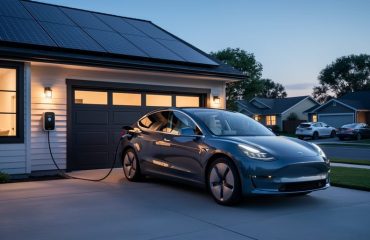
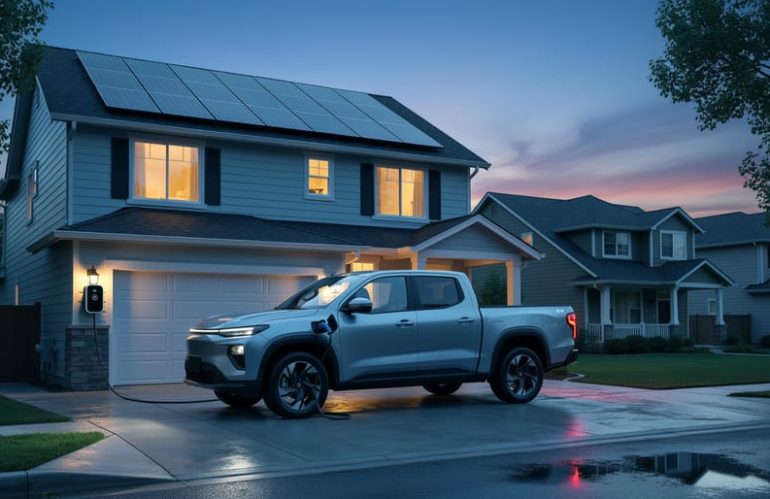
Picture this: Your electric vehicle sitting in your driveway transforms into a massive backup battery, powering your refrigerator during an outage, slashing your electricity bills during peak hours, and working seamlessly with your residential solar panels to create true energy independence. That’s exactly what GM’s vehicle-to-home technology delivers.
GM V2H turns your electric Silverado, Sierra, or Blazer into a mobile power station that can run your entire home for days. When utility rates spike during evening hours, your truck discharges stored electricity to power your house instead of drawing expensive grid power. During blackouts, you’ll keep the lights on while your neighbors scramble for flashlights. And if you already have solar panels, your EV becomes the missing piece that stores excess daytime solar energy for nighttime use.
The financial math is compelling. Homeowners typically save hundreds annually by avoiding peak electricity rates, and that’s before considering the value of backup power that eliminates the need for a traditional generator. Unlike standalone battery systems costing $10,000 or more, you’re getting backup power capacity built into a vehicle you already need.
This guide breaks down exactly how GM V2H works, what equipment you need, real-world costs and savings, and whether it makes sense for your home.
What GM’s V2H System Actually Does (In Plain English)
Think of GM’s vehicle-to-home technology as turning your electric truck into a giant power bank for your house. Just like your phone can charge other devices through reverse charging, GM’s V2H system lets your EV send electricity back to your home when you need it.
Here’s how it works in practice: Your GM electric vehicle stores energy in its battery pack, which is typically much larger than a traditional home battery system. When connected to your home through special equipment, that stored energy can power your lights, appliances, and heating or cooling systems during an outage or when electricity rates are at their highest.
Currently, GM supports V2H technology in several electric vehicles, with the 2024 Silverado EV and Sierra EV leading the charge. The GMC HUMMER EV also offers this capability. More GM electric models are expected to include this feature as the company expands its EV lineup.
To make this work, you’ll need three main components. First, your compatible GM electric vehicle. Second, a bidirectional charger that can both charge your vehicle and pull power from it. Third, a home energy management system that coordinates when to draw power from your truck versus the grid.
The beauty of this setup is its flexibility. During a power outage, your vehicle automatically becomes your backup generator, but unlike noisy gas generators, it’s silent and produces zero emissions. When electricity rates spike during peak hours, you can use your stored vehicle power instead of expensive grid electricity. And if you have solar panels, you can store excess solar energy in your truck’s battery during the day and use it at night.
The typical GM EV battery holds enough energy to power an average home for several days, giving you serious peace of mind and potential savings.
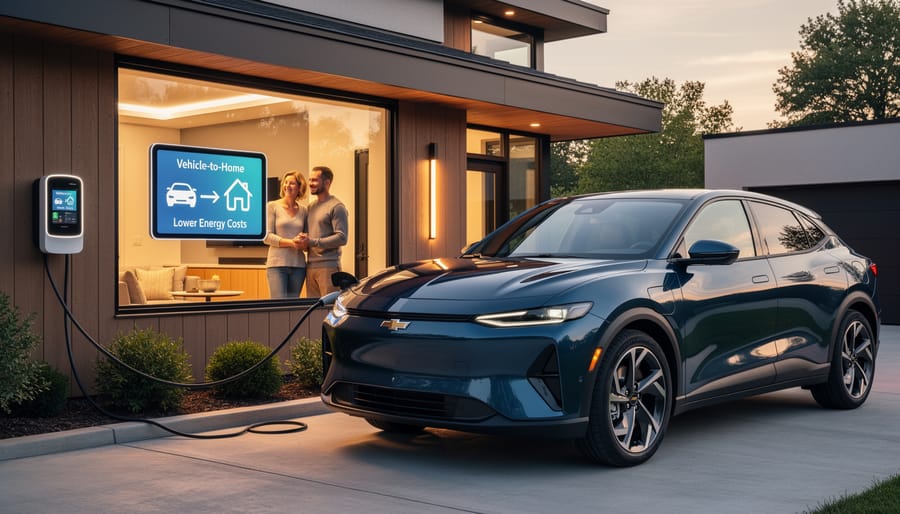
The Money-Saving Magic: Why V2H Pays You Back
Store Free Solar Energy Instead of Selling It Cheap
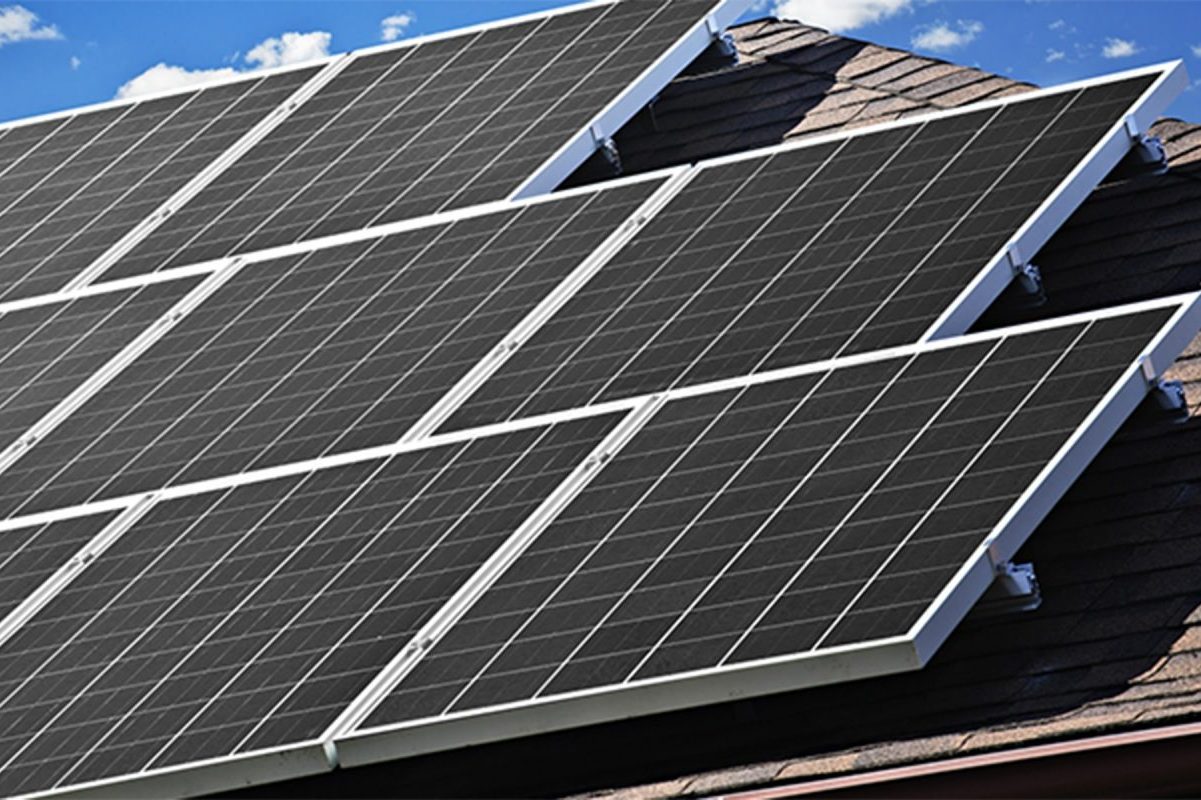
If you have solar panels, you’re probably familiar with the frustrating economics of net metering. During sunny afternoon hours when your panels are producing the most energy, electricity rates are typically at their lowest. Meanwhile, you often end up buying power back from the grid during expensive evening hours when your family actually needs it most. This is where GM’s V2H technology transforms your electric vehicle into a game-changing solution.
Think of your EV as a massive battery that can soak up all that excess solar energy your panels generate during the day. Instead of selling that power back to the utility company for pennies on the dollar, you’re storing it in your vehicle’s battery pack. When evening arrives and electricity rates spike, you simply reverse the flow and power your home with the energy you collected earlier.
The financial benefits are substantial. Many homeowners sell daytime solar power for rates as low as 3-5 cents per kilowatt-hour, only to buy evening power at 25-40 cents during peak hours. By storing that solar energy in your EV instead, you’re effectively capturing the full retail value of every kilowatt your panels produce.
Modern energy management systems can automate this entire process, intelligently directing solar power to your vehicle when production is high and drawing from it when grid rates climb. You’re not just maximizing your solar investment—you’re taking control of when and how you use the clean energy you generate.
Beat Peak Pricing Every Single Day
If you’ve ever cringed at your electricity bill during summer afternoons or winter evenings, you’re already familiar with peak pricing. Most utility companies charge significantly more for electricity during high-demand hours, typically between 4 PM and 9 PM on weekdays. These time-of-use rates can be two to three times higher than off-peak prices, and they add up fast when you’re running your air conditioning, cooking dinner, and charging devices.
GM’s V2H technology flips this expensive equation on its head. Instead of pulling costly electricity from the grid during peak hours, your EV becomes your personal power bank. Your vehicle charges overnight when rates are low, then automatically supplies your home with stored energy during those expensive peak periods. It’s like buying electricity on sale and using it when prices spike.
The math is compelling. A typical household might use 10 to 15 kilowatt-hours during peak evening hours. At peak rates of 40 to 50 cents per kilowatt-hour, that’s $4 to $7 every single evening. Over a month, you’re looking at $120 to $210 in peak charges alone. With V2H, you’re drawing from energy you purchased at off-peak rates of 10 to 15 cents per kilowatt-hour instead.
The system handles everything automatically through smart energy management. You set your preferences once, and the technology monitors time-of-use schedules, ensuring you never accidentally drain your vehicle’s battery below your driving needs while maximizing your savings during the most expensive hours of every day.
Real Numbers: What Homeowners Actually Save
Let’s look at what you could actually save. A typical GM electric vehicle with a 100 kWh battery can power essential home systems during peak rate hours when electricity costs around $0.30 per kilowatt-hour. If you’re currently paying $0.10 per kWh during off-peak times, that’s a $0.20 difference per kWh.
By charging your vehicle overnight and using that stored energy during expensive peak hours, you could shift about 30 kWh daily. That translates to roughly $6 in savings per day, or $180 monthly. Over a year, that’s approximately $2,160 in reduced electricity costs.
Homes with solar panels see even better returns. You can store excess daytime solar energy in your vehicle instead of selling it back to the grid at low rates, then use it during evening peak hours. This optimization can boost your total energy savings by an additional 15-20 percent annually.
Your Home’s New Backup Power System
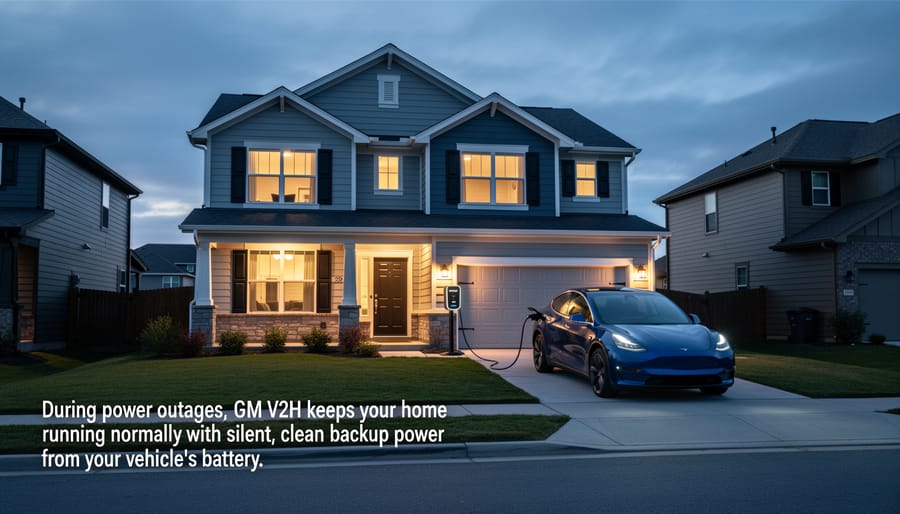
How Long Can Your EV Really Power Your Home?
The amount of backup power your GM EV can provide depends on two key factors: your battery size and how much electricity your home typically uses.
Most GM electric vehicles equipped with V2H capability have substantial battery packs. The GMC Hummer EV, for example, boasts a 200+ kWh battery, while the Chevrolet Silverado EV offers up to 170 kWh. The upcoming Chevy Blazer EV and Equinox EV feature smaller but still impressive batteries around 85 kWh.
Here’s what that means in real-world terms. The average American home uses about 30 kilowatt-hours of electricity per day. With a Silverado EV’s 170 kWh battery, you could theoretically power your entire home for nearly six days during an outage. Even if you only use half your battery (keeping the other half for driving), that’s still three full days of backup power.
During shorter outages, the numbers get even more impressive. If you’re only running essential appliances like your refrigerator, a few lights, and charging devices, your EV could stretch much longer. Many homeowners find they can maintain critical functions for a week or more with careful energy management.
The best part? Unlike traditional backup generators that require fuel runs and maintenance, your EV simply needs to be plugged in and charged through your regular routine or solar panels. This makes it a reliable, always-ready backup solution that doubles as your daily transportation.
No Noise, No Fuel, No Maintenance
Traditional gas generators have long been the go-to solution for backup power, but they come with significant drawbacks that GM’s V2H technology completely eliminates. When the power goes out, you won’t hear the loud rumble of an engine—your home simply continues running quietly on your EV’s battery. This silent operation means no disturbing your family’s sleep or annoying neighbors during outages.
Beyond the peace and quiet, you’ll avoid the ongoing expenses that make generators costly over time. There’s no need to stockpile gasoline or diesel, which can degrade and require stabilizers. You won’t face the hassle of regular oil changes, spark plug replacements, or seasonal maintenance checkups. Since your EV is already designed to store and deliver electricity efficiently, it doubles as a backup power source without any of the upkeep traditional generators demand.
The financial advantage adds up quickly. Generator fuel costs during extended outages can reach hundreds of dollars, and annual maintenance typically runs $100 to $300. With V2H, your vehicle simply uses the electricity you’ve already stored—potentially from your solar panels—to keep your home running. It’s a smarter, cleaner, and more economical approach to energy security.
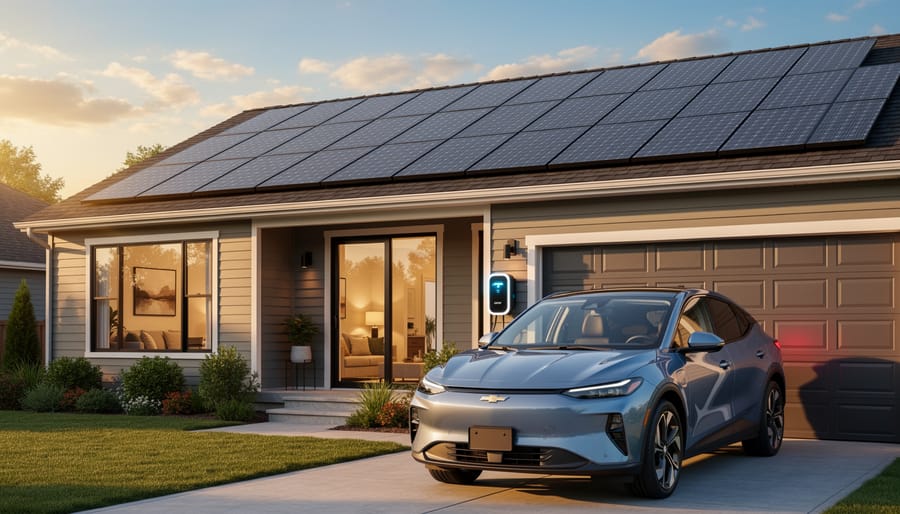
Pairing GM V2H With Your Solar Panels: The Perfect Match
Why This Works Better Than Traditional Battery Storage
Here’s the reality: if you’re buying an electric vehicle anyway, GM’s V2H technology transforms it into a massive home battery at no additional equipment cost. Think about it—you’re already investing $30,000 to $60,000 in a vehicle you need for daily transportation. With V2H capability, that same investment now pulls double duty as your backup power system.
Compare this to traditional solar battery storage, which typically costs $10,000 to $15,000 for a system that just sits in your garage doing one job. A standalone battery might store 13-15 kilowatt-hours, while GM’s electric trucks offer 130-200 kilowatt-hours—that’s ten times the capacity you’re getting from equipment you’d own regardless.
The math gets even better when you consider that your EV is mobile. Take it to work during peak sunshine hours, charge it with cheap workplace electricity or solar, then bring that stored energy home for evening use. A stationary battery can’t do that.
You’re essentially getting a premium home battery system as a bonus feature of your vehicle purchase. The PowerShift charger and home integration equipment costs around $7,000—still less than most standalone battery systems, and you’re unlocking exponentially more storage capacity. It’s the most cost-effective way to gain energy independence while meeting your transportation needs simultaneously.
Smart Charging: Set It and Forget It
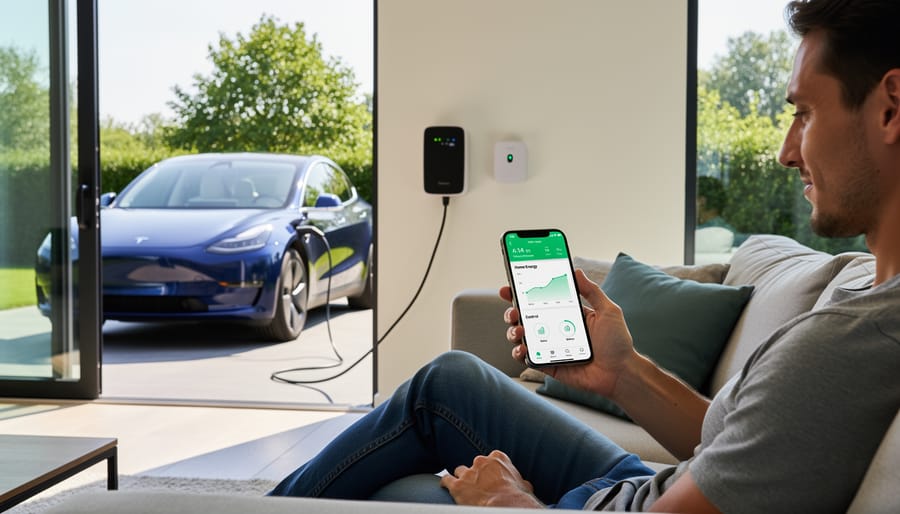
The beauty of GM’s V2H technology lies in how little effort it requires once installed. Modern home energy management systems work behind the scenes to optimize your energy use automatically, making decisions that save you money without any daily input from you.
Here’s how it works in practice: Your system monitors multiple factors simultaneously—your home’s energy consumption patterns, your solar panel production, current electricity rates, and your vehicle’s battery level. Based on this data, it makes intelligent decisions about energy flow. During sunny afternoons when your solar panels are producing excess electricity, the system automatically charges your EV. When evening rates spike and solar production drops, it can seamlessly discharge power from your vehicle to run your home, avoiding expensive grid electricity.
If a storm is forecast, the system can prioritize charging your EV battery to ensure backup power availability. When electricity rates are lowest (often overnight), it might draw from the grid to top off your battery. All of this happens automatically, optimized for your specific rate plan and usage patterns.
Think of it as having a personal energy manager working 24/7 to minimize your costs. You simply plug in your vehicle when you’re home, and the system handles the rest. Most homeowners report checking their energy dashboard out of curiosity rather than necessity, finding their bills lower without changing their daily routines.
What You Need to Make GM V2H Work at Your Home
Getting GM V2H up and running at your home is more straightforward than you might think, though it does require a few key components working together. Here’s what you’ll need to turn your GM electric vehicle into a backup power source.
First, you’ll need a bidirectional charger, which is the heart of the system. Unlike standard EV chargers that only send power one way (to your vehicle), bidirectional chargers can both charge your car and pull power from it to run your home. GM partners with specific manufacturers for these units, so you’ll want to confirm compatibility with your particular vehicle model.
Next, your home’s electrical setup needs to be ready. Most homes require a transfer switch or similar device that safely manages the flow of electricity between your vehicle, the grid, and your home circuits. This prevents power from backfeeding into utility lines, which is a safety requirement. Some homes may need electrical panel upgrades, especially if your current panel is older or already near capacity. A licensed electrician can assess your specific situation during an initial consultation.
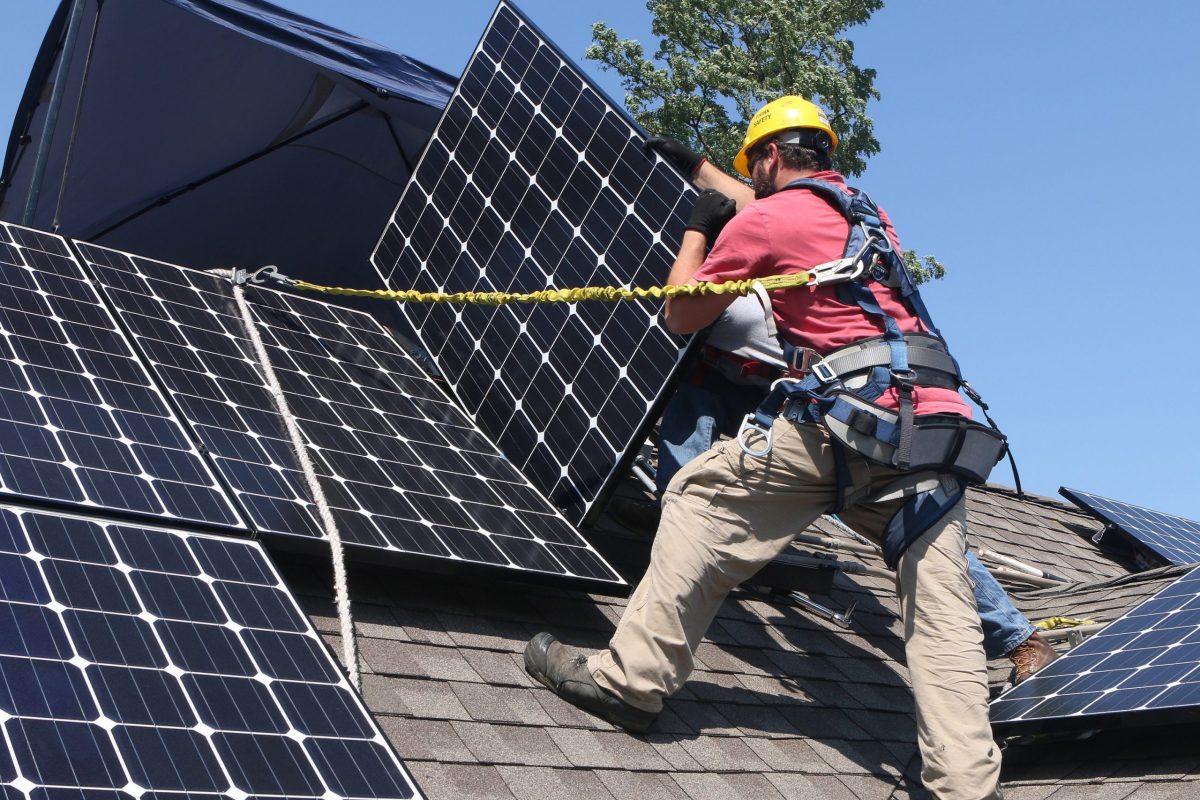
Professional installation is absolutely necessary for V2H systems. This isn’t a DIY project due to electrical code requirements and safety considerations. The good news is that qualified installers are becoming more common as the technology gains popularity. Installation typically takes one to two days, depending on your home’s existing infrastructure.
If you already have solar panels, V2H pairs beautifully with smart solar integration systems. Your installer can coordinate these technologies so they work seamlessly together, maximizing your energy independence.
While the upfront investment includes equipment and installation costs, many utilities offer rebates for home energy storage systems, and federal tax credits may apply. Check with your local utility company and a tax professional to understand available incentives in your area.
Debunking Common V2H Myths
Myth: V2H Will Ruin Your EV Battery
One of the biggest concerns homeowners have about V2H technology is whether it will wear out their expensive EV battery faster. The good news? Modern battery management systems are specifically designed to protect your investment during V2H use.
GM’s EVs equipped with Ultium batteries come with sophisticated software that controls charging and discharging cycles to minimize battery degradation. These systems prevent your battery from being fully drained or overcharged, keeping it within optimal ranges that preserve longevity. Think of it as having a built-in guardian watching over your battery’s health.
Research shows that occasional V2H use during power outages or peak demand periods creates minimal additional wear compared to regular driving. In fact, your battery experiences more stress from extreme temperatures and rapid charging than from controlled home energy discharge.
GM also backs this up with warranty protection. Most GM EVs come with battery warranties covering 8 years or 100,000 miles, and normal V2H operation doesn’t void this coverage. The company wouldn’t offer this technology if it significantly shortened battery life—it would cost them too much in warranty claims.
The bottom line: Using V2H as intended won’t ruin your battery. Your EV was built to handle it safely and efficiently.
Myth: You’ll Get Stranded With a Dead Car
One of the biggest concerns about V2H technology is waking up to find your car battery drained and being unable to drive. The good news? GM’s system is specifically designed to prevent this scenario. The technology includes built-in safeguards that automatically reserve a minimum charge level for driving—typically around 20% of your battery capacity. This ensures you always have enough range for your daily commute or emergency trips.
You’re also in complete control. Through the mobile app, you can set custom limits on how much power your home can draw from your vehicle. Want to keep 50% charge available at all times? Simply adjust your preferences. The system respects these boundaries and will never compromise your ability to drive when you need it.
Myth: It’s Too Complicated to Use Daily
Modern V2H systems are surprisingly simple to operate—in fact, most homeowners never think about them after initial setup. GM’s technology works automatically in the background, monitoring your home’s energy needs and switching seamlessly between grid power, your EV battery, and solar panels if you have them. You control everything through an intuitive smartphone app, similar to adjusting your home thermostat. Want to prioritize keeping your car charged for tomorrow’s commute? Tap a button. Expecting a storm and want maximum backup power? Another quick adjustment. The system handles the complex calculations and energy management automatically, learning your patterns over time. Many users report spending less than five minutes per month actively managing their V2H setup. Think of it like your smartphone—sophisticated technology made simple through smart design. There’s no need to understand electrical engineering or monitor voltage levels. The system does the heavy lifting while you enjoy lower energy bills and peace of mind during outages.
Is GM V2H Right for Your Home?
GM’s vehicle-to-home technology isn’t a one-size-fits-all solution, but it can be transformative for the right households. Understanding whether it aligns with your needs comes down to a few key factors.
You’re an ideal candidate if you experience frequent power outages in your area. Whether from storms, wildfires, or grid instability, V2H provides seamless backup power that keeps your essentials running without the noise and fumes of a traditional generator. Many homeowners find peace of mind knowing their refrigerator, medical devices, and home office can stay operational during extended outages.
This technology shines brightest when paired with solar panels. If you already have or plan to install solar, V2H creates a powerful energy ecosystem. Your EV becomes a giant battery that stores excess solar energy during the day and powers your home at night or during peak-rate hours, maximizing your solar investment and slashing electricity bills.
Homeowners with time-of-use electricity rates see substantial savings by charging their vehicle when rates are low and using that stored energy when rates spike. Over time, these savings can significantly offset your installation costs.
However, V2H may not make sense if you rarely experience outages, have low electricity rates without time-of-use pricing, or frequently need your vehicle’s full range for long commutes. The upfront equipment costs mean you’ll want some way to recoup that investment through outage protection or energy bill savings.
Consider your driving patterns too. If you typically return home with plenty of battery capacity to spare, you have energy available to share with your household without compromising your transportation needs the next day.
GM’s vehicle-to-home technology represents more than just a technological advancement—it’s an opportunity to fundamentally transform how you power your home. By turning your EV into a massive backup battery, you’re not only protecting your family from unexpected outages but also potentially saving hundreds or even thousands of dollars annually on energy costs.
For homeowners with solar panels, V2H integration creates an especially powerful combination. You can store excess solar energy in your vehicle during the day and use it to power your home during expensive peak hours, maximizing your solar investment while minimizing grid dependence. Even without solar, V2H gives you greater control over when and how you use electricity, helping you avoid high-cost periods.
The environmental benefits are equally compelling. Every kilowatt-hour you store and use from your EV is one less pulled from a grid that may still rely on fossil fuels. You’re actively contributing to a cleaner, more sustainable energy future while building resilience into your own home.
Ready to take control of your home energy costs? Exploring GM’s V2H technology could be your first step toward a more sustainable, resilient, and financially smart home energy solution.